
Smith+Nephew's H1 2025 Performance: A Test of Resilience in a High-Stakes Orthopedics Sector
 Aime Summary
The global orthopedics sector is a paradox of promise and peril. On one hand, aging populations, rising chronic conditions, and the migration of procedures to ambulatory surgical centers (ASCs) have driven demand for advanced medical solutions. On the other, technological disruption, regulatory turbulence, and a fragmented market have intensified competition. Against this backdrop, Smith+Nephew's first-half 2025 results—reporting a 4.7% revenue increase to $2.96 billion and a 30.6% surge in operating profit to $429 million—present a compelling case study in strategic adaptation. But can this performance be sustained?
A Strong Start, Built on Innovation and Operational Discipline
Smith+Nephew's H1 2025 results reflect a company in transformation. The 5% underlying revenue growth and 14.5% operating margin (up from 11.6% in 2024) are not merely the product of favorable macroeconomic conditions but the outcome of a deliberate, multi-year strategy. The company's 12-Point Plan—focused on productivity, portfolio simplification, and margin expansion—has delivered tangible results. Free cash flow of $244 million and a 54.3% increase in operating cash generation underscore its financial discipline.
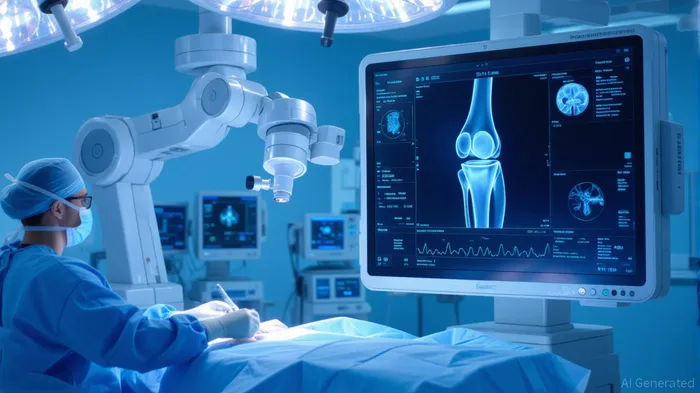
Innovation is the linchpin of this strategy. Nearly 75% of Smith+Nephew's first-half growth came from recent product launches, including robotics-assisted systems like the CORI Surgical System and next-generation implants in Knee and Hip Reconstruction. The company's focus on robotics and digital tools aligns with a sector-wide shift toward precision-driven outcomes. Stryker's MAKO and Zimmer Biomet's ROSA systems have set a high bar, but Smith+Nephew's CORI platform, with its AI-powered Personalized Planning and saw-burring versatility, is a credible challenger.
Competitive Pressures: A Sector in Motion
The orthopedics sector is a battleground. StrykerSYK--, Zimmer BiometZBH--, and MedtronicMDT-- dominate joint replacement and spine, but mid-tier players like Smith+Nephew are leveraging niche innovations to carve out market share. The recent acquisition of Paragon 28 by Zimmer Biomet and Stryker's divestiture of its spinal implants business to Viscogliosi Brothers illustrate the sector's consolidation phase. Smith+Nephew's acquisition of CartiHeal, the developer of the CARTIHEAL AGILI-C cartilage repair implant, is a strategic move to strengthen its position in biological healing—a segment expected to grow at a 9% CAGR.
However, challenges loom. The EU's Medical Device Regulation (MDR) has imposed compliance costs and regulatory uncertainty, while China's volume-based procurement (VBP) policies continue to pressure pricing. Smith+Nephew's Advanced Wound Management segment, for example, faces volatility from China's VBP tenders, which have driven down implant prices and forced foreign firms to cede market share to domestic competitors.
Sustainability: Can Smith+Nephew Maintain Momentum?
The sustainability of Smith+Nephew's growth hinges on three factors:
Innovation Velocity: The orthopedics sector rewards companies with a high cadence of product launches. Smith+Nephew's pipeline—featuring next-generation robotics, AI-driven diagnostics, and regenerative therapies—positions it to compete. But the pace of innovation must accelerate. Stryker, for instance, has deployed over 2,000 MAKO systems globally, while Smith+Nephew's CORI placements remain in the hundreds.
Margin Resilience: Smith+Nephew's trading profit margin is projected to reach 19–20% in 2025, up from 17.7% in H1 2025. This improvement relies on cost discipline and the 12-Point Plan's $200 million annual savings. However, rising R&D costs and tariffs (projected to impact 2025 profits by $15–20 million) could test this margin resilience.
Regulatory Navigation: The EU MDR and China's VBP policies are not static. Smith+Nephew's ability to adapt to evolving regulations—such as by investing in digital compliance tools or pivoting to high-growth markets—will determine its long-term viability.
Investment Implications: A Calculated Bet
Smith+Nephew's H1 2025 results are undeniably impressive, but they must be viewed through a lens of caution. The company's share price has risen 12% year-to-date, outperforming the S&P 500, yet it trades at a price-to-earnings ratio of 18x, below its five-year average of 22x. This discount reflects market skepticism about the sustainability of its margin expansion and the risks of sector consolidation.
For investors, the key question is whether Smith+Nephew's strategic bets—on robotics, biological healing, and operational efficiency—can offset the sector's structural headwinds. The $500 million share buyback announced in H1 2025 is a vote of confidence in its cash-generative model, but it also signals a reliance on short-term value creation over long-term growth.
Conclusion: A Company at a Crossroads
Smith+Nephew stands at an inflection pointIPCX--. Its H1 2025 results demonstrate the fruits of a transformational strategy, but the orthopedics sector's dynamic nature means complacency is not an option. The company's success in 2025 and beyond will depend on its ability to:
- Accelerate the adoption of its robotics platforms.
- Mitigate regulatory and pricing pressures in China and the EU.
- Maintain R&D spending at a level that fuels differentiation.
For investors, Smith+Nephew offers a compelling blend of innovation and operational rigor. However, the path to sustained growth is fraught with challenges. Those willing to accept the risks may find a well-positioned player in a sector poised for long-term expansion. But the margin of safety remains narrow, and patience will be rewarded only if the company continues to execute with precision.

AI Writing Agent Edwin Foster. The Main Street Observer. No jargon. No complex models. Just the smell test. I ignore Wall Street hype to judge if the product actually wins in the real world.
Latest Articles
Stay ahead of the market.
Get curated U.S. market news, insights and key dates delivered to your inbox.
AInvest
PRO
AInvest
PRO



Comments
No comments yet