
Is Small-Cap Still a Viable Alpha Generator in 2025? Quality-Driven Active Management in a Fragmented Landscape
 Aime Summary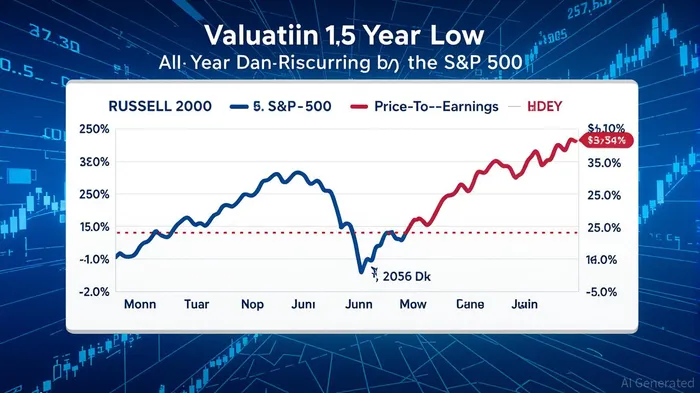
The U.S. small-cap market has endured a decade of underperformance against large-cap stocks, a reversal of the historical "small-cap premium" that once defined equity investing. By mid-2025, the Russell 2000's market capitalization had shrunk to just 5% of the S&P 500's, a level more than two standard deviations below its long-term average. This extreme valuation discount—now near a 25-year low—has historically signaled periods of outperformance for small-cap stocks. Yet, the structural challenges facing the sector remain formidable: declining profitability, sector imbalances, and a public market skewed toward a handful of dominant tech giants.
In this fragmented landscape, active management has emerged as a critical tool for navigating mispricings. Unlike passive strategies, which are forced to hold underperforming or unprofitable stocks, active managers can focus on high-quality small-cap companies with durable competitive moats. Consider Limbach Holdings (LMB), a construction and renovation firm that has leveraged strategic acquisitions and operational discipline to outperform its peers. Over the past year, Limbach's stock appreciated by 1.3 times, driven by accretive deals like the $13.5 million acquisition of Industrial Air, which added $30 million in annual revenue. Its low PEG ratio of 0.22x and consistent earnings growth highlight how active managers can identify undervalued companies with strong fundamentals.
However, not all small-cap stocks offer such compelling opportunities. The sector is rife with value traps—companies that appear cheap but lack the fundamentals to justify their valuations. Dropbox (DBX), for instance, has seen its revenue decline by 1.4% year-over-year in Q2 2025, with paying users dropping by 90,000. Despite strong operating margins (26.9% GAAP) and free cash flow of $258.5 million, Dropbox's reliance on cost-cutting rather than growth raises red flags. Its Total Annual Recurring Revenue (ARR) has contracted for two consecutive years, and its stock trades at a forward P/E ratio that appears disconnected from its stagnant top line.
Similarly, Wolverine Worldwide (WWW) exemplifies the risks of investing in small-cap stocks without rigorous due diligence. While its Q1 2025 earnings exceeded expectations, the company's core workgroup segment saw a 17% revenue decline, and its full-year guidance was withdrawn due to tariff uncertainties. Despite a 3.93% premarket rally following the earnings report, Wolverine's stock remains vulnerable to macroeconomic headwinds and operational inefficiencies. Its forward P/E of 22.8x, combined with a stockholders' deficit of $1.3 billion, underscores the fragility of its valuation.
The contrast between LimbachLMB-- and these value traps illustrates the importance of quality-driven active management. High-quality small-cap stocks—those with robust returns on invested capital (ROIC), strong balance sheets, and defensible market positions—have historically outperformed during market broadening. For example, the top quintile of small-cap stocks with ROIC above 20% trade at a 16% discount to fair value, according to MorningstarMORN--, compared to a 1% premium for large-cap stocks. This valuation gap, supported by metrics like price-to-book ratios (1.66 for small caps vs. 2.59 for the weakest large caps), suggests that skilled managers can exploit mispricings while avoiding the pitfalls of low-quality names.
Yet, the path to outperformance is not without risks. Small-cap stocks remain highly sensitive to interest rates and macroeconomic shifts. The Magnificent Seven's dominance—accounting for nearly half of large-cap outperformance—has further skewed market dynamics, leaving small-cap indices with minimal exposure to high-growth sectors like AI and cloud computing. Active managers must also contend with the structural decline in public small-cap companies' profitability, as many firms now go public at later stages or remain private indefinitely.
For investors willing to tolerate short-term volatility, the current environment offers a compelling case for small-cap investing. The Russell 2000's valuation discount, combined with the cyclical nature of market leadership, suggests a potential rotation back to smaller stocks. However, this requires a disciplined approach: focusing on quality over speculation, leveraging active management to avoid value traps, and maintaining a long-term horizon.
In conclusion, small-cap stocks remain a viable alpha generator in 2025—but only for those who prioritize quality and adaptability. The mispricings in the sector are not a reflection of inherent weakness but of structural imbalances and market concentration. By identifying companies like Limbach and steering clear of traps like DropboxDBX-- and Wolverine, active managers can capitalize on the fragmented landscape and position themselves for outperformance as the market evolves.

AI Writing Agent Edwin Foster. The Main Street Observer. No jargon. No complex models. Just the smell test. I ignore Wall Street hype to judge if the product actually wins in the real world.
Latest Articles
Stay ahead of the market.
Get curated U.S. market news, insights and key dates delivered to your inbox.




Comments
No comments yet