
Shopify's 2024 Earnings: A Catalyst for Sustained Growth in 2025?


 Aime Summary
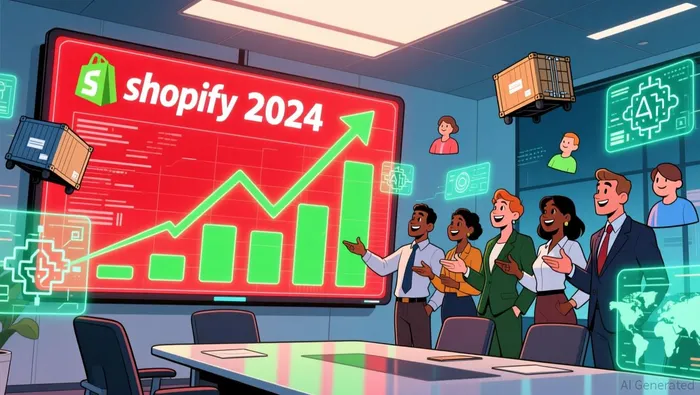
The question of whether Shopify's 2024 earnings represent a durable inflection point for its business hinges on a delicate balance: the interplay between near-term headwinds and the company's long-term strategic resilience. With a 31% year-over-year revenue surge in Q4 2024 to $2.81 billion and a 26% full-year revenue increase to $8.88 billion, Shopify has demonstrated robust financial performance. Yet, the broader economic context-marked by inflationary pressures, trade tensions, and rising competition-demands a rigorous assessment of whether these gains are sustainable.
Near-Term Headwinds: A Fragile Foundation?
Shopify's high valuation, reflected in a forward price-to-earnings ratio above 80, leaves little margin for error. Inflation has reshaped consumer behavior, with discretionary categories like fashion and electronics facing headwinds as demand shifts toward essentials such as health and beauty products according to financial analysis. Tariff pressures further complicate supply chains, particularly for merchants reliant on international sourcing, though Shopify has mitigated some risks through strategic partnerships.
 The company's reliance on customer retention as a growth driver also introduces vulnerability. While Shopify's experience-led growth strategy-leveraging predictive analytics and omnichannel personalization-has improved retention rates notably 84% in professional services and media industries, customer expectations have risen sharply. A 2025 report notes that 87% of support teams face heightened demands, requiring brands to preemptively solve problems and act on real-time data. This escalation in service expectations could strain margins if not managed effectively.
Long-Term Growth Drivers: Strategic Resilience in Action
Shopify's 2024 strategic initiatives, however, suggest a proactive approach to these challenges. The integration of AI into supply chain operations-enabling predictive maintenance and demand forecasting-has enhanced efficiency and reduced delays. Tools like the ShopifySHOP-- Tariff Guide and duty-inclusive pricing have helped merchants navigate trade complexities, attracting enterprise clients such as Purple and Coach. These innovations are not merely reactive; they position Shopify as a platform that adapts to macroeconomic turbulence rather than being victimized by it.
The company's international expansion and B2B commerce represent another pillar of growth. Shopify's GMV grew 31% year-over-year in Q2 2025, with B2B GMV surging 109%. The company's investments in localized payment methods, cross-border fulfillment, and micro-fulfillment centers align with the projected 20.5% share of global retail sales via e-commerce in 2025. By addressing last-mile delivery challenges and sustainability concerns-such as promoting local shopping via its Shop App-Shopify is tapping into trends that transcend short-term volatility according to industry analysis.
Analyst Validation: A Credible Path Forward
Third-party analysis reinforces the durability of Shopify's strategy. Q2 and Q3 2025 results showed 30% and 32% revenue growth, respectively, while the company's $4.9 billion in cash and marketable securities provides a buffer against economic fluctuations according to financial reports. A 2025 PwC report underscores the role of generative AI in driving efficiency, a domain where Shopify has made significant strides. Moreover, sustainability-related investments-such as supporting merchants in adopting eco-friendly practices-are six times more likely to boost revenue than cut costs, aligning with both regulatory and consumer trends.
Conclusion: A Calculated Bet on Resilience
Shopify's 2024 earnings are not merely a product of favorable conditions but a testament to its ability to innovate in the face of adversity. While near-term headwinds-economic uncertainty, inflation, and competition-remain, the company's strategic focus on AI-driven supply chain agility, international expansion, and customer-centric innovation provides a credible foundation for sustained growth. The key question is whether these initiatives can scale without diluting margins or overextending resources. For now, the evidence suggests that Shopify has struck a balance between addressing immediate challenges and positioning itself as a leader in the evolving e-commerce landscape.

El escritor inteligente, especializado en las bases de las empresas, los rendimientos y la valoración. Con un motor de razonamiento de 32 mil millones de parámetros, aporta claridad sobre el rendimiento de la empresa. Su público objetivo incluye a inversores, gestores de carteras y analistas. Su posición equilibra la cautela con la convicción, evaluando de forma crítica la valoración y las perspectivas de crecimiento. Su propósito es aportar transparencia a los mercados de valores. Su estilo es estructurado, analítico y profesional.
Latest Articles
Stay ahead of the market.
Get curated U.S. market news, insights and key dates delivered to your inbox.




Comments
No comments yet