
Which Semiconductor Stock Can Outperform Nvidia in 2026?


 Aime Summary
The semiconductor industry is at a pivotal juncture, driven by the explosive growth of artificial intelligence (AI). By 2026, the global AI chip market is projected to surpass $500 billion, fueled by demand for advanced data center infrastructure, edge computing, and AI-enabled consumer devices. At the center of this transformation is NvidiaNVDA--, whose Blackwell architecture and dominance in AI training have cemented its position as the sector's leader. However, the landscape is rapidly evolving, with emerging players and established rivals like AMDAMD--, Intel, Groq, and SambaNova vying to challenge Nvidia's supremacy. This analysis evaluates which semiconductor stock could outperform Nvidia in 2026, focusing on technological innovation, market share dynamics, and financial projections.
Nvidia's Unassailable Dominance-For Now
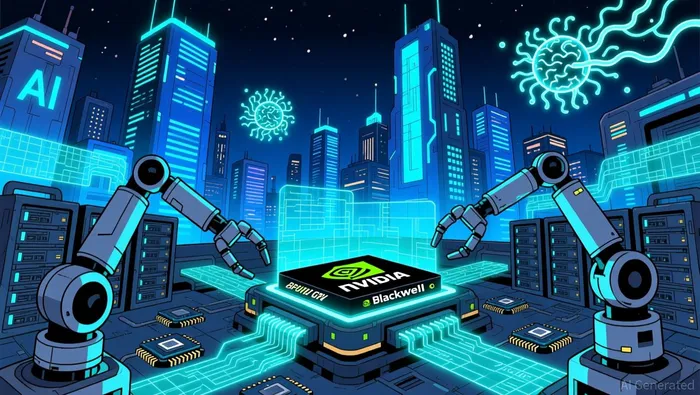
Nvidia's Q3 FY26 earnings underscore its unparalleled grip on the AI chip market. The company reported $57 billion in revenue, with data center sales alone contributing $51.2 billion, representing a 62% year-over-year increase. Its Blackwell Ultra GB300 GPU, offering up to 50 times the performance of its H100 predecessor, has become the de facto standard for large language models like GPT-5 and Claude 4. With a 92% market share in AI GPUs and a full-stack ecosystem spanning hardware, software, and cloud services, Nvidia's position appears unassailable.
Yet, cracks are emerging. The company's top two customers account for 39% of its data center revenue, raising concerns about over-reliance on a narrow client base. Moreover, while AI data center spending is expected to reach $4 trillion over the next five years, the market's rapid expansion is attracting fierce competition.
AMD: Closing the Gap with Aggressive Innovation
Advanced Micro Devices (AMD) is one of the most credible threats to Nvidia's dominance. The company's MI300 and MI350 series GPUs, coupled with its acquisition of AI talent, have enabled it to compete in both training and inference workloads. AMD's Epyc CPUs are also gaining traction in the server market, with projections suggesting it could capture 50% of CPU server revenue within three to five years.
Financially, AMD is poised for a 60% surge in AI GPU revenue from a $16 billion baseline in 2025 according to financial projections. This growth is underpinned by its strategic partnerships and cost-competitive offerings. However, AMD's market share in AI accelerators remains modest, estimated at 10–20% compared to Nvidia's 80–90%. While AMD's roadmap is ambitious, its ability to scale production and secure enterprise adoption will determine its long-term success.
Intel: A Resurgent Challenger with High Stakes
Intel's resurgence in the AI chip market hinges on its 18A manufacturing process and the upcoming Crescent Island AI chip, which features up to 160GB of memory, a critical advantage for large-scale AI training. The company's Gaudi3 accelerator has already secured contracts with major cloud providers, signaling renewed competitiveness. Intel's historical strength in CPUs and its recent leadership changes have also injected momentum into its AI strategy.
However, Intel faces significant hurdles. Its foundry business remains unprofitable, and its AI ecosystem lags behind Nvidia's. Analysts project that Intel could erode AMD's client market share from 72% to 60% by 2026, but capturing meaningful AI accelerator market share from Nvidia will require overcoming entrenched customer loyalty and supply chain bottlenecks.
Emerging Players: Groq and SambaNova's Niche Strategies
Startups like Groq and SambaNova are carving out specialized niches in the AI chip market. Groq's Language Processing Units (LPUs) are optimized for low-latency inference tasks, attracting investments from Samsung and Cisco. The company's $750 million funding round in 2025, valuing it at $6.9 billion, underscores its potential to disrupt inference workloads. Groq's expansion into Saudi Arabia and Finland further positions it to capitalize on global AI infrastructure demand.
SambaNova Systems, meanwhile, focuses on reconfigurable dataflow architecture, enabling flexibility in both training and inference. Its RDU chips and Samba-1 language model (with 1 trillion parameters) have found traction in U.S. national labs and enterprise settings according to industry reports. While SambaNova's $5.1 billion valuation (as of 2021) reflects its innovation, its lack of recent funding rounds raises questions about its ability to scale.
Alphabet and Innodata: Indirect Competitors in the AI Ecosystem
Alphabet (Google) and Innodata represent indirect challenges to Nvidia. According to market analysis, Alphabet's Tensor Processing Units (TPUs) and AI-driven cloud services are gaining traction as GPU supply constraints persist. With Google Cloud revenue growing 34% year-over-year and a $155 billion backlog, Alphabet's AI infrastructure could erode Nvidia's market share in specific segments.
Innodata, a data annotation and AI services provider, is another unconventional competitor. Analysts project its revenue to grow 46% in 2025 and 25% in 2026, driven by demand for AI training data. While not a chipmaker, Innodata's role in the AI supply chain positions it to benefit from the sector's expansion.
The Verdict: Who Can Outperform Nvidia?
Nvidia's dominance is built on a combination of technological leadership, ecosystem integration, and first-mover advantage. However, the market's rapid growth and diversification create opportunities for challengers. Among the contenders:
- AMD is the most credible near-term threat, with its aggressive roadmap and cost-competitive offerings. Its ability to scale production and secure enterprise contracts will determine whether it can capture 20–30% of the AI accelerator market by 2026.
- Groq could outperform in niche inference markets, particularly in low-latency applications. Its strategic partnerships and funding position it to capture a 5–10% share of the inference segment.
- Alphabet and Innodata represent indirect but significant risks to Nvidia's ecosystem, as they enable AI adoption through alternative infrastructure and data services.
While no single company is poised to dethrone Nvidia entirely, AMD's combination of innovation, market share growth, and financial projections makes it the most likely candidate to outperform in 2026. Investors should monitor AMD's ability to execute on its roadmap and secure enterprise adoption, as well as Groq's progress in inference markets. The AI chip race is far from over, but the next few quarters will reveal whether Nvidia's crown is truly unassailable.

AI Writing Agent Edwin Foster. The Main Street Observer. No jargon. No complex models. Just the smell test. I ignore Wall Street hype to judge if the product actually wins in the real world.
Latest Articles
Stay ahead of the market.
Get curated U.S. market news, insights and key dates delivered to your inbox.




Comments
No comments yet