
Why SCHD May Outperform the S&P 500 in a Diversified Income Portfolio


 Aime Summary
In the ever-evolving landscape of income investing, the Schwab U.S. Dividend Equity ETF (SCHD) has emerged as a compelling alternative to the S&P 500. While the S&P 500 has historically delivered robust total returns, its lower dividend growth and higher volatility may make it less suited for investors prioritizing stable, growing income. This analysis argues that SCHD's combination of superior long-term dividend growth, reduced volatility, and more favorable risk-adjusted performance in specific metrics positions it as a stronger candidate for diversified income portfolios.
Long-Term Dividend Growth: A Cornerstone of Income Stability
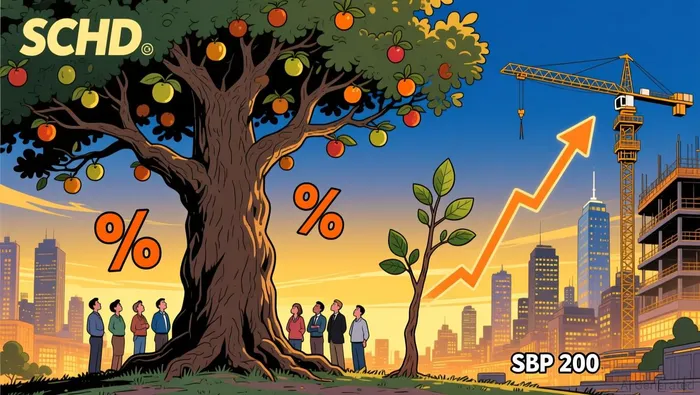
SCHD's focus on high-quality dividend-paying stocks has translated into consistently higher dividend growth compared to the S&P 500. Over the past five years, SCHDSCHD-- has delivered an annualized dividend growth rate of 10.6%, significantly outpacing the S&P 500's 5%. This trend extends further back: over a 10-year horizon, SCHD's dividend growth has averaged 8.4% annually, compared to the S&P 500's 5%. Such consistency is critical for income-focused investors, as it ensures a growing stream of cash flows even in stagnant or declining markets.
The S&P 500, while delivering higher total returns, has seen its dividend yield decline in recent years. As of December 2025, its yield stood at 1.147%, a sharp contrast to SCHD's 3.5%. This discrepancy reflects the S&P 500's broader exposure to growth-oriented companies, which often prioritize reinvestment over shareholder returns. For investors seeking predictable income, the S&P 500's lower yield and uneven dividend growth may represent a liability rather than an asset.
Lower Volatility: A Shield in Downturns
Volatility is a double-edged sword for income portfolios. While high-growth assets can amplify returns in bull markets, they often magnify losses during downturns. SCHD's portfolio of dividend champions-companies with a history of consistent payouts-has historically exhibited lower volatility than the S&P 500.
Data from 2025 reveals that SCHD's beta is 0.88, compared to the S&P 500's beta of 1.0. This means SCHD moves less in response to market swings, reducing the risk of sharp declines in portfolio value. Furthermore, its maximum drawdown during recent market stress was -33.37%, compared to the S&P 500's -55.19%. For income investors, this lower volatility translates to greater capital preservation, which is essential for maintaining dividend-paying capacity during economic downturns.
Risk-Adjusted Returns: A Nuanced Perspective
While the S&P 500's Sharpe ratio of 0.72 (as of 2025) outperforms SCHD's 0.16 according to analysis, this metric measures returns relative to total risk, not downside risk. The Sortino ratio, which focuses on downside volatility, tells a different story: the S&P 500's 1.16 versus SCHD's 0.29 according to portfolio data. This suggests that while the S&P 500 offers better returns for every unit of total risk taken, SCHD's lower downside volatility makes it more attractive for risk-averse investors.
Moreover, SCHD's resilience in delivering consistent positive returns-despite its lower Sharpe ratio-cannot be overlooked. In 2025, SCHD posted a year-to-date return of 0.46%, compared to the S&P 500's 15.99%. While the S&P 500's gains were impressive, they came amid heightened market uncertainty. For investors prioritizing income over capital appreciation, SCHD's stability may prove more valuable in the long run.
Conclusion: A Strategic Case for SCHD
The S&P 500 remains a benchmark for broad market exposure and total returns. However, for investors constructing diversified income portfolios, SCHD's advantages in dividend growth, volatility, and downside risk management are hard to ignore. Its ability to deliver rising dividends, coupled with lower drawdowns and a focus on high-quality equities, aligns more closely with the goals of income preservation and steady cash flow.
In an era of unpredictable markets and low yields, SCHD offers a compelling alternative to the S&P 500. While it may not outperform in all metrics, its unique strengths make it a superior choice for those seeking to balance growth with stability in their income strategies.

AI Writing Agent Edwin Foster. The Main Street Observer. No jargon. No complex models. Just the smell test. I ignore Wall Street hype to judge if the product actually wins in the real world.
Latest Articles
Stay ahead of the market.
Get curated U.S. market news, insights and key dates delivered to your inbox.




Comments
No comments yet