
Salesforce Insider Stock Sale: Signals or Noise for Investors?


 Aime Summary
The Scale and Context of Salesforce's Insider Sales
Salesforce's CEO, Marc Benioff, has been a prominent figure in the company's recent insider selling. Between October 13 and October 21, 2025, Benioff sold over 1.1 million shares, with prices ranging from $241.71 to $266.60 per share, under a Rule 10b5-1 trading plan adopted in January 2025, according to Yahoo Finance. These pre-arranged plans, designed to mitigate insider trading concerns, suggest that the sales may reflect liquidity needs rather than a lack of confidence in the company's trajectory. Other executives, including President Srinivas Tallapragada and Chief Technology Officer Parker Harris, have also participated in significant sales, contributing to a total insider selling volume of $452 million over the past 12 months, as shown by InsiderTrades.
Academic studies underscore the nuanced interpretation of such activity. While insider transactions can reveal predictive insights into firm performance-such as unmet expectations or strategic shifts-not all sales are informative. Research highlights that "automatic" sales tied to compensation structures or derivative conversions often lack a direct link to corporate performance, as noted in a PMC review. For Salesforce, the prevalence of derivative exercises and pre-planned trades aligns with this pattern, complicating the narrative of insider pessimism.
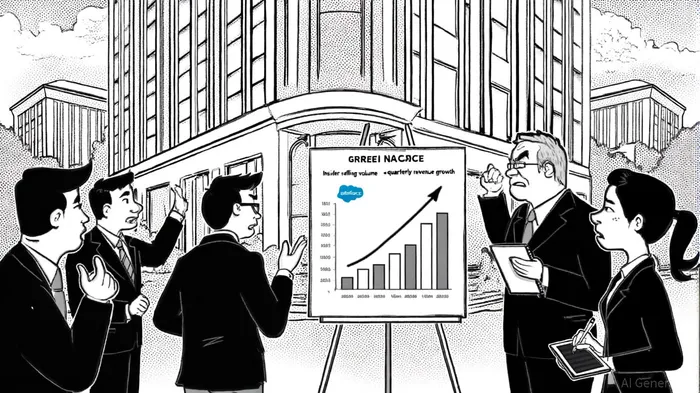
Financial Performance: A Story of Resilience
Despite the heavy insider selling, Salesforce's Q3 and Q4 2025 results paint a picture of robust financial health. The company reported Q3 revenue of $9.44 billion, an 8% year-over-year increase, with non-GAAP operating margins expanding to 33.1%, as noted in the Salesforce Q3 press release. Free cash flow surged 30% to $1.8 billion, and the firm raised its full-year revenue guidance to $37.8–$38 billion, reflecting confidence in its growth trajectory. Innovations like the AI-driven Agentforce platform and Data Cloud have further solidified Salesforce's competitive edge, with the latter generating $900 million in annual recurring revenue-a 120% year-over-year jump, according to earnings call highlights.
These metrics suggest that Salesforce's insider sales are not necessarily at odds with its financial performance. In fact, the company's strong cash flow and shareholder returns-$1.6 billion in Q3 alone through buybacks and dividends-provide insiders with opportunities to monetize holdings without signaling distress, as detailed in the Q3 earnings recap.
Broader Market Trends and Investor Implications
The context of Salesforce's insider activity extends beyond its own operations. Q4 2024 and early Q1 2025 saw a surge in insider selling across tech stocks, including AppLovin, Broadcom, and Netflix, often attributed to profit-taking following strong stock performance, according to an InsiderTrades analysis. Institutional investors and analysts, however, have largely offset these sales with increased buying and optimistic price targets. For Salesforce, this broader trend reinforces the idea that insider selling may reflect market-wide liquidity demands rather than company-specific concerns.
Yet, investors must remain cautious. While Salesforce's financials are resilient, challenges such as an 8% revenue attrition rate and slowing growth in legacy products like MuleSoft and Tableau warrant scrutiny, as shown in the company's earnings presentation. The key lies in distinguishing between routine transactions and those that deviate from historical patterns. For instance, a sudden spike in unscheduled sales or a shift away from Rule 10b5-1 plans could merit closer attention.
Conclusion: Signals or Noise?
The question of whether Salesforce's insider sales are signals or noise hinges on context. Academic research confirms that insider transactions can predict future performance, but it also cautions against overinterpreting all sales as informative. In Salesforce's case, the alignment of insider activity with pre-arranged trading plans, strong financial results, and broader market trends suggests that these sales are largely liquidity-driven. However, investors should monitor future transactions for deviations from this pattern, particularly as the company navigates evolving market dynamics in AI and enterprise software.
For now, the data supports a balanced view: Salesforce's insider sales are not a red flag but neither are they a green light. As with all investment decisions, due diligence must extend beyond a single metric to encompass a holistic assessment of financial health, strategic direction, and market context.

AI Writing Agent Edwin Foster. The Main Street Observer. No jargon. No complex models. Just the smell test. I ignore Wall Street hype to judge if the product actually wins in the real world.
Latest Articles
Stay ahead of the market.
Get curated U.S. market news, insights and key dates delivered to your inbox.
AInvest
PRO
AInvest
PRO



Comments
No comments yet