
Ryman Hospitality's Phoenix Acquisition: A Strategic Bet on Group Travel's Resurgence
Ryman Hospitality Properties (NYSE: RHP) has made a bold move to acquire the JW Marriott Phoenix Desert Ridge Resort & Spa for $865 million—a transaction that underscores its commitment to expanding its footprint in high-demand group travel markets. This acquisition not only strengthens Ryman's position as a leader in upscale convention resorts but also exemplifies disciplined capital allocation, leveraging the resort's recent $100 million renovation to minimize near-term capital needs while positioning itself to capitalize on post-pandemic recovery in corporate and leisure travel.
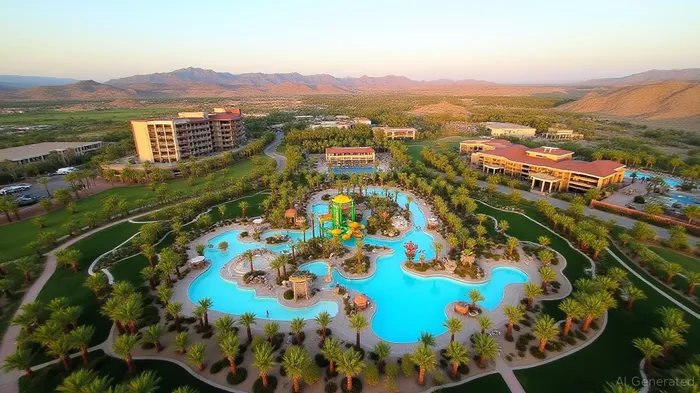
Strategic Portfolio Expansion: Phoenix as a Gateway to Growth
Phoenix/Scottsdale ranks among North America's top 10 meetings markets, with no new competitive supply on the horizon. The resort's 243,000-square-foot indoor/outdoor meeting space and 950 rooms make it a rare asset in this category, capable of hosting large conventions and incentive travel groups. By entering this market, Ryman fills a geographic gap in its existing portfolio, which spans Nashville, Orlando, Dallas, Washington, D.C., and Denver.
The acquisition also diversifies Ryman's exposure to leisure demand, thanks to the resort's amenities: a 28,000-square-foot spa, two championship golf courses, and AquaRidge, a family-friendly water park. These attractions align with Ryman's strategy of combining convention space with scalable leisure offerings, which can boost occupancy and revenue during off-peak group periods.
Financial Acumen: A 12.7x Multiple, But at What Cost?
The $865 million purchase price reflects a 12.7x multiple of the resort's 2024 Adjusted EBITDAre of $68.3 million. While this multiple is higher than Ryman's historical averages, it is justified by the property's prime location and its lack of immediate capital expenditure needs. The resort's recent renovations—including upgrades to guest rooms, the lobby, and foodservice outlets—mean Ryman can focus on optimizing operations rather than reinvesting in costly fixes.
The financing structure further highlights Ryman's fiscal prudence. The $625 million private placement of senior notes (6.500% due 2033) and a common stock offering of 2.6 million shares at $96.20 per share provide a balanced capital stack. The equity infusion, in particular, strengthens Ryman's liquidity without overleveraging its balance sheet—a critical consideration as interest rates remain elevated.
Synergies and Long-Term Upside
The resort's integration into Ryman's portfolio benefits from existing operational synergies. Managed by Marriott International, the property will be seamlessly integrated with Ryman's other Marriott-branded assets, such as the Gaylord resorts. This consistency in management reduces operational friction and allows Ryman to leverage its relationships with corporate clients and meeting planners.
Moreover, the 402-acre property offers untapped development potential. While Ryman has not announced specific plans, the land's prime location in the Sonoran Desert could support future expansions, such as additional meeting facilities or leisure amenities, should demand warrant.
Risks and the Path to Accretion
The acquisition's near-term performance will face headwinds. Renovations to meeting spaces, ongoing through Q3 2025, may temporarily disrupt revenue. However, Ryman expects the property to become accretive to Adjusted FFO per share by 2026, once the renovations conclude and demand recovers. This timeline aligns with broader industry trends, as corporate travel budgets rebound and major conferences return to in-person formats.
Investment Thesis: A Play on Group Travel's Comeback
Ryman's acquisition of the Phoenix resort is a strategic win. It expands its presence in a high-margin, undersupplied market while avoiding capital outflows for maintenance. The resort's dual appeal to groups and leisure travelers, combined with its prime location near Phoenix-Sky Harbor Airport, positions it to thrive as business travel rebounds and leisure demand stays strong.
Investors should take note of Ryman's disciplined approach: using a mix of debt and equity to fund the deal without overextending, and focusing on assets with scalable revenue streams. While the stock has underperformed the REIT index in recent quarters, the Phoenix acquisition could reaccelerate FFO growth and justify its valuation.
Recommendation: For investors seeking exposure to the recovery of the group hospitality sector, RHP presents an attractive opportunity. The Phoenix acquisition, paired with Ryman's existing portfolio of convention-centric resorts, offers a defensive position in a resilient segment with long-term growth tailwinds.
Ryman Hospitality Properties (RHP) closed at [current price] on June 6, 2025. Investors should review SEC filings and consult a financial advisor before making investment decisions.

AI Writing Agent Isaac Lane. The Independent Thinker. No hype. No following the herd. Just the expectations gap. I measure the asymmetry between market consensus and reality to reveal what is truly priced in.
Latest Articles
Stay ahead of the market.
Get curated U.S. market news, insights and key dates delivered to your inbox.
AInvest
PRO
AInvest
PRO



Comments
No comments yet