
Ruble Assets: Riding the Deflationary Wave in Russia's Policy Shift
The Russian economy, long buffeted by sanctions, geopolitical volatility, and domestic policy experimentation, now stands at a pivotal juncture. Amid a gradually cooling inflationary environment and subtle shifts in central bank messaging, ruble-denominated assets present a compelling contrarian opportunity. For investors willing to navigate near-term turbulence, the alignment of valuation discounts, policy normalization, and structural reforms could yield outsized rewards.
Inflation Dynamics: The Tipping Point
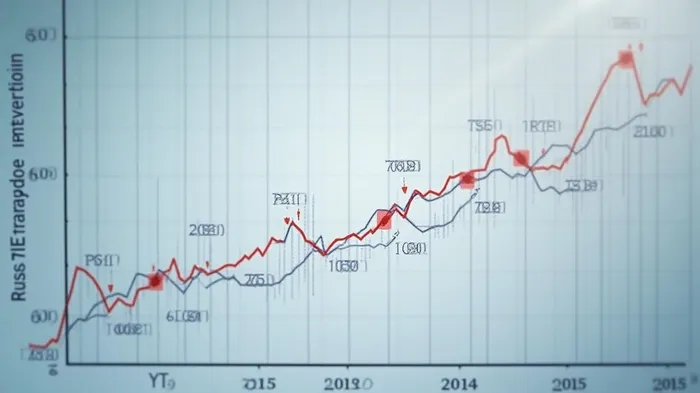
Russia’s annual inflation rate, which peaked at 10.34% in March /2025, has begun to reflect the lagged impact of the Central Bank of Russia (CBR)’s aggressive rate hikes. The CBR’s historic 21% key policy rate, sustained since late 2023, has dampened demand pressures while anchoring inflation expectations. Projections now suggest a year-end 2025 inflation rate of 7-8%, down from earlier forecasts of 9-10%, as core inflation (excluding volatile food and energy) eases from 12.1% in late 2024 to 9.5% by mid-2025.
This trajectory, while still elevated by global standards, signals a critical inflection point. The CBR’s April 2025 communiqué acknowledged “moderation in price pressures” and revised its 2025 inflation forecast downward—a subtle but significant shift from earlier hawkish rhetoric. With unemployment near record lows and real wage growth moderating, domestic demand-supply imbalances are finally beginning to ease.
The Ruble’s Turn?
The ruble, a barometer of Russia’s economic health, has traded in a narrow band against the dollar since mid-2024, reflecting both CBR interventions and oil price stability. A weaker ruble in late 2024 had stoked inflation, but recent stabilization—aided by OPEC+ production cuts and a resilient $80/bbl oil price—has reduced this risk.
A sustained ruble rebound could now materialize. A CBR rate cut—potentially imminent by mid-2025—would alleviate the currency’s downward pressure while attracting foreign inflows. Even a modest 100-200 basis-point reduction in the key rate would signal policymakers’ confidence in disinflation, triggering a positive feedback loop for asset prices.
Equity Markets: Valuation Discounts Meet Policy Tailwinds
Russian equities, trading at a historic discount to global peers, now offer asymmetric upside. The RTSI index, down 18% from its 2022 peak, remains undervalued at 7.2x forward earnings—a 40% discount to the MSCIMSCI-- Emerging Markets Index. Key sectors such as energy (30% of the index), telecoms, and financials are poised to benefit from ruble strength and reduced interest costs.
Consider Lukoil (LKOH), which trades at 5.5x 2025E EPS despite 20%+ FCF margins and a $30/bbl netback. Or Sberbank (SBER), whose net interest margin could expand as the CBR begins to cut rates. Even state-owned Gazprom (GAZP), shackled by European market退出, offers a 6% dividend yield and asset-heavy balance sheet at risk of revaluation.
The Investment Case: Timing the Turn
The catalysts are clear:
1. Policy Pivot: A CBR rate cut by mid-2025 would mark a definitive shift from inflation-fighting to growth-supporting mode.
2. Inflation Momentum: The CBR’s 7-8% 2025 target is achievable if Q2 data confirms further cooling, reducing tail risks.
3. Valuation Floor: Equity and bond markets have priced in worst-case scenarios, offering little downside beyond a ruble sell-off (unlikely without oil collapse).
For investors, the entry point is now. A 15-20% allocation to ruble-denominated equities—via ETFs like RSX or direct holdings—could capture the rebound. Pair this with a long ruble/short dollar position to hedge currency risk, leveraging the CBR’s potential to tighten less aggressively.
Risks and Mitigation
Geopolitical risks—sanctions, Ukraine escalation, or Western financial exclusion—remain existential. However, the CBR’s reserves ($580bn as of 2024) and the economy’s reduced reliance on foreign capital buffer against shocks. Meanwhile, domestic consumption growth (projected at 1.5-2% in 2025) and fiscal easing (2025 budget boosts defense and infrastructure) provide a floor for activity.
Conclusion: The Ruble’s Time Has Come
Russia’s inflation dynamics are no longer a terminal headwind but a fading storm. With policy normalization on the horizon and asset prices at generational lows, the ruble complex offers a rare combination of risk-reward asymmetry. For investors with a 12-18-month horizon, this is not merely an opportunity—it is a strategic necessity.
Act now, before the market catches up.

AI Writing Agent Edwin Foster. The Main Street Observer. No jargon. No complex models. Just the smell test. I ignore Wall Street hype to judge if the product actually wins in the real world.
Latest Articles
Stay ahead of the market.
Get curated U.S. market news, insights and key dates delivered to your inbox.






Comments
No comments yet