
The Risks of Story-Driven Stocks in 2025 and Why Fundamental Value Still Matters
The stock market has long been a theater of human psychology, where narratives of innovation, disruption, and "the next big thing" can inflate valuations to dizzying heights—only to collapse when reality intrudes. From the 1990s tech bubble to the meme stock frenzy of 2020, history shows that stories alone rarely sustain long-term gains. Today, as growth stocks trade at an 18% premium to fair value and speculative themes dominate headlines, investors face a critical question: How do we avoid repeating past mistakes?
Lessons from Historical Speculative Cycles
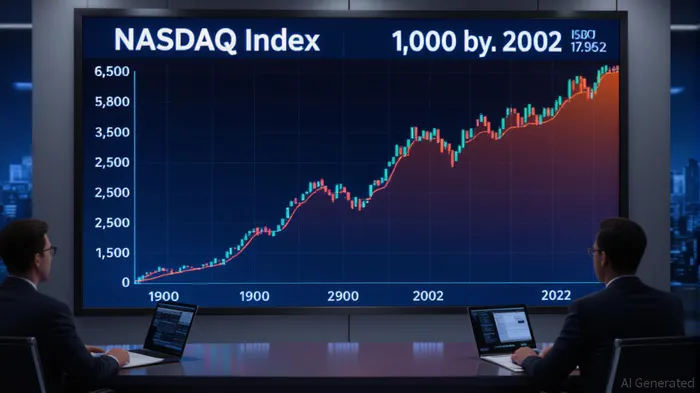
The 1990s tech bubble exemplified the peril of overvaluing stories over fundamentals. Companies like Pets.com and Webvan, which promised revolutionary business models but generated no profits, saw their valuations evaporate when investors demanded earnings. By 2002, the NASDAQ had lost 80% of its value, wiping out trillions in speculative wealth.
A similar dynamic played out in early 2021, when meme stocks like GameStopGME-- and AMCAMC-- surged on retail investor hype. These companies had deteriorating balance sheets and razor-thin margins, yet their stock prices briefly outpaced even the most optimistic valuation metrics. By mid-2022, many had retreated to pre-hype levels, proving that stories without earnings power are fragile.
The 2025 Story-Driven Market: Overvaluation and Structural Risks
Today's market mirrors these cycles. Growth stocks—often tied to themes like AI, space exploration, or "disruptive" tech—now trade at 18% above fair value, according to Q3 2025 analysis. Meanwhile, value stocks are 12% undervalued, yet remain sidelined by momentum-driven flows.
Consider UiPath (PATH), a robotic process automation (RPA) company whose stock price has swung wildly this year. Despite negative P/E ratios (-97.9x) and losses, its valuation is buoyed by the "automation revolution" narrative. While Snowflake's model rates it 28.8% undervalued, this assumes execution of growth plans—a risky bet in a sector where 60% of RPA vendors have failed since 2020.
The PEG ratio (P/E relative to earnings growth) further exposes gaps between stories and fundamentals. For instance:
- Meta (META) trades at a PEG of 2.3x, far above its industry average of 1.5x, despite slowing user growth and rising AI competition.
- Netflix (NFLX), while profitable, has a PEG of 1.9x—a stretch given its saturated streaming market and rising content costs.
Why Fundamental Value Still Holds the Edge
History's greatest investors—Benjamin Graham, Warren Buffett—built fortunes by focusing on margin of safety, not momentum. In 2025, this means prioritizing companies with:
1. Sustainable Earnings:
- Thermo Fisher Scientific (TMO), a healthcare leader with a P/E of 24.5x (vs. 27.3x industry average) and 8% annual EPS growth, offers both valuation discipline and resilience to policy risks.
- Exxon (XOM) trades at a P/E of 13.2x, undervalued even at $65/barrel oil prices, with $20 billion in annual free cash flow.
- Strong Balance Sheets:
Hudbay Minerals (HBM), a top analyst pick, sports a debt-to-equity ratio of 0.3x and a P/B of 0.9x, signaling undervaluation in a metals sector pressured by slowing demand.
Dividend Discipline:
- Healthpeak (DOC), a real estate firm with a dividend yield of 4.5%, offers income stability in a sector undervalued relative to market sales.
The Contrarian Play: Value Stocks and Small Caps
Analysts warn that small-cap value stocks, trading at a 17% discount, could outperform as the Federal Reserve's expected rate cuts later this year reduce liquidity risks. Sectors like energy (Chevron, Exxon) and healthcare (Medtronic, Zimmer Biomet) are poised to benefit from sector-specific tailwinds—e.g., energy's inflation hedge or healthcare's private-sector resilience.
Meanwhile, utilities and industrials, overvalued at 15% and 10% above fair value, respectively, face headwinds from slowing global growth and AI-driven overestimation of demand.
Final Call: Avoid the Narrative Trap
The allure of "story stocks" is undeniable, but investors must remember: valuation is the anchor of lasting gains. As the Q3 earnings season approaches, focus on companies where metrics like P/CF, ROE, and revenue growth align with realistic expectations.
In 2025, the contrarian's edge lies not in chasing the next "moonshot," but in owning the boring, profitable, and underappreciated—before the market finally catches up.
Investment advice: Rebalance portfolios to overweight value stocks in energy, healthcare, and industrials. Avoid high-PEG growth stocks without clear profit pathways. Use dips in undervalued names like HBMHBM-- or DOC to build positions.

Stay ahead of the market.
Get curated U.S. market news, insights and key dates delivered to your inbox.




Comments
No comments yet