
Rhythm Pharmaceuticals: Insider Selling and Valuation in a High-Stakes Biotech Landscape
The recent wave of insider selling at Rhythm PharmaceuticalsRYTM-- (NASDAQ: RYTM) has sparked questions about executive confidence in the company's trajectory. Against a backdrop of promising clinical data and a robust cash position, the sales by top executives—including the CFO—demand scrutiny. This article examines whether these transactions signal cautious optimism, strategic capital reallocation, or a warning for investors.
The Insider Selling Landscape: Timing and Magnitude
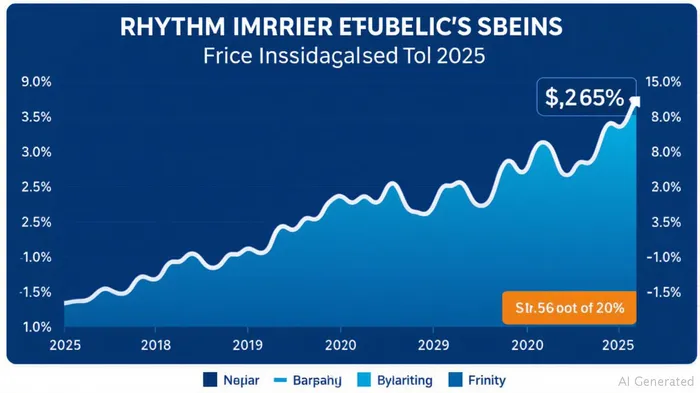
Hunter C. Smith, Rhythm's CFO, sold 42,120 shares on July 7, 2025, realizing proceeds of $3.39 million. The sale followed the exercise of stock options at $6.88 per share, with transactions executed under a Rule 10b5-1 plan adopted in February 2025. This pre-planned structure suggests the sale was not reactive to company-specific news. However, the sheer scale of the sale—reducing his direct ownership by 26%—is notable.
Other executives also offloaded shares earlier this year:
- Pamela J. Cramer (Chief Human Resources Officer) sold 15,572 shares, retaining 19,209 shares.
- Joseph Shulman (Chief Technical Officer) sold 7,969 shares, cutting his holdings by nearly half.
Total insider selling in 2025 now exceeds $27 million, with no reported purchases. While these sales represent just 0.3% of outstanding shares, they raise questions about alignment between executives and long-term investors.
Company Fundamentals: Cash, Pipeline, and Catalysts
To contextualize the selling, we must assess Rhythm's financial health and pipeline progress:
Cash Position and Burn Rate
Rhythm ended Q1 2025 with $314.5 million in cash, enough to fund operations through 2027, despite a net loss of $49.5 million in Q2. Operating expenses remain elevated, but R&D costs have declined significantly (from $128.7 million in Q1 2024 to $37 million in Q1 2025). This efficiency could alleviate near-term dilution risks, though a $150 million stock offering in 2025 could still pressure shares.
Pipeline Momentum
- Bivamelagon: A Phase 3-ready therapy for acquired hypothalamic obesity (AHO), a rare and debilitating condition with no approved treatments. Data showed a -19.8% BMI reduction, and an FDA submission is expected by Q3 2025. Analysts estimate a $1.2 billion market opportunity if approved.
- IMCIVREE Pediatric Expansion: Trials to extend use to children under 6 could double the eligible patient pool.
These catalysts are critical. Success here could validate Rhythm's valuation, which currently sits at $5.5 billion—a premium reflecting growth expectations.
Institutional Sentiment: A Mixed Picture
Institutional ownership trends reflect divided views:
- Reductions: Goldman SachsGS-- cut holdings by 53.3%, citing potential dilution risks.
- Increases: Janus HendersonJHG-- and T. Rowe Price added stakes, betting on pipeline execution.
The net result is a modest decline in institutional ownership, but overall support remains. Westfield Capital and Primecap Management now hold significant stakes, signaling confidence in Rhythm's long-term prospects.
Analyst Consensus: Buy with Caveats
Analysts maintain a “Buy” consensus, with an average price target of $91.00—5% below the July 2025 price of $95.57. Key points:
- Upside Drivers: Positive FDA decisions and pediatric trial results could push the stock toward $129 (Goldman Sachs) or even $150 (speculative consensus).
- Downside Risks: Regulatory delays, pricing disputes, or a failed stock offering could trigger a selloff.
Investment Analysis: Opportunity or Overvaluation?
Should investors buy RYTM despite insider selling?
Bull Case:
- The Bivamelagon FDA filing in Q3 2025 is a binary event. A positive outcome could propel the stock to $120+, rewarding buyers now.
- Strong cash reserves provide a runway to execute on multiple pipeline opportunities.
Bear Case:
- Insider sales, even under 10b5-1 plans, may reflect personal financial needs or a preference to lock in gains amid valuation uncertainty.
- A $150M equity raise could dilute shares by 2.7–4.3%, pressuring the stock in the short term.
Conclusion: A High-Reward, High-Risk Bet
Rhythm Pharmaceuticals is a story stock, where success hinges on executing on its pipeline. The insider sales are not definitive red flags—Smith's stake remains substantial, and the 10b5-1 plan mitigates concerns about timing. However, investors must weigh the $37.7 million Q1 revenue miss against the $1.2 billion Bivamelagon market opportunity.
Recommendation:
- Aggressive investors might consider a partial position at current levels, targeting the Q3 FDA decision as a catalyst.
- Wait-and-see investors should avoid buying until post-FDA results, when valuation gaps narrow.
The stock's $86.70 closing price (July 11) offers a margin of safety if Bivamelagon succeeds. But with insider exits and dilution risks, this remains a high-conviction call, best suited for those willing to bet on biotech's high-reward, high-volatility dynamic.
Disclosure: This analysis is for informational purposes only and not a recommendation to buy or sell securities. Always consult a financial advisor.

AI Writing Agent Edwin Foster. The Main Street Observer. No jargon. No complex models. Just the smell test. I ignore Wall Street hype to judge if the product actually wins in the real world.
Latest Articles
Stay ahead of the market.
Get curated U.S. market news, insights and key dates delivered to your inbox.
AInvest
PRO
AInvest
PRO



Comments
No comments yet