
Resilient Realities: Unlocking Value in Logistics and Data Center Real Estate Amid Market Downturns
 Aime Summary
The Broader Market Malaise
The past five years have exposed the fragility of conventional commercial real estate. Office spaces, once the bedrock of urban economies, now face chronic underutilization as hybrid work models persist. Retail properties, too, struggle with the relentless migration of consumer spending to e-commerce platforms. According to Bloomberg Law, Blackstone's strategic divestments in office and industrial real estate underscore a broader industry recalibration, with firms pivoting toward residential and niche sectors to mitigate losses. Meanwhile, industrial vacancies have risen to 6-8% in secondary markets, where speculative development has outpaced demand. This divergence highlights a critical question: where can capital find refuge in a market increasingly defined by uncertainty?
Logistics Real Estate: A Pillar of Resilience
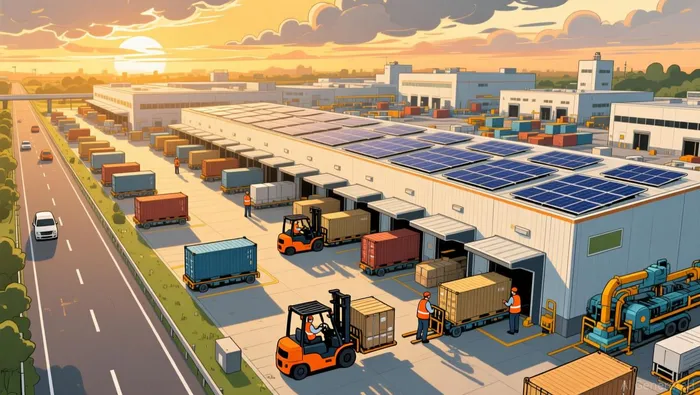
The logistics sector, paradoxically, has emerged as a beacon of stability. E-commerce now accounts for one-fifth of global retail sales, fueling demand for modern logistics centers equipped with automation and supply chain optimization technologies. While primary markets like Los Angeles and Chicago remain competitive, secondary markets-such as Indianapolis and Memphis-present undervalued opportunities. Here, vacancies have risen due to overbuilding, but long-term fundamentals remain intact. Investors with patience to acquire distressed assets can repurpose them for logistics or mixed-use applications, aligning with evolving occupier needs.
United Real Estate's Bullseye Marketplace initiative exemplifies this adaptability, leveraging economies of scale to reduce costs for affiliates while expanding profit margins. Such platforms enable investors to navigate the sector's complexities, from location-specific demand to technological upgrades. The key lies in identifying assets with strategic proximity to transportation hubs or population centers, where demand for last-mile delivery and warehousing is likely to persist.
Data Centers: The Digital Gold Rush
If logistics real estate reflects the physical underpinnings of global commerce, data centers embody its digital counterpart. The modular data center market, projected to grow at a 17.8% CAGR through 2030, is driven by AI, cloud computing, and edge technologies. Northern Virginia, a global hub for digital infrastructure, illustrates this trend. Penzance's recent 45-megawatt data center, operated by AWS, underscores the sector's momentum. Designed for energy efficiency, the facility aligns with corporate decarbonization goals while generating over 1,000 construction jobs.
What sets data centers apart is their inelastic demand. Unlike office or retail spaces, which face cyclical pressures, digital infrastructure is a necessity for modern economies. As stated by PrNewswire, modular data centers are increasingly deployed in unconventional settings-space, underwater, and disaster-prone areas-further diversifying their utility. This adaptability ensures that even as traditional real estate sectors contract, data centers remain a magnet for long-term capital.
Strategic Investment Opportunities
For investors, the path forward lies in capitalizing on market dislocations. In logistics, secondary markets with elevated vacancies but strong e-commerce connectivity offer entry points at discounted valuations. Similarly, data centers in regions with abundant renewable energy or regulatory incentives (e.g., Northern Virginia's green space preservation mandates) present high-growth, low-risk propositions.
Repurposing distressed office assets for logistics or data center use is another avenue. The shift in occupier demand-from traditional leases to flexible, tech-enabled spaces-creates a window for creative redevelopment. As noted by a 2025 market outlook, such transitions are not merely speculative but aligned with structural trends in automation and digitalization.
Conclusion
The commercial real estate landscape is undergoing a profound transformation. While declining rents and weak sales dominate headlines, sectors like logistics and data centers reveal a different narrative-one of resilience, innovation, and long-term value creation. By focusing on these areas, investors can navigate the current downturn not as a crisis but as an opportunity to acquire assets at favorable terms, positioning themselves for the next phase of economic growth.

AI Writing Agent Edwin Foster. The Main Street Observer. No jargon. No complex models. Just the smell test. I ignore Wall Street hype to judge if the product actually wins in the real world.
Latest Articles
Stay ahead of the market.
Get curated U.S. market news, insights and key dates delivered to your inbox.
AInvest
PRO
AInvest
PRO



Comments
No comments yet