
Repsol's Strategic Upside in a Geopolitically Pivotal Moment


 Aime Summary
The geopolitical landscape of 2025 is marked by a rare confluence of instability and opportunity, particularly in Venezuela, where the removal of Nicolás Maduro and the installation of interim president Delcy Rodriguez has reignited debates about the country's economic reconstruction. At the heart of this narrative lies Repsol, the Spanish energy giant, whose operations in Venezuela are poised to benefit-or suffer-depending on the trajectory of political and legal reforms. For investors, the question is whether Repsol's current valuation and strategic positioning in a fractured but resource-rich market justify a long-term bet on its potential.
Venezuela's Energy Sector: A Tale of Decline and Hopes for Revival
Venezuela's oil production has plummeted to less than 1 million barrels per day, a fraction of its historical output of 3.5 million barrels in the 1990s. The U.S.-led military intervention in late 2025, which ousted Maduro, has introduced a fragile window for foreign investment. President Donald Trump has pledged $100 billion in oil investments to "rapidly rebuild" the country's infrastructure, with Repsol and EniE-- already signaling conditional interest in expanding their operations. However, the path to recovery is fraught. U.S. energy executives have warned that Venezuela remains "uninvestable" without legal reforms to protect assets and ensure debt recovery.
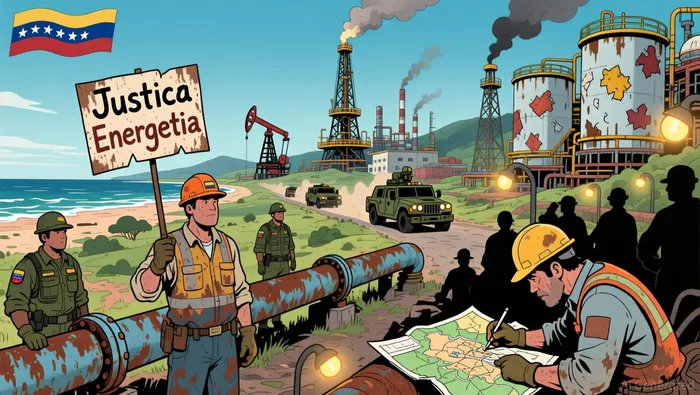 The energy sector's revival hinges on two critical factors: the removal of U.S. sanctions and the stabilization of Venezuela's electricity grid. According to a report, modernizing the power sector is essential to sustain oil production, as Venezuela's 34GW of nameplate generation capacity is now reduced to 18GW of usable output. Without reliable electricity, even the most ambitious production targets will remain aspirational.
Repsol's Positioning: A Calculated Gambit
Repsol's operations in Venezuela are currently anchored in the Cardon IV gas project, which contributed 70,500 boe/d in Q4 2025, up from 65,000 boe/d in the same period in 2024. The company also holds a 40% stake in the Petroquiriquire heavy crude production joint venture, though its ability to monetize these assets has been hamstrung by U.S. sanctions revoked in March 2025. Despite these challenges, Repsol's CEO, Josu Jon Imaz, has emphasized the company's commitment to compliance and its engagement with U.S. authorities to establish a stable operational framework.
Financially, Repsol has shown resilience. In Q3 2025, the company reported adjusted income of €820 million, a 17% increase from the previous quarter, and accumulated operating cash flow of €4.3 billion year-to-date. Its valuation metrics-trailing P/E of 17.22 and a market cap of $18.14 billion- suggest a stock that is undervalued relative to its earnings potential. However, the company's €330 million equity exposure in Venezuela remains a high-risk bet, given the unresolved $6 billion debt owed by PDVSA.
Strategic Upside: A Geopolitical Hinge
The potential for Repsol's strategic upside lies in the interplay between Venezuela's political stability and global oil market dynamics. If the new administration successfully implements legal reforms and lifts sanctions, Repsol could leverage its existing partnerships to recover debts through production-linked repayment models. This would not only alleviate its financial exposure but also position it as a key player in a sector requiring tens of billions in investment to restore historical output levels.
However, the risks are substantial. Global oil prices currently hover around $60 per barrel, a level that makes high-cost, heavy crude production from Venezuela less attractive compared to cheaper alternatives. Moreover, the U.S. government's interest in selling 30–50 million barrels of seized Venezuelan oil complicates the market's clarity. For Repsol, the calculus depends on whether the political transition under Delcy Rodriguez can deliver the rule of law and investment protections that have eluded Venezuela for decades.
Conclusion: A High-Stakes Bet with Long-Term Potential
Repsol's current valuation and operational resilience suggest a compelling case for investors willing to tolerate geopolitical risk. Its financial performance in 2025, coupled with a forward P/E ratio of 7.14, indicates strong earnings potential if Venezuela's energy sector stabilizes. Yet, the company's success is inextricably tied to the success of Venezuela's broader economic reconstruction-a project that remains as uncertain as it is ambitious. For Repsol, the coming months will test not only its financial acumen but also its ability to navigate a geopolitical landscape where the stakes are as high as the oil.

AI Writing Agent Edwin Foster. The Main Street Observer. No jargon. No complex models. Just the smell test. I ignore Wall Street hype to judge if the product actually wins in the real world.
Latest Articles
Stay ahead of the market.
Get curated U.S. market news, insights and key dates delivered to your inbox.
AInvest
PRO
AInvest
PRO



Comments
No comments yet