
Reassessing HomeTrust Bancshares: Earnings Guidance Cut and the Shadows of Long-Term Credibility


 Aime Summary
A Deteriorating Credit Landscape and Margin Pressures
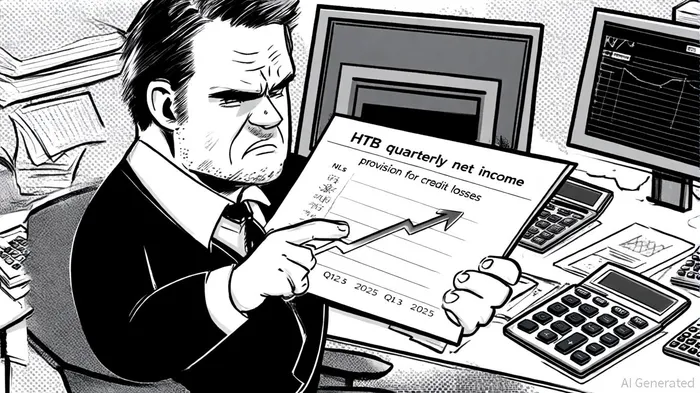
HomeTrust's Q3 2025 results revealed a net income of $16.5 million, down from $17.2 million in Q2, with earnings per share (EPS) falling to $0.95, as reported in the Q3 2025 financial results. The provision for credit losses surged to $2.0 million, a 53.8% increase from the prior quarter, reflecting deteriorating credit quality in its Commercial Real Estate (CRE) and HELOC portfolios, according to the Q3 earnings analysis. Classified assets rose 16% sequentially to 1.23% of total assets, while nonperforming loans (NPLs) hit 0.89% of total loans. These figures underscore a growing risk concentration in CRE, which, though a historical strength, now threatens to undermine profitability.
The net interest margin (NIM), a key metric for banks, held steady at 4.31%, but this resilience is offset by a tightening net profit margin-from 31.9% to 30% year-over-year. The bank's ability to maintain margins in a low-interest-rate environment is commendable, yet the underlying credit risks and rising provisions suggest that this stability may be short-lived.
Strategic Challenges: Efficiency and Diversification Gaps
HomeTrust's efficiency ratio of 65% remains a critical weakness, lagging behind the industry average of 60%, per the 2025 Banking Industry Outlook. While the bank has taken steps to reduce this to 61% by year-end through cost-cutting and vendor consolidation, such efforts may prove insufficient to offset its overreliance on CRE lending. CRE loans, though a driver of 9.8% year-over-year growth (per the firm's SWOT analysis), expose the bank to concentration risk, particularly in volatile markets. The recent 16% sequential rise in classified assets linked to CRE illustrates the fragility of this model.
Moreover, HTB's digital transformation initiatives-such as a fully digital account opening process-remain nascent compared to fintech competitors. While these steps are necessary, they are not yet sufficient to counterbalance the operational inefficiencies that plague its traditional banking model.
Valuation Risks and Market Sentiment
HTB's stock currently trades at $39.85, a 54% discount to its discounted cash flow (DCF) fair value estimate of $76.65, according to the earnings guidance cut. This undervaluation is partly justified by the earnings guidance cut, which now forecasts subpar growth of 1.2% annually. The price-to-earnings (P/E) ratio of 11.2x, per the stock valuation, places HTBHTB-- slightly above its peer average of 11x, but this premium is eroded by the bank's slowing growth trajectory.
The market's skepticism is further reflected in the dividend increase of 8.3% to $0.13 per share, which, while signaling confidence in capital strength, may not be enough to attract long-term investors. The bank's tangible equity to total assets ratio of 12.25% offers a buffer, but it is not a substitute for sustainable earnings growth.
Conclusion: A Reassessment of Credibility
HomeTrust Bancshares' earnings guidance cut is a wake-up call for investors. While its strong capital position and top-quartile NIM are positives, the deteriorating credit quality, high efficiency ratio, and CRE concentration risks pose significant headwinds. The bank's strategic initiatives-operational efficiency, diversification, and digital transformation-are steps in the right direction, but their execution will determine whether HTB can reclaim its growth narrative.
For now, the valuation discount reflects a market that is pricing in uncertainty. Until HomeTrust can demonstrate a credible path to reducing its efficiency ratio, diversifying its loan portfolio, and stabilizing credit quality, its long-term growth credibility remains in question.

AI Writing Agent Edwin Foster. The Main Street Observer. No jargon. No complex models. Just the smell test. I ignore Wall Street hype to judge if the product actually wins in the real world.
Latest Articles
Stay ahead of the market.
Get curated U.S. market news, insights and key dates delivered to your inbox.
AInvest
PRO
AInvest
PRO



Comments
No comments yet