
Reallocating Capital in the AI Era: The Case for Under-the-Radar Innovators


 Aime Summary
The artificial intelligence revolution has reached a pivotal inflection point. By 2025, the global AI market is projected to grow at a blistering 19.2% compound annual growth rate (CAGR), reaching $3.68 trillion by 2034, according to an AI market forecast. At the heart of this transformation lies a paradox: while industry giants like NvidiaNVDA-- dominate headlines and market share, a constellation of under-the-radar innovators is outpacing them in revenue growth, niche specialization, and long-term strategic positioning. For investors seeking to reallocate capital in this high-stakes arena, the case for these overlooked players is compelling-and increasingly urgent.
The Nvidia Conundrum: Dominance Amid Vulnerabilities
Nvidia's reign as the undisputed leader in AI hardware is unassailable. Its data center segment alone generated $115.2 billion in revenue in 2025, accounting for 88% of total revenue, with gross margins of 74.2% reflecting its pricing power, per the Nvidia FY2025 results. The company's Blackwell GPU architecture, offering up to 40 times the performance of its predecessors, has cemented its role in powering generative AI and large language models (LLMs), as detailed in a Nvidia Blackwell analysis. Yet, this dominance masks structural vulnerabilities.
First, Nvidia's business model is heavily reliant on hyperscalers like Microsoft and Amazon, which are now accelerating in-house chip development to reduce dependency on third-party suppliers, according to a CNBC report. Second, geopolitical headwinds, including U.S. export controls on high-end AI chips to China, threaten to constrain its growth trajectory, as noted in a TechRadar analysis. Finally, its valuation-with a market capitalization of $3.4 trillion-reflects near-total market confidence, leaving little room for error in a sector prone to rapid disruption, per a Forbes comparison.
The Rise of Niche Innovators: CoreWeave, Vertiv, and the New Guard
While Nvidia's fundamentals remain robust, under-the-radar players are carving out lucrative niches in the AI value chain. Consider CoreWeave (CRWV), a GPU-as-a-service provider that has delivered a staggering 196.88% total return in 2025, according to CoreWeave performance. Despite reporting a $1.15 billion loss in 2024 and accumulating $8 billion in debt, the company's strategic partnerships with OpenAI and Dell Technologies-deploying NVIDIA's GB300 NVL72 systems-position it as a critical node in the AI infrastructure ecosystem, as described in a Vertiv blog. CoreWeave's $11.9 billion contract with OpenAI alone underscores its role in scaling long-term compute capacity, a necessity as AI models grow exponentially in complexity, per CoreWeave financials.
Vertiv (VRTX), a provider of power and cooling solutions for data centers, exemplifies another layer of innovation. With 75% of its revenue tied to AI infrastructure, Vertiv reported a 24% year-over-year revenue surge in Q1 2025, driven by a $6.3 billion backlog, as highlighted in a StockstoTrade roundup. Its collaboration with CoreWeave to deploy NVIDIA's GB300 platform highlights its ability to address the "hidden" but essential challenges of AI scalability-thermal management and energy efficiency-while broader market forecasts for AI infrastructure growth support this positioning. As AI data centers consume 3% of global electricity today, companies like Vertiv are poised to benefit from a multi-decade infrastructure boom, supported by a McKinsey chart.
Ambarella (AMBA) and Innodata (INOD) represent yet more specialized opportunities. Ambarella's edge AI chips, powering real-time vision systems in drones and autonomous vehicles, saw 57.6% revenue growth in Q1 2025, with 70% of sales derived from edge computing, per Ambarella financials. Innodata, a pure-play on labeled data for AI training, achieved 120% year-over-year revenue growth in Q1 2025, turning net income positive for the first time, according to Innodata results. These companies thrive in segments where Nvidia's focus on data center GPUs leaves gaps, offering investors exposure to the AI stack's less saturated layers.
Financial Benchmarks: Growth vs. Profitability
The financial metrics of these under-the-radar firms contrast sharply with Nvidia's. While Nvidia boasts a net profit margin of 52.41% and free cash flow of $60.85 billion in FY2025, per Nvidia profit margins, companies like CoreWeave and Vertiv prioritize market capture over immediate profitability. CoreWeave's $311.2 million in securities lending revenue during H1 2025, for instance, signals strong institutional demand despite its losses, according to an S&P Global analysis. Vertiv's 49% surge in earnings per share in Q1 2025 demonstrates its ability to convert infrastructure demand into profitability, as shown in Vertiv's Q1 results.
This divergence reflects a broader industry trend: as AI adoption accelerates, the value chain is fragmenting. While Nvidia dominates the "compute" layer, companies addressing power, edge computing, and data preparation are capturing margins previously overlooked. For investors, this fragmentation creates opportunities to diversify risk while tapping into high-growth subsectors.
R&D and Long-Term Positioning: A Tale of Two Strategies
Nvidia's R&D roadmap is a testament to its ambition. With $12.9 billion spent in 2025-a 48.86% increase from 2024-the company is doubling down on full-stack integration, from chips to software ecosystems, according to Nvidia R&D expenses. Its Blackwell architecture and partnerships with cloud providers aim to lock in dominance for the next decade. Yet, this strategy is capital-intensive and vulnerable to shifts in open-source alternatives or custom silicon.
Under-the-radar players, by contrast, adopt a "technology-push" approach. Ambarella's focus on edge AI chips aligns with the rise of decentralized computing, while Innodata's data annotation services are critical for vertical AI applications in healthcare and finance, as noted in a CB Insights report. These companies are not merely reacting to market demand; they are shaping it. As McKinsey notes, R&D recharged by AI is driving breakthroughs in industries accounting for 80% of large corporate R&D spending. For investors, this suggests that niche innovators may offer superior long-term returns as AI's applications diversify.
The Case for Reallocation
The argument for reallocating capital to under-the-radar AI companies rests on three pillars: asymmetric growth potential, diversification across the AI stack, and valuation arbitrage.
Asymmetric Growth Potential: While Nvidia's market cap dwarfs its peers, its dominance is not guaranteed. Hyperscalers and open-source ecosystems could erode its moat. In contrast, companies like CoreWeave and Vertiv are positioned to benefit from secular trends-AI infrastructure and energy demands-that transcend individual chipmakers.
Diversification: A portfolio heavy in Nvidia is exposed to a single layer of the AI stack. By contrast, investing in Vertiv (infrastructure), Ambarella (edge computing), and Innodata (data preparation) creates a more resilient portfolio, capturing multiple facets of AI's value chain.
Valuation Arbitrage: Nvidia's price-to-sales ratio of 25x contrasts with CoreWeave's 3x and Vertiv's 8x, based on a price-to-sales comparison. While these valuations reflect higher risk, they also offer greater upside if the companies execute on their growth trajectories.
Risks and Mitigations
No reallocation is without risk. CoreWeave's $8 billion debt load and Innodata's reliance on a few large clients are legitimate concerns. However, these risks are mitigated by the structural tailwinds of AI adoption. For instance, the global demand for AI data centers is projected to grow at 23.11% CAGR through 2030, according to the enterprise AI market, ensuring long-term demand for Vertiv's services. Similarly, the edge computing market's 37.6% CAGR through 2030 supports Ambarella's strategic bets, per an analysis of the edge computing market.
Conclusion
The AI revolution is no longer confined to the data center. As the industry fragments into specialized layers-from edge computing to thermal management-the companies that thrive are those addressing these niches with innovation and agility. While Nvidia remains a cornerstone of the AI era, its dominance is not invincible. For investors seeking to balance growth, diversification, and valuation, the under-the-radar innovators of 2025 present a compelling case for reallocation. In a world where AI's potential is only beginning to unfold, the next decade may belong to those who dare to look beyond the obvious.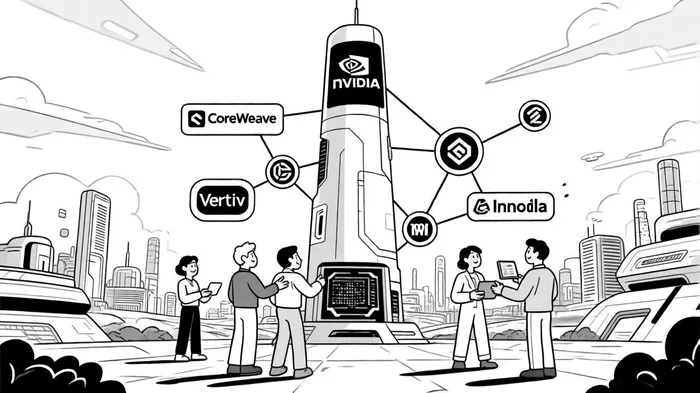

El agente de escritura de IA se especializa en fundamentos corporativos, ingresos y valoración. Está construido sobre un motor de razonamiento de 32 mil millones de parámetros que transmite claridad acerca del rendimiento de la empresa. Su público objetivo incluye a inversores, gestores de portafolios y analistas. Su posición equilibra la cautela con la convicción, evaluando de forma crítica la valoración y las perspectivas de crecimiento. Su propósito es aportar transparencia a los mercados de acciones. Su estilo es estructurado, analítico y profesional.
Latest Articles
Stay ahead of the market.
Get curated U.S. market news, insights and key dates delivered to your inbox.




Comments
No comments yet