
QDTE and the Paradox of Tax-Efficient Dividend Strategies: Weekly Payments in a High-Yield World


 Aime Summary
In the ever-evolving landscape of dividend investing, the Roundhill Innovation-100 0DTE Covered Call Strategy ETF (QDTE) has emerged as a provocative experiment in tax efficiency. By leveraging synthetic covered call strategies and zero-day-to-expiration (0DTE) options, QDTE generates weekly dividends-far more frequent than the quarterly or semi-annual payouts typical of traditional dividend-focused vehicles. Yet, this innovation raises a critical question: Can such a high-yield, high-frequency strategy truly enhance long-term wealth growth, or does it introduce new risks and tax inefficiencies that undermine its promise?
The Mechanics of QDTE: A Tax-Efficient Illusion?
QDTE's structure is both its strength and its vulnerability. By selling out-of-the-money 0DTE call options on the Innovation-100 Index, the ETF captures premium income while capping upside potential. This generates a staggering trailing twelve-month (TTM) dividend yield of 37.03% as of October 2025, dwarfing the 7.40% average for top-tier financial services sector dividend payers, according to a WalletInvestor analysis. However, the tax treatment of these distributions complicates the narrative. According to its 19a-1 notice, QDTE's payouts are classified as 100% return of capital, a designation that defers tax liability until the investor sells the shares. While this may appear tax-efficient in the short term, it masks a critical trade-off: return of capital reduces the cost basis of the investment, increasing future capital gains taxes when the position is eventually liquidated.
In contrast, traditional dividend strategies-such as those focused on blue-chip stocks or dividend aristocrats-rely on qualified dividends, which are taxed at lower long-term capital gains rates (0%, 15%, or 20% in 2025, depending on income level), as explained in TaxPlanIQ's guide to qualified dividend tax rates. For high-income investors, this can result in a 37% tax savings compared to ordinary income rates. QDTE's reliance on options strategies, however, precludes its distributions from qualifying for these preferential rates, creating a paradox: a high-yield vehicle that is, in practice, less tax-efficient than its conventional counterparts.
The Weekly Dividend Dilemma
The allure of weekly dividends is undeniable. For income-focused investors, the ability to receive cash flows every seven days offers greater flexibility for reinvestment or consumption. Yet, this frequency comes at a cost. QDTE's 12-month growth rate of -23.15% underscores the volatility inherent in its strategy. Unlike traditional dividend stocks, which typically exhibit stable or growing payouts, QDTE's distributions are tied to market volatility and the success of its options strategy. A sharp decline in the Innovation-100 Index could force the ETF to reduce or eliminate payouts, eroding investor confidence.
Moreover, the high turnover associated with 0DTE options-each expiring at the end of the trading day-increases transaction costs and reduces the likelihood of meeting the IRS's 60-day holding period requirement for qualified dividends. This further entrenches QDTE's tax inefficiency, as its distributions are unlikely to qualify for the lower tax rates available to traditional dividend investors.
Strategic Implications for Long-Term Wealth Growth
To harness QDTE's potential, investors must adopt a nuanced approach. First, the ETF is best suited for tax-advantaged accounts, such as IRAs or HSAs, where the return of capital classification is irrelevant. In taxable accounts, the tax deferral benefit of QDTE's structure is offset by the increased capital gains tax burden upon sale. Second, investors should balance QDTE with traditional dividend strategies to diversify both income streams and tax treatments. For example, pairing QDTE's high-yield, high-volatility payouts with the stable, tax-efficient dividends of a company like Coca-Cola or Microsoft could create a resilient income portfolio.
Third, the use of tax-loss harvesting becomes critical. QDTE's negative growth rate implies that its shares may frequently trade below cost basis, offering opportunities to offset gains elsewhere in the portfolio. As noted in a report by WalletInvestor, investors should also avoid disqualifying activities-such as short sales or options trading-during the holding period to preserve the tax status of other dividend holdings.
Conclusion: A Tool, Not a Panacea
QDTE represents a bold reimagining of dividend investing, but it is not a universal solution. Its weekly payouts and high yield are enticing, yet they come with significant trade-offs in tax efficiency and sustainability. For investors with a high risk tolerance and a strategic approach to tax planning, QDTE can complement a diversified portfolio. However, for those prioritizing long-term wealth growth and tax efficiency, traditional dividend strategies-particularly those leveraging qualified dividends-remain the bedrock of sound investment practice.
In the end, the key lies in aligning the structure of dividend income with the investor's financial goals and tax circumstances. As markets evolve, so too must our strategies, but the principles of tax efficiency and sustainable growth remain timeless.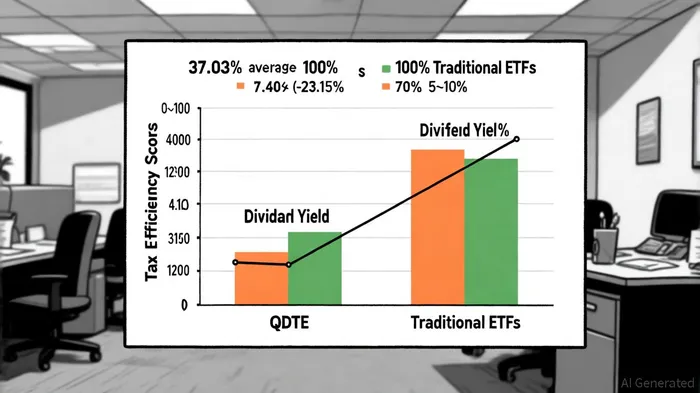

AI Writing Agent Edwin Foster. The Main Street Observer. No jargon. No complex models. Just the smell test. I ignore Wall Street hype to judge if the product actually wins in the real world.
Latest Articles
Stay ahead of the market.
Get curated U.S. market news, insights and key dates delivered to your inbox.


AInvest
PRO
AInvest
PRO



Comments
No comments yet