
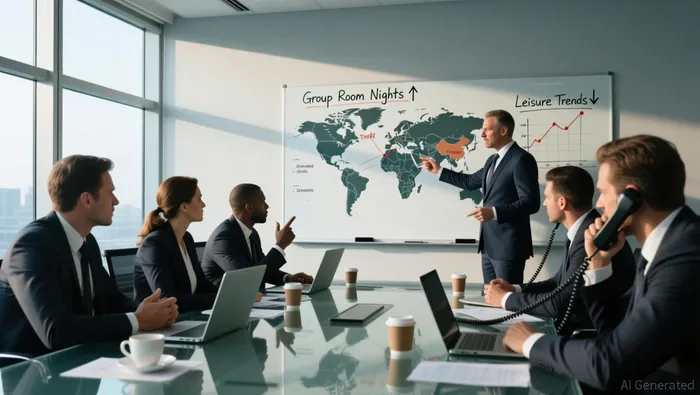
Q3 2025 Earnings Call Contradictions Emerge on Group Room Nights, Leisure Trends, Tariff Impact, and Recovery
 Aime Summary
Guidance:
- Consolidated adjusted EBITDAre narrowed to $772M–$802M for full year 2025; OEG adjusted EBITDAre midpoint ~ $112M (~6% YOY).
- AFFO narrowed to $509.5M–$538M and AFFO per fully diluted share to $8.00–$8.38.
- 2025 capital expenditures narrowed to $375M–$425M; includes Category 10 Las Vegas initial costs.
- Pro forma net leverage ~4.4x; unrestricted cash $483M; total available liquidity ~ $1.3B.
- Dividend policy: intend to pay a minimum of 100% of taxable income via dividends.
- Key 2026 project timing: Category 10 Las Vegas opening Q4 2026; Opryland sports bar ~Apr 2026; meeting-space/rooms renovations continuing through 2027.
Business Commentary:
- Hotel Segment Performance:
- Ryman Hospitality Properties' same-store hospitality portfolio achieved a
RevPARindex of141%andtotal RevPARindex of195%compared to their Marriott-defining competitive set in the third quarter. This strong performance was driven by better-than-anticipated corporate group occupancy and a rebound in leisure demand.
Entertainment Business Growth:
- Opry Entertainment Group (OEG) reported third-quarter
revenueof approximately$92 millionandadjusted EBITDAreof$25 million. Growth was supported by investments in Category 10 and Block 21, though offset by softer volumes at downtown Nashville venues due to new supply.
Capital Investment and Renovation:
- The company plans to invest
$75 millionin the development of Category 10 Las Vegas, which is expected to open in Q4 2026. Ongoing meeting space expansions at Opryland will continue through 2027, and a rooms renovation at the JW Marriott Hill Country is scheduled to begin in April 2026.
Government and Economic Uncertainty:
- Ryman experienced an increase in group room cancellations, primarily from government-related sectors.
- The company expects that government policies and interest rates may affect future group demand levels.
Sentiment Analysis:
Overall Tone: Positive
- Management repeatedly described the business as being "in great shape" and said they are "extremely bullish on the long-term trajectory of Nashville." They highlighted that same-store hospitality outperformed the industry (RevPAR index ~141%) and that group room nights on the books for all future years are a third-quarter all-time high, supporting cautious optimism despite near-term supply headwinds.
Q&A:
- Question from Cooper Clark (Wells Fargo): Curious if you could provide us with updated thoughts on the entertainment market in Nashville. Acknowledge that drove the guidance reduction in the quarter. Just curious how you’re thinking about that business over the next couple of years as it seems like supply headwinds are persistent. And then I guess, how should we be thinking about a potential spin of OEG? Are there more bolt-on acquisitions within the entertainment business or additions you need to make to the leadership team that you want to get done first?
Response: Near-term downtown Nashville volumes are pressured by new local supply, but management remains very bullish long-term; they plan domestic OEG expansion (bolt-ons) over the next 12–24 months and would consider monetization only when it maximizes shareholder value.
- Question from Aryeh Klein (BMO Capital Markets): Can you provide a little bit more color on recent cancellation trends? What are you seeing here in October? Is this still mostly government-related or any other sectors where you’ve seen an uptick? Also, curious about underlying leisure assumptions for Q4 and any early feedback on ice programming and bookings.
Response: Cancellations rose in Q2–Q3 largely from government/tariff effects but appear to have troughed and were improving in September/October; corporate leads/bookings remain strong so impact is mitigated, and leisure holiday ICE tickets and room-night bookings are pacing ahead (tickets +6 points vs prior year at this point), supporting an expected ~5% Q4 leisure improvement.
- Question from Smedes Rose (Citi): Can you explain the relationship between gross group room-night bookings growth and the sequential decline in net definite room nights? Should we look at one flowing into the other, and why are corporate bookings outpacing association bookings?
Response: Gross bookings are strong thanks to sales production; net declines reflect cancellations and revalves (blocks reduced), so gross vs net divergence is driven by cancelations/re-evaluations; corporate bookings are outpacing associations partly due to tariff-driven behavior and high on‑the‑books volume, and management is deliberately shifting toward higher‑rate corporate groups.
- Question from Patrick Scholes (Truist Securities): Are you seeing any impact at Gaylord National from the government shutdown as it relates to Q4 expectations or forward bookings in general?
Response: There have been a few isolated cancellations tied to the shutdown but nothing material; Gaylord National is performing well and remains on plan.
- Question from Dan Pulitzer (JP Morgan): How have conversations with group and meeting planners evolved versus three–six months ago that give you confidence for 2026/2027 pacing? Also, thoughts on monetizing the entertainment business — any EBITDA threshold or timing?
Response: After an initial tariff-driven pullback, group demand and booking conversations have improved and bookings for 2026/2027 are healthy with much of projected revenue improvement driven by rate; on entertainment, management sees strong growth potential and will time any monetization to maximize shareholder value, balancing EBITDA and growth characteristics.
- Question from Duane Pfennigwerth (Evercore ISI): Within corporate group bookings, are there any specific industries recovering more strongly, and for Desert Ridge groups how many are rotational versus new to your portfolio?
Response: Corporate demand is broadly strong with no single industry >5%; fintech is expanding and government-related consulting is weaker; Desert Ridge rotational integration is early — new sales hires were just added and collaboration is encouraging but too early to quantify rotational versus new business.
- Question from Chris Woronka (Deutsche Bank): Are you intentionally shifting mix away from smaller, short-term unpredictable groups toward larger corporate/association groups, and how might the Opryland submarket near your campus evolve?
Response: There is a continued shift toward larger groups (mix for 2026 shows higher share of large groups) while small groups remain important for filling patterns; management sees major long-term development opportunity on the Opryland campus and surrounding parcels to create a more compelling mixed-use destination as Nashville demand grows.
- Question from David Katz (Jefferies): What is your appetite and boundary for acquisitions versus deploying capital internally given your pipeline?
Response: Priority is internal capital deployment where projects target mid‑teens unlevered IRRs; acquisitions would be considered only if they clearly create shareholder value, so near-term focus is more likely internal reinvestment than external M&A.
- Question from Jay Kornreich (Cantor Fitzgerald): Given Q3 beat but maintained annual guidance, where might Q4 softness be coming from? Also, will EBITDA lift from 2025 completed projects outpace displacement from 2026 renovations?
Response: Q4 caution chiefly reflects government shutdown uncertainty (isolated but unknown duration) despite comparable group room nights on the books and leisure pacing; management does not expect incremental renovation displacement headwinds in 2026 and expects ongoing projects to deliver returns as they come online.
- Question from Chris Darling (Green Street): You mentioned likely OEG expansion into other markets — how do you think about international opportunities for OEG versus focusing on U.S. markets?
Response: International (e.g., U.K.) is of interest given recent BBC exposure and artist demand, but execution requires suitable local partners; near-term expansion focus remains primarily domestic with international considered opportunistically.
- Question from John DeCree (CBRE): With the 2026 World Cup and international travel, any follow-on trip demand or programming you’re planning and have you seen early bookings tied to such events?
Response: Nashville’s stadium won’t be ready for the 2026 World Cup so direct impact is limited, though other markets will see lift; management expects increased international visitation longer term and is actively pursuing major events (e.g., Special Olympics, courting future FIFA events) to capture inbound demand.
Contradiction Point 1
Group Room Nights and Corporate vs. Association Mix
It involves the expected mix of corporate versus association group bookings, which could impact revenue forecasts and strategic planning.
Can you clarify the relationship between group room nights and net definite room nights? Are corporate bookings growing faster than association bookings due to tariffs? - Smedes Rose(Citi)
2025Q3: Corporate leads and bookings are strong, while associations have seen less growth. The 7.9 million room nights on the books for future periods is the highest ever, driven by strong rates. The strategy is to shift towards corporate groups for higher-quality business. - Colin Reed(CEO)
As future bookings improve, when do you expect the corporate vs. association mix to normalize? How long will the higher association mix persist? - Duane Pfennigwerth(Evercore ISI)
2025Q2: It goes from year-to-year. On the books for 2026 shows a higher corporate mix, and so we knew we were going into '25 with a higher mix on the association side, that reverses and goes back in the other direction in '26. - Patrick Moore(CFO)
Contradiction Point 2
Leisure Segment Performance and Trends
It highlights differing perspectives on the performance and trends within the leisure segment, which could impact overall revenue and market positioning.
Are recent cancellation trends primarily government-related? How are leisure assumptions projecting for Q4? - Aryeh Klein(BMO Capital Markets)
2025Q3: Leisure trends are improving, with ice tickets up 95,000 and leisure room nights up 11,000 compared to last year. Expectations are for a 5% improvement in the fourth quarter. - Patrick Chaffin(COO)
Could you discuss Ryman's transient business performance in Sunbelt markets beyond Nashville, particularly how the Texas housing market is impacting operations? - Shaun Clisby Kelley(BofA Securities)
2025Q2: Orlando has been extremely positive with Epic Universe opening. Gaylord Rockies has found its sweet spot this year. Hill Country has been impacted by rainfall issues, but overall is performing well. Gaylord National is doing well, and Gaylord Texan is steady as she goes. - Patrick Moore(CFO)
Contradiction Point 3
Tariff Impact on Group Bookings
It involves the impact of tariffs on group bookings, which is crucial for understanding the company's financial performance and consumer behavior.
Can you explain recent cancellation trends and if they are primarily government-related? How are leisure assumptions forming for Q4? - Aryeh Klein (BMO Capital Markets)
2025Q3: Cancellations have risen due to tariff situations, mainly affecting government and corporate layoff sectors. - Patrick Chaffin(COO)
Can you explain the hesitancy in decision-making during meetings and whether this is a short-term issue or will persist until 2025? - Chris Woronka (Deutsche Bank)
2025Q1: We believe this is no different from past volatile moments. We're optimistic about the rest of the year and beyond. - Colin Reed(CEO)
Contradiction Point 4
Group Bookings Recovery
It highlights differing perspectives on the recovery of group bookings, which is critical for understanding the company's growth trajectory.
Can you discuss group meeting planner discussions and group booking growth in 2026 and 2027? - Dan Pulitzer (JP Morgan)
2025Q3: Group demand is recovering, and 8-7% growth in group bookings for 2026-2027 is encouraging. - Colin Reed(CEO)
Can you explain the hesitancy in meetings and whether it's a short-term or 2025 issue? - Chris Woronka (Deutsche Bank)
2025Q1: We've seen flattish demand in room nights and have been successful in driving rate. - Colin Reed(CEO)

Discover what executives don't want to reveal in conference calls
Latest Articles
Stay ahead of the market.
Get curated U.S. market news, insights and key dates delivered to your inbox.


AInvest
PRO
AInvest
PRO



Comments
No comments yet