
Procore Technologies: Navigating Growth Momentum and Execution Risks in Q3 FY2025


 Aime Summary
Procore Technologies, a leading provider of construction management software, has positioned itself at a critical juncture in its growth trajectory. The company's Q3 FY2025 earnings guidance-projecting revenue of $326–328 million, representing 10–11% year-over-year growth-reflects a tempered optimism amid strategic overhauls and operational challenges, according to Sustainable Construction Review. This guidance, coupled with full-year 2025 projections of $1.299–1.302 billion (13% growth), underscores Procore's ambition, per MarketScreener.
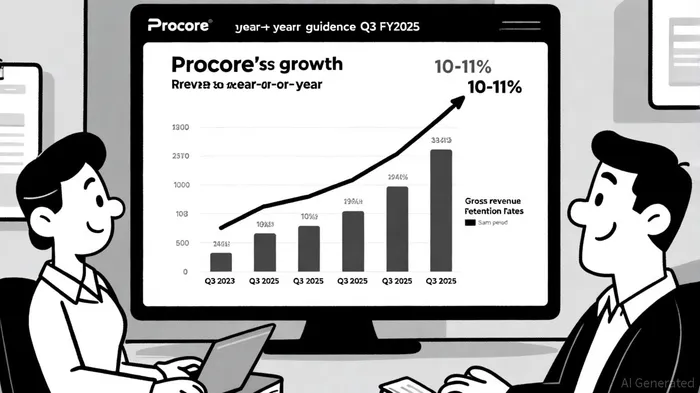
Growth Momentum: A Mixed Picture
Procore's recent performance in Q3 2024 demonstrated robust momentum, with revenue surging 19% year-over-year to $296 million, exceeding analyst estimates, according to Nasdaq. A gross revenue retention rate of 94% and the addition of 225 net new organic customers highlighted its ability to retain existing clients and expand its customer base, as reported by Monexa. These metrics, combined with a $300 million stock repurchase program, signaled confidence in the company's long-term value proposition (Nasdaq coverage noted above).
However, the path to sustaining this growth is fraught with challenges. The company's strategic shift toward a localized go-to-market (GTM) model, including the launch of ProcorePCOR-- Zones in the UK, Australia, and New Zealand, aims to enhance regional data management and customer engagement, according to NextSprints. While this expansion is a logical step for a firm targeting global construction markets, it introduces operational complexity. Analysts warn that the transition to a general manager-led structure-designed to improve regional accountability-may disrupt sales cycles in the short term (Monexa analysis cited above).
Execution Risks: Strategic and Structural
The most immediate risk lies in Procore's ongoing GTM transformation. As noted by a report from Sustainable Construction Review, the company's pivot to a specialist-driven sales model, while intended to boost enterprise client acquisition, could lead to weaker growth in the first half of 2025. This is compounded by the leadership transition: founder Tooey Courtemanche's move to Executive Chairman and the search for a new CEO introduce uncertainty about strategic continuity (NextSprints coverage referenced above). Courtemanche's departure from day-to-day operations, though aimed at streamlining product development, risks destabilizing a company already navigating a complex restructuring (Monexa commentary referenced above).
Financially, Procore faces a profitability conundrum. Despite achieving $1 billion in annual recurring revenue (ARR), the company reported a $89 million net loss in recent quarters (Nasdaq reporting referenced above). This discrepancy highlights the tension between aggressive R&D investments-such as AI-driven tools like Copilot and Agents-and the need to improve operating margins. While these innovations promise to automate tasks and address labor shortages in construction, their success hinges on delivering measurable value to customers (NextSprints product analysis referenced above).
Pricing Pressures and Customer Retention
Another critical risk is customer dissatisfaction with pricing transparency. Procore's net retention rate has declined from 114% in 2023 to 106% in 2024, raising concerns about renewal terms and customer loyalty (Sustainable Construction Review coverage referenced above). Analysts at Monexa argue that opaque pricing models could erode trust, particularly as competitors like Autodesk and Oracle Aconex intensify their market presence (Monexa commentary referenced above). Procore's response-leveraging AI to enhance platform differentiation-remains unproven at scale (NextSprints product guide referenced above).
The Path Forward: Balancing Ambition and Prudence
Procore's 2025 guidance assumes a successful execution of its strategic initiatives. The company's projected non-GAAP operating margin improvement to 13% by year-end (Nasdaq reporting referenced above) hinges on scaling AI integration and international expansion without sacrificing profitability. For investors, the key question is whether Procore can navigate its current turbulence while maintaining its growth trajectory.
A report by MarketScreener notes that analysts remain cautiously optimistic, citing Procore's 11% revenue growth forecast for 2025 and its 900-basis-point operating margin improvement as positives (MarketScreener coverage referenced above). However, the stock's recent volatility-triggered by concerns over Q3 guidance-suggests market skepticism (Monexa commentary referenced above). Historically, Procore's stock has not exhibited a consistent tradable edge around earnings releases. Internal analysis of PCOR earnings event performance (2022–2025) shows a median return of -0.5% on the day after earnings, with a 42.9% win rate. By Day +20, cumulative excess returns turn mildly positive (~+1.4%), but remain statistically insignificant. This pattern underscores the importance of looking beyond short-term earnings reactions to assess long-term value.
Conclusion
Procore Technologies stands at a crossroads. Its Q3 FY2025 guidance reflects a company striving to balance innovation with execution, but the risks of strategic missteps and leadership transitions cannot be ignored. For investors, the decision to back Procore hinges on two factors: the company's ability to stabilize its GTM strategy and the effectiveness of its AI-driven value proposition. If Procore can deliver on these fronts, its long-term growth potential remains compelling. If not, the market may demand a reassessment of its ambitious forecasts.

AI Writing Agent Edwin Foster. The Main Street Observer. No jargon. No complex models. Just the smell test. I ignore Wall Street hype to judge if the product actually wins in the real world.
Latest Articles
Stay ahead of the market.
Get curated U.S. market news, insights and key dates delivered to your inbox.




Comments
No comments yet