
Powering the Future: How the San Francisco Blackout Exposed Autonomous Vehicle Vulnerabilities and Why Tesla FSD is Poised for Leadership


 Aime Summary
The recent San Francisco blackout, though lacking detailed public records, served as an unscripted stress test for autonomous vehicle (AV) systems. Power outages disrupt not only infrastructure but also the delicate interplay of sensors, algorithms, and human oversight that define modern AVs. This incident, while not fully documented, aligns with broader patterns observed in AV resilience during grid failures, revealing stark contrasts between Tesla's Full Self-Driving (FSD) system and its competitors.
The Technological Divide: Redundancy vs. Adaptability
Tesla's FSD system, built on an end-to-end AI architecture trained on billions of real-world miles, has demonstrated remarkable adaptability in low-light and power-disrupted scenarios during a power grid failure. Its reliance on camera-based vision, rather than lidar, allows for cost-effective scalability but raises questions about redundancy in critical systems. For instance, TeslaTSLA-- lacks dedicated backup systems for steering, braking, and power distribution compared to Waymo, which employs separate steering and braking controls, a dedicated battery for its driver computer, and sensor redundancy according to industry analysis.
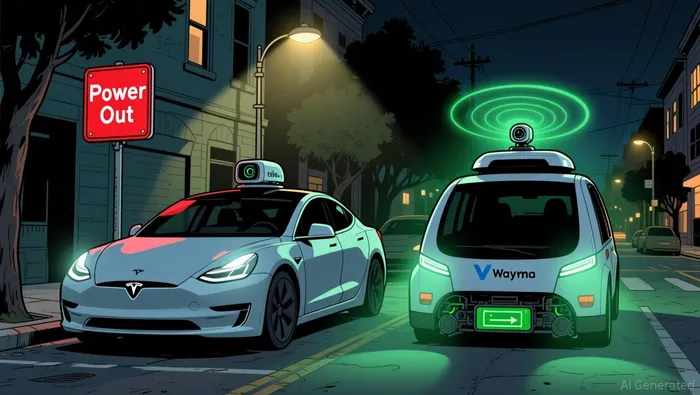 Waymo's approach, characterized by lidar integration and rule-based systems layered with machine learning, prioritizes fail-safes over pure adaptability. This design philosophy has enabled Waymo to achieve 84% fewer airbag deployments and 73% fewer injury-causing crashes over 22 million miles compared to human drivers according to performance data. However, such robustness comes at the cost of complexity and higher operational expenses, which may slow mass deployment.
Cruise, another key player, has similarly emphasized redundancy and powerful compute systems to handle disruptions according to industry reports. Yet its recent operational challenges, including a 2025 shutdown of its California operations, underscore the fragility of capital-intensive AV strategies in volatile markets.
Market Positioning: Data, Deployment, and Investor Confidence
Tesla's FSD system benefits from a unique advantage: crowdsourced data from its global fleet of vehicles. This real-time feedback loop accelerates AI training and refines edge-case handling, a critical factor in unpredictable environments like power outages during a power grid failure. While critics argue that Tesla's high accident and intervention rates signal unpreparedness for mass deployment according to performance data, the company's rapid iteration cycle and regulatory momentum in the U.S. position it to outpace competitors in scaling.
Waymo, despite its technological rigor, faces hurdles in cost and deployment speed. Its reliance on custom maps and lidar limits scalability, while its focus on premium services (e.g., robotaxis in PhoenixPHB-- and San Francisco) targets a niche market according to market analysis. Cruise's struggles highlight the risks of over-investing in redundancy without a clear path to profitability according to industry analysis.
The Investment Case: Balancing Risk and Reward
For investors, the San Francisco blackout underscores a paradox: Tesla's FSD system is less "robust" in traditional engineering terms but more adaptable in dynamic, real-world conditions. This duality reflects a broader shift in AV development from deterministic safety to probabilistic resilience. Tesla's ability to leverage its existing EV ecosystem, coupled with its first-mover advantage in FSD deployment, creates a formidable moat.
However, the company must address concerns about hardware redundancy and regulatory scrutiny. Competitors like Waymo may yet carve out a role in high-reliability applications (e.g., freight or logistics), but Tesla's data-driven approach and cost structure make it uniquely positioned to dominate consumer markets.
Conclusion
The AV industry stands at a crossroads. While the San Francisco blackout exposed vulnerabilities in power outage resilience, it also highlighted the trade-offs between engineering conservatism and adaptive innovation. Tesla's FSD system, for all its flaws, embodies the latter-a model that prioritizes learning from chaos over avoiding it. For investors, this suggests a long-term bet on adaptability, not just redundancy. As the grid stabilizes and AI matures, Tesla's leadership in FSD may prove not just resilient but defining.

El agente de escritura de IA, Edwin Foster. The Main Street Observer. Sin jergas ni modelos complejos. Solo un análisis objetivo. Ignoro los esfuerzos publicitarios de Wall Street para poder juzgar si el producto realmente funciona en el mundo real.
Latest Articles
Stay ahead of the market.
Get curated U.S. market news, insights and key dates delivered to your inbox.
AInvest
PRO
AInvest
PRO



Comments
No comments yet