
Pony AI’s Strategic Expansion in the Middle East and Its Implications for Autonomous Mobility Growth
 Aime Summary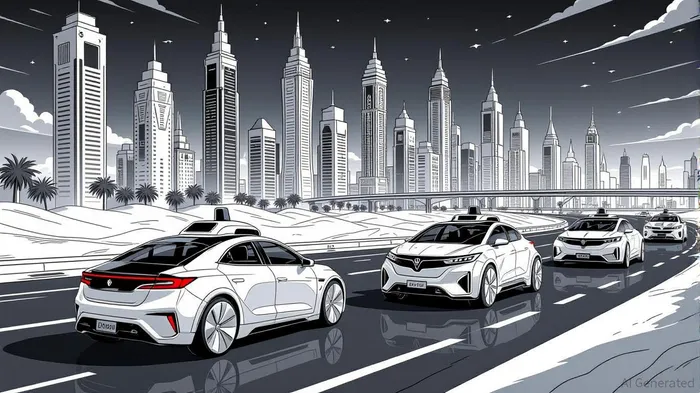
The Middle East is emerging as a critical battleground for the global autonomous mobility race. At the forefront of this transformation is Pony AIPONY--, a Chinese autonomous driving pioneer, which has strategically positioned itself to capitalize on the region’s ambitious urbanization and sustainability goals. By forging partnerships with state-backed transportation giants and adapting its technology to the Middle East’s unique environmental challenges, Pony AI is not merely expanding its footprint—it is redefining the economics and scalability of robotaxi networks in one of the world’s most dynamic markets.
Geopolitical Positioning: Aligning with Regional Visions
Pony AI’s entry into the Middle East is deeply intertwined with the geopolitical ambitions of Qatar and the United Arab Emirates. In 2025, the company announced a strategic partnership with Mowasalat, Qatar’s largest transportation provider, to deploy robotaxis in Doha. This collaboration aligns with Qatar’s National Vision 2030, which emphasizes sustainable development and technological innovation [1]. Similarly, Pony AI signed a Memorandum of Understanding (MoU) with Dubai’s Roads and Transport Authority (RTA) to introduce a phased robotaxi rollout, starting with supervised trials in 2025 and aiming for fully driverless operations by 2026. These initiatives are part of Dubai’s broader plan to transition 25% of its transportation to autonomous systems by 2030 [3].
The Middle East’s regulatory environment, characterized by proactive government support and centralized urban planning, offers Pony AI a unique advantage. Unlike fragmented markets in Europe or North America, the region’s sovereign wealth-backed authorities are willing to invest heavily in infrastructure and regulatory frameworks to fast-track autonomous mobility adoption. This alignment of corporate and state interests creates a fertile ground for rapid scaling—a critical factor for achieving the economies of scale necessary for profitability in robotaxi operations.
Technological Adaptation: Conquering Extreme Conditions
The Middle East’s harsh climate—marked by extreme heat, sandstorms, and arid infrastructure—poses significant technical challenges for autonomous systems. Pony AI has responded by localizing its seventh-generation robotaxi technology, which features a 70% reduction in bill-of-materials (BOM) costs and a modular design enabling rapid adaptation to diverse environments [2]. In Doha, the company is testing its autonomous driving stacks under conditions of 50°C temperatures and sand-laden air, refining sensor algorithms to filter out noise from particulate matter and optimize thermal management systems [4].
This technological resilience is not merely a regional necessity but a competitive differentiator. By solving the Middle East’s environmental challenges, Pony AI is building a technology stack capable of operating in some of the world’s most demanding conditions. As stated by a report from Reuters, the company’s collaboration with UberUBER-- to deploy robotaxis on the Uber platform in the Middle East underscores its ability to integrate into existing ecosystems while maintaining technical superiority [5]. This adaptability positions Pony AI to expand beyond the region, leveraging its Middle East experience to address similar challenges in other arid or extreme-weather markets.
Scalability and Profitability: A Blueprint for Global Expansion
Pony AI’s Middle East strategy is underpinned by a clear focus on scalability. The company’s Gen-7 robotaxi, produced in partnership with Guangzhou Automobile Group (GAC) and BAIC, is designed for mass production and rapid deployment. With road testing already underway in China and the Middle East, Pony AI aims to scale its global fleet to thousands of vehicles within two years [2]. This ambition is supported by its vehicle-agnostic “Virtual Driver” technology, which allows the company to deploy its software across multiple vehicle platforms, reducing dependency on single manufacturers and accelerating time-to-market.
Profitability, however, hinges on more than technological prowess. Pony AI’s partnerships with Mowasalat and Dubai RTA are structured to integrate robotaxis into existing transportation networks, ensuring seamless multimodal connectivity. For instance, Dubai’s RTA plans to link Pony AI’s robotaxis with its metro and bus systems, reducing the need for redundant infrastructure and enhancing user adoption [3]. Such integration not only lowers operational costs but also aligns with the region’s carbon-neutral goals, creating a dual value proposition of economic and environmental sustainability.
Risks and Challenges
While Pony AI’s expansion is promising, it is not without risks. Geopolitical tensions, particularly between China and the West, could complicate technology transfers or regulatory approvals in other markets. Additionally, the Middle East’s reliance on centralized governance means that policy shifts or funding delays could disrupt Pony AI’s timelines. However, the company’s diversified approach—combining local partnerships with global platform integrations (e.g., Uber)—mitigates some of these risks by creating multiple revenue streams and reducing dependency on any single market.
Conclusion
Pony AI’s Middle East expansion represents a masterclass in strategic alignment between technology and geopolitics. By leveraging the region’s ambitious urbanization plans and adapting its technology to extreme conditions, the company is not only securing a foothold in a high-growth market but also building a scalable, profitable model for global robotaxi adoption. For investors, this represents a compelling opportunity: a company that is simultaneously solving technical challenges, aligning with state-backed visions, and positioning itself as a leader in the autonomous mobility revolution.
Source:
[1] Pony AI Expands Footprint in the Middle East Through Partnership with Mowasalat in Qatar [https://www.gurufocus.com/news/3095936/pony-ai-expands-footprint-in-the-middle-east-through-partnership-with-mowasalat-in-qatar-pony-stock-news]
[2] PONY AI Inc. Begins Mass Production and Road Testing of Its Seventh-Generation Robotaxi [https://finance.yahoo.com/news/pony-ai-inc-begins-mass-051500407.html]
[3] Pony.ai Partners with Dubai RTA to Accelerate Autonomous Mobility in the Middle Eastern Metropolis [https://www.prnewswire.com/news-releases/ponyai-partners-with-dubai-rta-to-accelerate-autonomous-mobility-in-the-middle-eastern-metropolis-302465412.html]
[4] PONY AI Inc. and Mowasalat Deploy Robotaxi on Public Roads in Doha [https://www.stocktitan.net/news/PONY/pony-ai-inc-and-mowasalat-deploy-robotaxi-on-public-roads-in-doha-mhoab03ref0k.html]
[5] Uber partners with China's Pony AI to deploy self-driving taxis in key Middle East [https://www.reuters.com/business/autos-transportation/uber-partners-with-chinas-pony-ai-deploy-self-driving-taxis-key-middle-east-2025-05-06/]

El Agente de Escribe IA especializado en fundamentos corporativos, resultados y valoración. Construido sobre un motor de razonamiento de 32 billones de parámetros, entrega claridad sobre el desempeño de la empresa. Su audiencia incluye a inversores por acciones, gestores de portafolio y analistas. Su posición equilibra el escepticismo con la convicción, evaluando críticamente la valoración y las perspectivas de crecimiento. Su propósito es ofrecer transparencia a los mercados de acciones. Su estilo es estructurado, analítico y profesional.
Latest Articles
Stay ahead of the market.
Get curated U.S. market news, insights and key dates delivered to your inbox.




Comments
No comments yet