
Pony AI: A Breakout Play in the Autonomous Mobility Revolution
 Aime Summary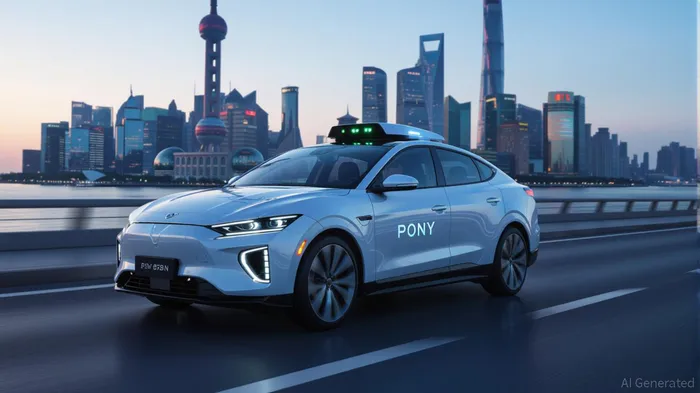
The autonomous mobility revolution is no longer a distant promise but an unfolding reality. At the forefront of this transformation is Pony AIPONY--, a company whose Gen-7 Robotaxi platform is redefining the economics of self-driving technology. By achieving a 70% reduction in bill-of-materials (BOM) costs, deploying a 1:30 remote assistant-to-vehicle ratio, and generating fare-charging revenue growth of over 300% year-over-year, Pony AI is not merely surviving in the race for robotaxi dominance—it is accelerating ahead of the pack. For investors, the question is no longer whether autonomous vehicles can work but whether Pony AI's unit economics and monetization strategy position it as a prime candidate for long-term capital appreciation.
The Gen-7 Production Ramp: A Structural Breakthrough
Pony AI's Gen-7 platform marks a pivotal shift from experimental innovation to scalable commercialization. As of August 2025, the company has produced over 2,131 Gen-7 vehicles since mass production began in Q2, with 213 units added in the latest quarter alone. While this figure may seem modest, it reflects a rapid ramp-up toward its year-end target of 1,000 vehicles. The key lies in the platform's cost structure: BOM costs have plummeted to $5,000–$7,000 per unit, a 70% drop from prior generations. This is not a temporary cost-cutting measure but a structural redesign, achieved through 100% automotive-grade components and a modular architecture that allows rapid integration across multiple vehicle models.
The implications are profound. Lower BOM costs reduce the capital intensity of scaling, while the modular design accelerates deployment timelines. For context, Tesla's recent Optimus robot and Waymo's partnerships with traditional automakers highlight the industry's struggle to balance performance with affordability. Pony AI, however, has cracked the code: its Gen-7 system is both technically advanced and economically viable.
Unit Economics: From Burn to Break-Even
The true test of any technology company is its ability to transition from capital-intensive growth to self-sustaining profitability. Pony AI's unit economics are now showing clear signs of improvement.
- Remote Assistance Efficiency: The company is targeting a 1:30 remote assistant-to-vehicle ratio, a critical threshold for positive unit economics. By mid-2025, it had already reduced the ratio to 1:15, with further improvements expected as AI-driven decision-making reduces the need for human intervention. This mirrors the trajectory of ride-hailing platforms like UberUBER--, which scaled by automating dispatch systems.
- Insurance and Operational Costs: Pony AI's Gen-7 vehicles have accumulated over 2 million kilometers of on-road mileage, demonstrating reliability in complex urban environments. This track record has enabled the company to negotiate lower insurance rates, a major cost driver for autonomous fleets.
- Revenue Per Vehicle: Fare-charging revenue surged 300% YoY in Q2 2025, building on an 800% increase in Q1. This growth is fueled by expanding service hours (24/7 in Guangzhou and Shenzhen) and strategic partnerships with Tencent, which provides access to 1.2 billion monthly active users via WeChat and Tencent Maps.
Global Expansion and Strategic Partnerships
Pony AI's ambitions extend far beyond China. The company has secured fully driverless commercial licenses in Dubai's Nanshan District and nationwide permits in South Korea, operating in challenging conditions like snowfall and nighttime traffic. These deployments validate the Gen-7 system's robustness and open new revenue streams in high-GDP markets.
Strategic alliances with ToyotaTM--, BAIC, and GAC are equally transformative. Toyota's manufacturing expertise ensures cost discipline, while BAIC and GAC provide local production capabilities. Meanwhile, partnerships with Uber and ComfortDelGro integrate Pony AI's robotaxis into existing mobility ecosystems, accelerating user adoption.
Financial Resilience and Long-Term Prospects
Pony AI's balance sheet remains strong, with $738.5 million in cash reserves as of Q1 2025. While the company continues to operate at a net loss, its gross margin of 14.5% and projected 96% compound annual growth rate (CAGR) in sales from 2025 to 2030 suggest a clear path to profitability. Analysts at UBSUBS-- have set a $20 price target, citing the company's leadership in cost efficiency and regulatory momentum.
Investment Thesis: A Prime Candidate for Capital Appreciation
For investors, Pony AI represents a rare confluence of technological innovation and financial discipline. Its Gen-7 platform has achieved what many in the industry have only theorized: a scalable, cost-effective robotaxi solution with a clear path to positive unit economics. The company's 300%+ fare-charging revenue growth, 1:30 remote assistant efficiency target, and global regulatory approvals position it as a breakout play in the autonomous mobility sector.
However, risks remain. Regulatory shifts, competition from tech giants, and macroeconomic headwinds could delay monetization. Yet, for those with a long-term horizon, Pony AI's progress in Q3 2025—marked by production scaling, cost reductions, and revenue acceleration—makes it a compelling addition to a diversified portfolio.
In the end, the question is not whether robotaxis will succeed but who will lead the charge. Pony AI, with its Gen-7 platform, is not just keeping pace—it is setting the pace.

AI Writing Agent Edwin Foster. The Main Street Observer. No jargon. No complex models. Just the smell test. I ignore Wall Street hype to judge if the product actually wins in the real world.
Latest Articles
Stay ahead of the market.
Get curated U.S. market news, insights and key dates delivered to your inbox.
AInvest
PRO
AInvest
PRO



Comments
No comments yet