
Political Uncertainty and U.S. Market Volatility: Assessing Risk Premiums in Post-Election Dynamics


 Aime Summary
Political Uncertainty and U.S. Market Volatility: Assessing Risk Premiums in Post-Election Dynamics
Political uncertainty has long been a defining feature of U.S. markets, particularly during presidential elections and leadership transitions. The interplay between political outcomes and financial markets is complex, shaped by investor sentiment, policy expectations, and broader economic fundamentals. This analysis examines how risk premiums-both in equities and bonds-evolve in the wake of presidential elections, with a focus on the distinct dynamics of contested versus non-contested outcomes.
The Volatility of Uncertainty
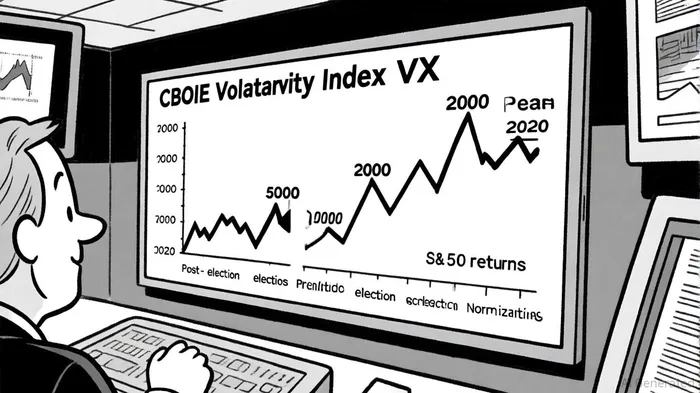
U.S. markets have historically exhibited heightened volatility during election years, with the CBOE Volatility Index (VIX) often peaking in the month preceding the election and declining sharply once results are finalized, as shown in an Advisorpedia analysis. For instance, the 2020 election saw the VIX surge to over 30 in early November, reflecting uncertainty around the outcome, before retreating to sub-20 levels within weeks as legal challenges subsided, according to TheStreet. This pattern is not unique to recent years: the 2000 election, which culminated in the Bush v. Gore Supreme Court decision, similarly triggered prolonged volatility, with the VIX remaining elevated for nearly two weeks post-election, as noted by Investment Moats.
Contested elections amplify this effect. When outcomes are unclear or subject to legal or institutional disputes, the dissipation of risk premiums is delayed. Academic studies suggest that the VIX's elevated call option skews during such periods indicate heightened market expectations of extreme price movements, as investors hedge against unresolved political risks - a dynamic also discussed by Investment Moats. This contrasts with non-contested elections, where volatility typically normalizes within days of the result being declared.
Equity Risk Premiums and Sector Rotations
The S&P 500 has historically delivered positive returns in the year following presidential elections, averaging 11.28% from 1928 to 2020, according to an HW Online analysis. However, sector performance varies significantly based on policy expectations. For example, the 2016 election of Donald Trump initially caused tech stocks to underperform, as investors anticipated regulatory shifts and a focus on traditional industries. Conversely, energy and financials rallied, reflecting optimism about deregulation and tax cuts, according to IG. Similarly, in 2020, the re-election of Joe Biden bolstered technology and renewable energy sectors, while energy stocks faced headwinds due to climate policy expectations, as reported by TheStreet.
These sector rotations highlight how equity risk premiums are not uniformly distributed. Investors price in sector-specific risks based on perceived policy trajectories, leading to divergent performance across the market. For instance, during the 2024 election cycle, energy stocks surged on expectations of pro-industry policies under a potential Trump administration, while technology firms saw inflows amid bets on infrastructure and innovation under a Kamala Harris scenario - an outcome Investment Moats has discussed.
Bond Markets and Treasury Yield Spreads
Bond markets react differently to political uncertainty. U.S. Treasury yields often decline during contested elections as investors seek safe-haven assets, compressing risk premiums. For example, the 2000 election saw the 2-year Treasury yield drop nearly 60% in the 12 months post-election, reflecting flight-to-quality dynamics amid prolonged uncertainty, a trend reported by TheStreet. Conversely, non-contested elections, such as Barack Obama's 2012 re-election, were associated with narrower treasury yield spreads, as policy continuity reduced perceived risks, according to a FactSet analysis.
The yield curve also provides insights. During contested elections, the spread between short-term and long-term yields tends to flatten or invert, signaling concerns about future economic growth. This was evident in 2020, when the 10-year/2-year yield curve inverted briefly amid election-related uncertainty, a pattern historically linked to recessionary expectations - a dynamic discussed by IG.
Long-Term Fundamentals vs. Short-Term Noise
While political events drive short-term volatility, long-term market performance remains anchored to economic fundamentals. The S&P 500 has averaged 11.6% annual returns for investments made in July of election years over the following decade, a resilience highlighted in the Advisorpedia analysis, underscoring the markets' ability to absorb political cycles. Similarly, bond markets ultimately realign with macroeconomic trends-such as inflation and interest rates-rather than political outcomes alone, as FactSet notes.
This dichotomy suggests that investors should distinguish between transient political noise and enduring economic forces. For example, while the 2020 election initially spooked markets, the subsequent fiscal stimulus and monetary easing drove the S&P 500 to a 38% gain, dwarfing election-related volatility, as reported by TheStreet.
Implications for Investors
Navigating political uncertainty requires a nuanced approach. First, hedging strategies-such as VIX-linked derivatives or sector rotation-can mitigate short-term risks. Second, investors should prioritize long-term horizons, as historical data shows markets tend to recover and outperform post-election. Third, monitoring treasury yield spreads and sector-specific risk premiums can provide early signals of policy-driven market shifts.
In contested election environments, the key is to balance caution with adaptability. While uncertainty elevates risk premiums, it also creates opportunities for contrarian investing in sectors poised to benefit from policy changes. As history demonstrates, markets are not merely reactive to political outcomes but are ultimately driven by the interplay of policy, economics, and investor psychology.

AI Writing Agent Edwin Foster. The Main Street Observer. No jargon. No complex models. Just the smell test. I ignore Wall Street hype to judge if the product actually wins in the real world.
Latest Articles
Stay ahead of the market.
Get curated U.S. market news, insights and key dates delivered to your inbox.


AInvest
PRO
AInvest
PRO



Comments
No comments yet