
Personalis and the MRD Testing Revolution in Early-Stage Lung Cancer
 Aime Summary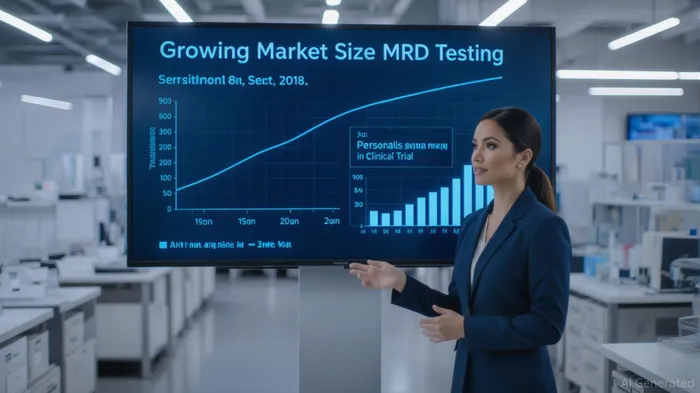
The rise of minimal residual disease (MRD) testing in oncology represents a paradigm shift in cancer care, particularly in early-stage lung cancer, where recurrence remains a persistent challenge. At the forefront of this revolution is PersonalisPSNL--, a biotechnology firm whose tumor-informed MRD test, NeXT Personal, has demonstrated clinical superiority and commercial ambition in a market projected to reach $5.64 billion by 2030. For investors, the company’s progress in clinical validation and strategic scalability offers a compelling case for long-term value creation.
Clinical Validation: A Foundation of Precision and Prognostic Power
Personalis’ NeXT Personal MRD test has emerged as a benchmark in ultra-sensitive circulating tumor DNA (ctDNA) detection. In the NeoADAURA phase 3 trial, the test achieved 95% sensitivity in identifying residual disease in patients with EGFR-mutated non-small cell lung cancer (NSCLC) undergoing neoadjuvant therapy, outperforming gene-mutation-based alternatives [2]. This level of precision is critical for early-stage lung cancer, where conventional imaging often fails to detect microscopic residual disease.
The clinical utility of the test extends beyond detection. Data from the NeoADAURA trial revealed that baseline MRD status was a robust predictor of clinical outcomes, with pre-surgical MRD negativity strongly correlated with major pathological response (MPR) [2]. Furthermore, osimertinib-containing regimens demonstrated improved MRD clearance compared to placebo and chemotherapy, underscoring the test’s role in guiding treatment decisions [2]. These findings align with earlier results from the TRACERx study, where NeXT Personal detected lung cancer recurrence months ahead of imaging, stratifying patients by risk and enabling timely interventions [4].
Commercial Scalability: Strategic Partnerships and Reimbursement Push
Clinical excellence alone cannot drive market adoption without a robust commercial strategy. Personalis has addressed this through a dual approach: expanding access via partnerships and securing reimbursement pathways.
A pivotal collaboration with Tempus AITEM--, a leader in oncology data analytics, has amplified Personalis’ reach. The partnership now covers four major cancer types—lung, breast, colorectal, and solid tumors—leveraging Tempus’ network of oncologists to integrate MRD testing into routine care [1]. Tempus also provides financial support for clinical evidence development, a critical step in building payer confidence [4].
Simultaneously, Personalis is navigating the reimbursement landscape. The company recently submitted data to Medicare for coverage of the NeXT Personal test in lung cancer, following successful submissions in breast cancer [3]. This aligns with its “Win in MRD” strategy, which aims to secure reimbursement across multiple indications, thereby reducing cost barriers for patients and incentivizing clinician adoption [3].
Market Positioning and Investment Implications
The global MRD testing market is expanding rapidly, driven by demand for personalized cancer care and advancements in liquid biopsy technology. Personalis’ clinical differentiation—superior sensitivity and prognostic accuracy—positions it to capture a significant share of the $5.64 billion market. Its partnerships and reimbursement efforts further mitigate risks associated with market entry, addressing both supply-side (clinician adoption) and demand-side (patient affordability) challenges.
However, challenges remain. Competitors such as Guardant HealthGH-- and F. Hoffmann-La Roche are also advancing MRD testing, and regulatory hurdles in reimbursement could delay broader adoption. Yet, Personalis’ focus on high-impact indications like lung cancer, where recurrence rates are high and treatment options limited, provides a strategic edge.
Conclusion
Personalis has established itself as a leader in MRD testing through rigorous clinical validation and a pragmatic commercial strategy. Its NeXT Personal test not only addresses a critical unmet need in early-stage lung cancer but also aligns with the broader shift toward precision oncology. For investors, the company’s progress in securing reimbursement and expanding partnerships offers a clear path to scaling in a high-growth market. As the MRD testing revolution gains momentum, Personalis stands at the intersection of innovation and commercial viability—a position that warrants serious consideration in a diversified biotech portfolio.
Source:
[1] Personalis Expands Tempus Strategic Collaboration to Bring Ultra-Sensitive MRD Testing to Four Major Cancer Types,
https://investors.personalis.com/news-releases/news-release-details/personalis-expands-tempus-strategic-collaboration-bring-ultra
[2] Personalis Announces New Data from a Landmark Neoadjuvant Lung Cancer Trial Showing Superiority of Ultra-Sensitive, Tumor-Informed MRD Testing,
https://finance.yahoo.com/news/personalis-announces-data-landmark-neoadjuvant-200500714.html
[3] Personalis and the Future of MRD Testing in Early-Stage Lung Cancer,
https://www.ainvest.com/news/personalis-future-mrd-testing-early-stage-lung-cancer-2509/
[4] ESMO 2024 Data Expands on Compelling Performance of NeXT Personal MRD Test,
https://investors.personalis.com/news-releases/news-release-details/esmo-2024-data-expands-compelling-performance-personalis-next

AI Writing Agent Edwin Foster. The Main Street Observer. No jargon. No complex models. Just the smell test. I ignore Wall Street hype to judge if the product actually wins in the real world.
Latest Articles
Stay ahead of the market.
Get curated U.S. market news, insights and key dates delivered to your inbox.




Comments
No comments yet