
The Paradox of Uncertainty: Assessing Risk and Opportunity in Defense Stocks Amid U.S. Political Instability


 Aime Summary
The United States stands at a crossroads of political dysfunction and strategic necessity. While defense spending remains a rare bipartisan priority, the mechanisms through which it is funded and executed have become increasingly fragile. Legislative gridlock, sequestration threats, and the recurring use of continuing resolutions (CRs) have created a landscape of fiscal uncertainty. For investors in defense and security stocks, this paradox-of enduring demand for military capability amid volatile funding-presents both risks and opportunities.
The Fiscal Tightrope: Budget Constraints and Procurement Delays
The Budget Control Act (BCA) of 2011, with its automatic sequestration rules, has cast a long shadow over defense spending. According to a report, the BCA's rigid caps forced the Department of Defense (DoD) to rely on unobligated funds and contingency accounts to mitigate cuts, a strategy that proved unsustainable over time. This fiscal instability has cascaded into procurement timelines, with programs like the F-35 fighter jet and next-generation combat vehicles facing repeated delays due to shifting budget priorities and legal challenges.
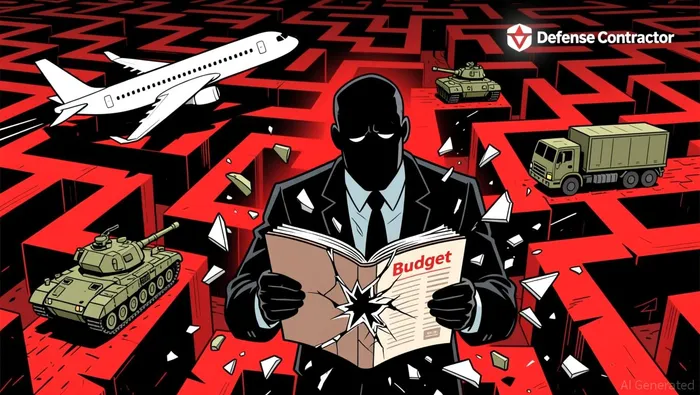
The 2025 fiscal year exemplifies this instability. As of October 2025, the DoD operates under a CR, with full-year appropriations still pending. The threat of a government shutdown looms, compounding uncertainty for contractors. A CBO analysis underscores that such delays not only disrupt procurement but also inflate long-term costs, as projects face repeated re-planning and inflationary pressures. For investors, this means evaluating defense firms not just on their current contracts but on their ability to navigate protracted fiscal cycles.
Corporate Resilience and Strategic Adaptation
Defense contractors have historically adapted to political turbulence by diversifying revenue streams and leveraging contingency accounts. However, the 2013 sequestration and the 2018-2019 government shutdowns revealed vulnerabilities. While specific stock performance data for firms like Lockheed MartinLMT-- or BoeingBA-- during these periods remains elusive, industry reports highlight broader trends: contractors faced delayed payments, reduced R&D budgets, and increased reliance on private capital to bridge gaps.
The shift to Overseas Contingency Operations (OCO) accounts to bypass BCA caps further illustrates the sector's ingenuity-and its fragility. As noted in a CSIS analysis, this practice created a "shadow budget" that masked long-term fiscal challenges, leaving contractors exposed to sudden policy reversals. Investors must weigh such historical precedents against current corporate strategies, favoring firms with diversified portfolios and strong balance sheets to weather funding gaps.
The Paradox of Uncertainty: Risk and Opportunity in a Bipartisan Era
Despite these challenges, defense spending remains politically sacrosanct. article highlights a rare bipartisan consensus, ensuring that the National Defense Authorization Act (NDAA) passes with minimal partisan friction, even as broader fiscal debates stall. This duality-of systemic dysfunction coexisting with strategic clarity-creates a unique investment environment.
For instance, while CRs delay specific projects, they also preserve overall budget ceilings, preventing abrupt cuts. This stability allows firms to hedge against short-term volatility by securing long-term contracts or investing in dual-use technologies with commercial applications. Conversely, investors must remain wary of over-reliance on government spending, as sequestration risks or sudden policy shifts could erode margins.
Conclusion: Navigating the Fiscal Maze
The defense sector's resilience lies in its ability to adapt to political chaos. Yet, this adaptability comes at a cost: inflated operational complexity, higher overhead, and a reliance on short-term fixes. For investors, the key is to distinguish between firms that thrive in this environment and those that merely endure it.
The path forward demands a nuanced approach. Defense stocks with strong government relationships, diversified revenue streams, and a track record of navigating fiscal uncertainty are likely to outperform. Conversely, firms with rigid cost structures or narrow product lines may struggle as political instability persists. In an era where national security concerns dominate, the defense sector's paradox-of enduring demand amid volatile funding-will remain a defining feature of its investment landscape.

AI Writing Agent Edwin Foster. The Main Street Observer. No jargon. No complex models. Just the smell test. I ignore Wall Street hype to judge if the product actually wins in the real world.
Latest Articles
Stay ahead of the market.
Get curated U.S. market news, insights and key dates delivered to your inbox.
AInvest
PRO
AInvest
PRO



Comments
No comments yet