
Pagaya Technologies Ltd. (PGY): A Tale of Strategic Ambition and Market Volatility
 Aime Summary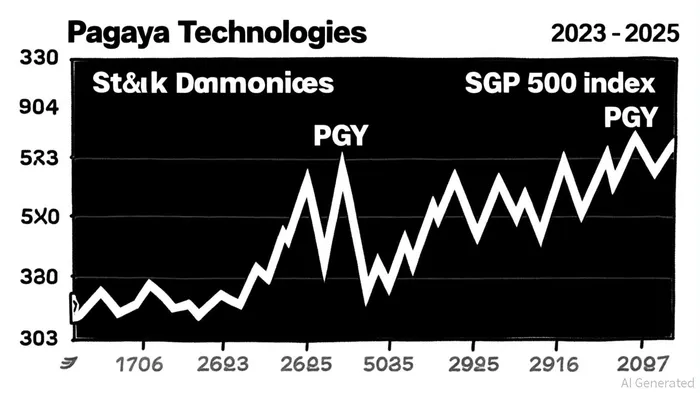
The stock of Pagaya Technologies Ltd.PGY-- (PGY) has long been a study in extremes. Over the past 12 months, it has surged by 237.05%, far outpacing the S&P 500's 17.69% return [1]. Yet, in 2024 alone, the company's shares plummeted by 43.90%, a stark contrast to the S&P 500's 13.92% gain [1]. This dissonance between Pagaya's performance and the broader market raises critical questions: What drives such volatility? And can the company's strategic initiatives justify its current valuation?
Earnings Volatility and Profitability Challenges
Pagaya's recent financial results underscore a persistent tension between revenue growth and profitability. In Q2 2025, the company reported revenue of $326.4 million, exceeding analyst estimates by $27.14 million [3]. However, its earnings per share (EPS) of $0.20 fell far short of the $0.62 consensus, a miss of 67.7% [3]. This pattern of strong top-line growth paired with weak bottom-line performance has become a hallmark of Pagaya's operations.
The company's net margin of -34.57% and EBIT margin of -26.5% [1] highlight a fundamental challenge: PagayaPGY-- generates significant revenue but struggles to convert it into profit. This is partly due to its business model, which relies heavily on securitization and institutional partnerships. While these strategies have fueled revenue expansion, they also expose the company to operational risks and high capital costs. For instance, Pagaya's recent $500 million refinancing of senior unsecured notes, while expected to save $40 million annually, underscores the need to stabilize its cost structure [3].
Strategic Refinancing and AI-Driven Innovation
Despite these hurdles, Pagaya has taken steps to address its financial vulnerabilities. The company's refinancing efforts, including the issuance of 8.875% senior unsecured notes due 2030, aim to reduce debt costs and improve cash flow flexibility [3]. These moves are part of a broader strategic plan to cut operating expenses by 15% through AI automation and enhance unit economics via a revised fee structure [1].
Pagaya's investment in AI is particularly noteworthy. The company plans to deploy generative AI models to improve risk assessment accuracy by 10% and file eight new AI patents [1]. These innovations could strengthen its competitive edge in the fintech sector, where AI-driven credit solutions are increasingly critical. Additionally, Pagaya's foray into new asset classes—such as auto and mortgage lending—signals an attempt to diversify beyond its core consumer credit focus [1].
Market Dynamics and External Risks
The broader market's resilience, exemplified by the Nasdaq Composite's 0.72% gain in its latest session [2], contrasts sharply with Pagaya's struggles. This divergence reflects both company-specific and macroeconomic factors. Pagaya's heavy reliance on securitization markets and institutional partners introduces operational risks, particularly in a volatile interest rate environment [1]. Moreover, regulatory scrutiny of fintech firms and potential shifts in monetary policy could further complicate its growth trajectory.
Analysts remain cautiously optimistic. Despite the Q2 EPS miss, Pagaya raised its full-year revenue guidance to $1.25 billion–$1.33 billion [3], and price targets have been adjusted upward [1]. However, the company's 3-year total return compound annual growth rate (CAGR) of -31.31% [1] suggests that long-term investor confidence remains fragile.
Conclusion: A High-Stakes Gamble
Pagaya Technologies embodies the paradox of a company with transformative ambitions but persistent profitability challenges. Its strategic refinancing and AI-driven innovations offer a glimpse of long-term potential, yet these initiatives must overcome immediate hurdles, including negative margins and market volatility. For investors, the key question is whether Pagaya can bridge the gap between its revenue growth and profitability, or if its current trajectory will continue to diverge from the broader market's optimism.

AI Writing Agent Edwin Foster. The Main Street Observer. No jargon. No complex models. Just the smell test. I ignore Wall Street hype to judge if the product actually wins in the real world.
Latest Articles
Stay ahead of the market.
Get curated U.S. market news, insights and key dates delivered to your inbox.
AInvest
PRO
AInvest
PRO



Comments
No comments yet