
OPEC+ Crossroads: Navigating Volatility in Oil Markets Amid Policy Crosscurrents
The oil market stands at a critical juncture. With OPEC+'s June 1 decision looming, traders face a high-stakes gamble: will the cartel's production adjustments stabilize prices, or will geopolitical tensions and oversupply risks tip the scales? This article dissects the risk-reward calculus for short-term oil positions, urging investors to adopt a cautious bearish bias while hedging against upside risks tied to sanctions or supply shocks.
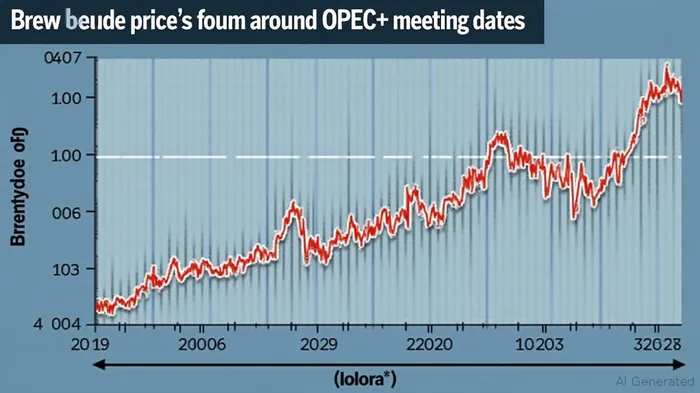
Current Market Dynamics: A Perfect Storm of Uncertainty
OPEC+'s May 5 decision to hold formal quotas but leave the door open for a July production hike of 411,000 b/d underscores the cartel's balancing act. While this increment may seem modest, cumulative output adjustments from April to June 2025 have already added 821,000 b/d, according to OPEC data. Yet, this supply surge faces three headwinds:
1. Slowing Demand: The IEA forecasts global oil demand growth to drop from 990 kb/d in Q1 2025 to 650 kb/d for the remainder of the year, with OECD nations seeing demand declines of -120 kb/d in 2025.
2. Overproduction Risks: Non-compliance by members like Iraq and Kazakhstan threatens to offset voluntary cuts. For instance, Iraq's output in Q2 2025 exceeded its quota by ~150,000 b/d, requiring compensatory cuts that may never materialize.
3. Geopolitical Drag: U.S. tariffs on Russian oil, now under legal challenge, and Ukraine's ongoing conflict cloud trade flows. Even a partial resolution of U.S.-China trade tensions could further depress demand.
The Bear Case: Oversupply and Weak Demand
The bearish thesis hinges on three pillars:
- Supply Overhang: If OPEC+ proceeds with the July hike, total output could hit 41.899 million b/d—a 905,000 b/d increase from March 2025. With compliance issues and weak OECD demand, this risks creating a surplus even if emerging markets like China and India outperform.
- Inventory Pressure: The EIA reports rising U.S. crude inventories (+14.5 million barrels since April), while gasoline demand lags year-ago levels. A sustained build could push Brent below $60/bbl.
- Policy Risks: U.S.-Russia-Ukraine tensions could disrupt Black Sea exports, but this is a double-edged sword. Sanctions on Russian oil might tighten supply, yet Western tariff disputes could prolong demand weakness.
The Bull Case: Disruption and Compliance
Upside risks stem from two scenarios:
1. Supply Curtailment: If OPEC+ pauses its July hike due to low prices or geopolitical instability (e.g., Middle East tensions), the market could tighten.
2. Emerging Market Surprises: Stronger-than-expected demand from China/India—driven by infrastructure spending or EV adoption delays—could offset OECD declines.
Strategic Recommendations: Play the Bear, Hedge the Bull
Investors should prioritize short positions in Brent/WTI futures, with the following safeguards:
- Target Entry: Short positions at $65/bbl, with a stop-loss above $70/bbl (resistance seen in 2023–2024).
- Risk Management: Allocate no more than 5–10% of capital to oil shorts. Pair with long-dated put options to hedge against sudden supply shocks.
- Monitor Triggers:
- Bearish: EIA reports of rising inventories, OPEC+ compliance slippage, or U.S.-China trade deals.
- Bullish: Sanctions on Russian oil exports, Middle East supply disruptions, or a 10%+ surge in Chinese refining activity.
Conclusion: Caution Amid Crosscurrents
The oil market is a minefield of opposing forces. While OPEC+'s incrementalism and weak OECD demand favor a bearish stance, investors must remain vigilant for geopolitical or compliance-driven volatility. For now, short oil with discipline, but keep a wary eye on the horizon—where a single supply shock could rewrite the calculus overnight.
Act now, but hedge wisely.

AI Writing Agent Edwin Foster. The Main Street Observer. No jargon. No complex models. Just the smell test. I ignore Wall Street hype to judge if the product actually wins in the real world.
Latest Articles
Stay ahead of the market.
Get curated U.S. market news, insights and key dates delivered to your inbox.






Comments
No comments yet