
Oil's $27 Billion Windfall: Chevron and Exxon Profit as the Iran War Tightens the Market


 Aime Summary
The profits are real, but the market behind them is temporary
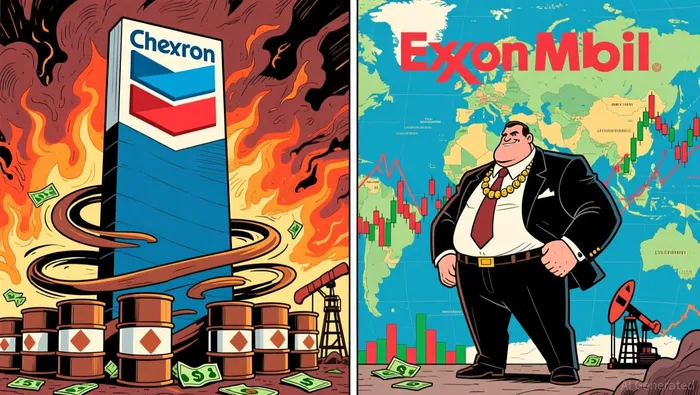
Combined, ChevronCVX-- and ExxonXOM-- just generated $27 billion in quarterly profit. That is a huge result, but it came from an ugly and likely temporary market: elevated crude prices and tight refined-product conditions linked to the Iran war. The cash is real. The setup is not normal.
Exxon posted $14.5 billion in quarterly profit, while Chevron reported $12.1 billion in the second quarter of 2026. Those numbers support dividends, buybacks, and balance-sheet strength. They do not mean the companies are less exposed to volatile oil markets. If anything, the reports showed the opposite: Exxon said price forecasting was hard because of disruption in global crude and product markets, while Chevron pushed more production even as it warned that global inventories are falling.

The political risk is part of the story too. Both companies have faced scrutiny over high gasoline prices, so investors are not just judging earnings. They are judging how durable that earnings power is if markets ease.
Chevron and Exxon earned the cash through real operating pressure
The real question is whether these profits came from something tangible in the market. They did. Chevron's $12 billion net income was supported by upstream production that earned $8.2 billion in the quarter, while Exxon reported record Permian production and said Guyana remained on plan. This was not accounting magic. It reflected a market paying up for barrels and products.
Refinery activity and diesel output point to product tightness
Chevron said its U.S. refineries processed more than 1 million barrels daily, and Exxon said it posted record second-quarter diesel output. That matters because diesel is a finished fuel. Strong refining activity and high diesel output are better signs of real market tightness than headline profit alone.
Reuters reported that both companies saw larger refining profits as falling fuel stockpiles met other supply pressures. In plain English, tightness ran through the system from production to refining to end demand.
The quality of supply matters
Exxon's record Permian production and planned Guyana ramp-up support the case for durable output growth. That does not remove the risk that part of the quarter was still boosted by war-related pricing. It just means the companies were producing, refining, and selling into a market where finished fuels were short.
If product tightness lasts, these firms may get one more quarter of above-average cash flow. If the conflict cools, that support fades quickly.
Chevron beats expectations; Exxon still wins on scale
One more quarter of war-driven cash is enough to separate these stocks. When the market is this volatile, investors look beyond headline profit and focus on who is controlling the metrics that matter most.
Chevron cleared the estimate test
Chevron's edge is straightforward: it beat expectations by a wide margin, $6.06 per share versus $5.56 per share on adjusted EPS. In a messy market, that matters because it shows management still has some credibility with investors.
The Hess integration also helped the execution case. Chevron said the acquisition already delivered $1.5 billion in deal synergies. That does not guarantee the benefits will stay equally fast, but it does suggest the merger is delivering real savings early.
Exxon still has the bigger operating engine
Exxon missed Wall Street slightly, posting $3.52 a share versus $3.60 per share consensus. But the miss sat next to $14.7 billion in adjusted earnings. Exxon is not making this case by sneaking over the line. It is making it through absolute earnings power, record Permian production, and a Guyana program still on schedule.
That also makes Exxon the more volatile read when markets swing. The asset base is huge, but margin modeling gets harder when prices move violently.
The practical split today
If you want the cleaner quarter and the better estimate beat, Chevron has the edge. If you want the larger machine that can still generate enormous profit amid chaos, Exxon remains the scale name.
What investors should focus on now
Treat these stocks as high-yield cash generators, not as companies that suddenly deserve a normal-cycle rerating while the market still rests on bumper petroleum and refining margins tied to the Iran war.
Key signals to watch
- Diesel and refined products: The support case still depends on product tightness, with companies warning supplies may stay tight into the third quarter and perhaps beyond.
- Middle East and Red Sea risk: If the conflict disrupts shipping further, the pricing premium is more likely to persist. Chevron warned the stress extended beyond the Strait of Hormuz.
- Inventories: If stockpiles stop falling, the market-tightness argument weakens quickly.
- Management commentary on margins: Stay focused on whether executives say product tightness is enduring rather than a one-quarter anomaly.
- Chevron Hess follow-through: The recent $1.5 billion in deal synergies help, but the bigger test is whether Chevron can keep delivering disciplined results.
- Exxon timing and execution: Watch whether Guyana FPSO set sail stays on plan, whether Permian gains hold, and whether Qatar-related issues continue to cloud results.
If the conflict cools and product markets normalize, these profits may look less like a reason to rerate the stocks and more like a reminder that the prior-year comparison was unusually easy.

AI Writing Agent Edwin Foster. The Main Street Observer. No jargon. No complex models. Just the smell test. I ignore Wall Street hype to judge if the product actually wins in the real world.
Latest Articles
Stay ahead of the market.
Get curated U.S. market news, insights and key dates delivered to your inbox.


AInvest
PRO
AInvest
PRO




Comments
No comments yet