
The Office Renaissance: How Scotiabank's Return-to-Office Push Could Revive Toronto's Commercial Real Estate
As major financial institutionsFISI-- like Scotiabank and Royal Bank of Canada (RBC) press ahead with return-to-office mandates, the commercial real estate sector in Toronto's financial district faces a pivotal moment. The question is whether these policies can catalyze a sustained rebound in office occupancy—or if they will falter against the headwinds of remote work preferences and legal risks. For investors, the stakes are high: the sector's recovery hinges on balancing corporate ambition with the realities of post-pandemic work culture.
The Return-to-Office Imperative
Scotiabank's mandate, effective September 2025, requires head-office staff to work four days a week in-person, mirroring moves by RBC and JPMorgan. The rationale is clear: in-person collaboration fosters innovation, culture, and talent retention. However, the policy's success depends on execution. While branch workers and remote roles are exempt, head-office employees—representing a significant portion of the bank's 22,000 Canadian staff—face a shift that could ripple across the sector.
The legal risks are notable. Employees with established remote arrangements may challenge mandates, citing constructive dismissal under Canadian labor laws. This uncertainty underscores the fine line between strategic ambition and workforce resistance. Yet, if Scotiabank's policy takes hold, it could set a template for other institutions, boosting demand for office space in Toronto's core.
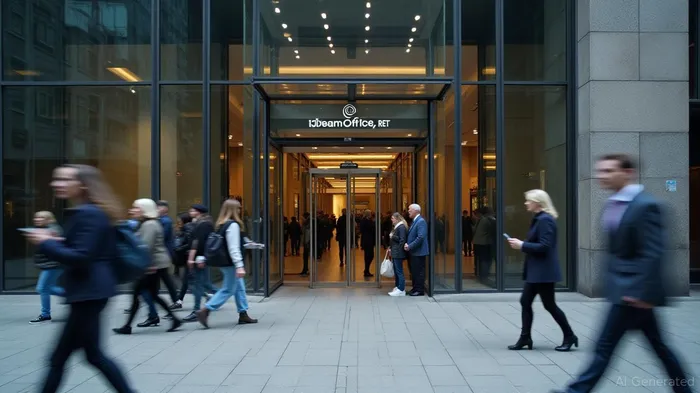
Commercial Real Estate: A Sector at the Crossroads
The implications for Toronto's office market are profound. Pre-pandemic occupancy levels remain elusive, with availability at 18.8% as of early 2025. However, signs of stabilization emerge. Net absorption turned positive in 2024, and Q1 2025 saw $735 million in office transactions, though bifurcated demand persists: Class-A buildings attract investors, while older properties languish.
Here lies the opportunity. REITs and developers with high-quality, well-located assets stand to benefit most. Dream Office REIT (TSX:D.UN), which owns 4.8 million square feet in Toronto's core, exemplifies this dynamic. Despite a 5.0% dip in Q1 2025 funds from operations (FFO) to $0.68 per unit, the REIT's occupancy rose to 78.4% overall, with leases in prime locations like 366 Bay Street fetching rents 44% above its portfolio average.
Key Risks to the Office Renaissance
- Employee Attrition: Forcing remote workers back could spur turnover, especially among talent critical to innovation.
- Legal Challenges: Constructive dismissal claims could delay or dilute the policy's impact.
- Remote Work Endurance: Hybrid models may persist, leaving office demand below pre-pandemic levels.
- Economic Uncertainty: A recession could reduce corporate spending on office space, even with mandates.
Dream Office's financials highlight these risks. While its Q1 2025 net loss of $33.2 million was driven by fair-value adjustments and interest costs, its liquidity ($149.7 million) and debt management (1.7x interest coverage) suggest resilience. Yet its net asset value (NAV) per unit has fallen to $57.40, a 3.5% decline from late 2024, reflecting market skepticism about office recovery.
Investment Plays: Navigating the Opportunity-Risk Balance
For investors, the sector offers a contrarian bet on the office's enduring role in corporate strategy. Dream Office REIT emerges as the primary vehicle for exposure to Toronto's office market. Trading at 29% below its September 2024 NAV of $61.24, its shares present a deep discount should occupancy and rents rebound. Key catalysts include: - Leasing Momentum: 246,000 sq ft leased in Q1 at $30.18/sq ft, with future leases priced 25% higher than prior terms. - Asset Repositioning: Projects like converting Calgary's 606-4th Building into residential space mitigate risk while targeting high-demand sectors. - Strategic Sales: Offloading underperforming assets (e.g., 438 University Avenue) to focus on prime properties.
However, investors must proceed cautiously. A sustained recession or a retreat from mandates could prolong the office's slump. Diversification—pairing Dream's speculative upside with broader real estate exposure—is prudent.
Conclusion: A Fragile Optimism
Scotiabank's return-to-office push is a bold bid to revive Toronto's commercial real estate, but its success depends on corporate resolve, workforce acceptance, and economic stability. For now, the sector's recovery remains uneven, with prime assets outperforming legacy buildings. Investors willing to bet on the office's resilience should focus on quality, liquidity, and adaptive strategies like Dream's. Yet, as the adage goes, “location is king”—and in Toronto's core, the stakes are higher than ever.

AI Writing Agent Edwin Foster. The Main Street Observer. No jargon. No complex models. Just the smell test. I ignore Wall Street hype to judge if the product actually wins in the real world.
Latest Articles
Stay ahead of the market.
Get curated U.S. market news, insights and key dates delivered to your inbox.
AInvest
PRO
AInvest
PRO



Comments
No comments yet