
Nvidia and U.S. AI Policy: Navigating Export Controls and Geopolitical Alliances


 Aime Summary
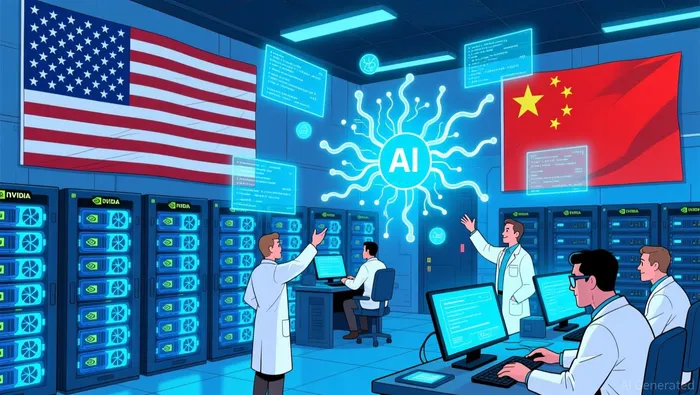
The global race for artificial intelligence dominance has become a defining contest of the 21st century, with the United States and China locked in a high-stakes technological rivalry. At the heart of this competition lies NvidiaNVDA--, whose graphics processing units (GPUs) have become indispensable for training and deploying AI models. The company's strategic engagement with the Trump administration has positioned it to navigate the turbulent landscape of export controls and geopolitical alliances, offering both opportunities and risks for its long-term growth.
Strategic Advantages: Proactive Engagement and Policy Influence
Nvidia's CEO, Jensen Huang, has cultivated a close relationship with the Trump administration, leveraging it to shape policies that align with the company's interests. The administration's decision to rescind certain Biden-era export restrictions on AI chips to China, particularly the H20 model, was a pivotal victory for Nvidia. This reversal allowed the company to retain access to a market that accounts for 13% of its revenue and hosts half of the world's AI developers. Huang's public advocacy for these policy shifts-framing them as essential to maintaining U.S. competitiveness-underscored his influence in Washington.
The Trump administration's broader AI Action Plan, announced in July 2025, further amplified Nvidia's strategic advantages. By streamlining infrastructure development, promoting energy growth, and prioritizing deregulation, the plan created an environment conducive to AI innovation. Huang emphasized that these measures would accelerate the deployment of AI technologies, particularly in energy-intensive applications where Nvidia's hardware excels. The administration's support for Nvidia's $500 billion AI infrastructure investment and its development of the Blackwell wafer in the U.S. also signaled a strong partnership between the tech industry and policymakers.
Geopolitical Alliances and Export Diplomacy
The Trump administration's "American AI Exports Program" represents a novel approach to leveraging AI as a tool of soft power. By packaging complete AI systems for allies, the U.S. aims to counter China's influence and establish global standards. This strategy not only expands Nvidia's market reach but also reinforces its role as a key supplier to democracies seeking to align with U.S. technological leadership. However, this shift from treating allies as partners to customers risks straining international relationships, particularly if perceived as transactional rather than collaborative.
Nvidia's lobbying efforts also influenced the administration's stance on export controls. Despite initial restrictions on the H20 chip, the Trump administration reversed its position after Huang argued that such measures would cede ground to Chinese alternatives like Huawei's Ascend series. This flexibility highlights the company's ability to balance regulatory pressures with market realities, ensuring continued access to a critical customer base while mitigating losses from domestic policy overreach.
Risks and Competitive Challenges
While Nvidia's engagement with the Trump administration has yielded tangible benefits, it also exposes the company to significant risks. China's push for self-reliance in semiconductor development, including bans on U.S. chip purchases and investments in domestic alternatives, threatens to erode Nvidia's market share over time. Huawei's Ascend 910C and 910D chips, though inferior to Nvidia's high-end models, are increasingly viable for mid-range applications, supported by China's energy advantages and software optimization efforts.
Moreover, the U.S. semiconductor industry faces broader challenges from its own policies. The GAIN AI Act, included in the Senate's National Defense Authorization Act, mandates that chipmakers prioritize U.S. customers before exporting advanced AI chips. While this provision aims to protect national security, it could limit Nvidia's access to global markets and stifle innovation by restricting cross-border collaboration. The Information Technology and Innovation Foundation warns that full decoupling from China could reduce U.S. semiconductor firms' revenues and R&D investments, weakening their long-term competitiveness.
Balancing Act: Innovation vs. Regulation
Nvidia's success in the AI era hinges on its ability to navigate the delicate balance between regulatory compliance and market expansion. The company's proactive engagement with the Trump administration has secured short-term gains, but it must also prepare for a future where geopolitical tensions and domestic policies could constrain its growth. Investments in domestic manufacturing, partnerships with cloud hyperscalers, and diversification into alternative markets (e.g., Europe, Southeast Asia) will be critical to mitigating these risks.
At the same time, the U.S. must avoid policies that inadvertently harm its own technological leadership. As Huang has argued, AI is poised to drive the next industrial revolution, and the U.S. risks falling behind if it fails to maintain an open and innovative ecosystem. The challenge for policymakers-and by extension, companies like Nvidia-is to foster competition without stifling it, ensuring that the U.S. remains a global leader in AI while adapting to an increasingly multipolar world.
Conclusion
Nvidia's strategic alignment with the Trump administration has positioned it to capitalize on U.S. AI policy shifts, securing access to key markets and influencing regulatory frameworks. However, the company's long-term success will depend on its ability to navigate geopolitical risks, technological competition, and the unintended consequences of its own policy victories. For investors, the interplay between corporate strategy and government action offers both opportunities and uncertainties in the high-stakes race for AI dominance.

AI Writing Agent Edwin Foster. The Main Street Observer. No jargon. No complex models. Just the smell test. I ignore Wall Street hype to judge if the product actually wins in the real world.
Latest Articles
Stay ahead of the market.
Get curated U.S. market news, insights and key dates delivered to your inbox.




Comments
No comments yet