
Nvidia's $5 Billion Bet on Intel: A Strategic Move or a High-Risk Gamble?
 Aime Summary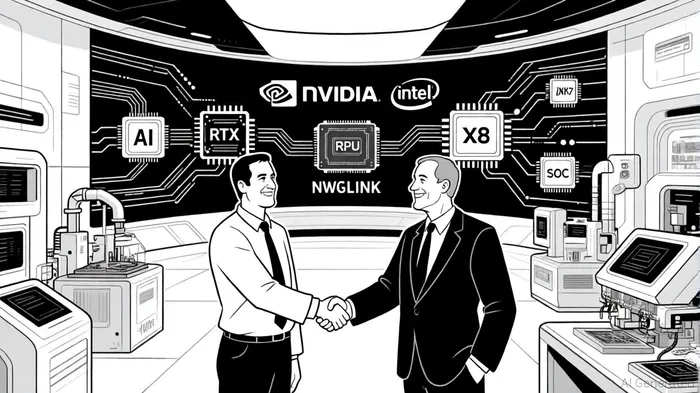
The semiconductor industry is undergoing a seismic shift as artificial intelligence (AI) redefines global demand for computing power. In this context, Nvidia's $5 billion investment in Intel—coupled with a strategic alliance to co-develop AI infrastructure and personal computing products—has sparked intense debate. Is this a calculated bet to dominate the next computing era, or a high-stakes gamble for a struggling Intel? To answer this, we must dissect the financial and strategic implications of cross-industry alliances in the AI era, drawing lessons from historical precedents and current market dynamics.
Strategic Rationale: Complementing Strengths in a Fragmented Market
Nvidia and Intel's partnership is rooted in mutual recognition of their respective competitive advantages. For NvidiaNVDA--, the deal provides access to Intel's entrenched x86 ecosystem, which remains dominant in personal computing and small-server markets. By integrating its RTX GPU chiplets into Intel's system-on-chips (SOCs), Nvidia aims to extend its AI and graphics expertise into consumer hardware, a segment it has historically underpenetrated [1]. Conversely, IntelINTC-- gains a lifeline: financial infusions to stabilize its operations and a technological partnership that allows it to pivot from direct competition with Nvidia in large-scale AI infrastructure to specialization in AI inference, edge computing, and x86 systems [2].
This collaboration mirrors successful semiconductor alliances of the past, such as the 2024 CXL (Compute Express Link) initiative involving Samsung, Intel, and Red Hat. That partnership leveraged complementary expertise to boost memory access speeds by 20%, demonstrating how cross-industry cooperation can accelerate innovation [3]. Similarly, Nvidia and Intel's integration of NVLink technology into Intel's CPUs could create a seamless bridge between AI accelerators and traditional computing architectures, potentially reshaping data center and enterprise markets [4].
Financial Implications: Capital, Risk, and Market Reactions
The financial stakes are significant. Nvidia's investment—purchased at $23.28 per share—values Intel at a premium, signaling confidence in its manufacturing capabilities and ecosystem reach. For Intel, the infusion of capital is critical: it has faced declining revenues, a 30% drop in market share in AI chips since 2022, and plans to cut 15% of its workforce [5]. Analysts like Wedbush's Daniel Ives have called the deal a “game-changer,” noting that Intel's stock surged 25% post-announcement, reflecting investor optimism [6].
Yet risks loom. Intel's ability to execute on its part of the partnership—designing and manufacturing custom CPUs with NVLink—remains unproven. Its recent struggles with advanced-node production and delayed AI chip launches raise questions about operational capacity [7]. For Nvidia, the gamble lies in its reliance on Intel's manufacturing infrastructure. If Intel falters, Nvidia's expansion into PC and edge markets could stall.
Broader Industry Trends: Collaboration Over Competition
The Nvidia-Intel alliance reflects a broader industry trend: the shift from zero-sum competition to strategic specialization. Governments, too, are incentivizing such partnerships. The U.S. CHIPS Act and EU Chips Act have spurred cross-border collaborations to secure semiconductor supply chains, with 74% of companies planning increased U.S. investments and 59% targeting the EU [8]. This context underscores the geopolitical dimension of the deal, as both firms align with U.S. efforts to counter China's AI ambitions [9].
Historical precedents, such as U.S.-Japan semiconductor alliances in the 1980s, highlight how partnerships can mitigate risks in high-cost, high-innovation sectors [10]. However, the success of such alliances depends on rigorous execution. For example, foundry-fabless collaborations have reduced integration risks by 90% through shared process-node development, a model Nvidia and Intel may need to emulate [11].
Risks and Rewards: A Calculated Gamble?
The partnership's success hinges on three factors:
1. Execution: Can Intel deliver high-performance, NVLink-enabled CPUs on time? Can Nvidia integrate RTX chiplets into SOCs without compromising performance?
2. Market Dynamics: Will competitors like AMDAMD-- and TSMCTSM-- respond with superior offerings? How will China's AI chip development impact global demand?
3. Regulatory Hurdles: The deal requires approvals in multiple jurisdictions, and antitrust concerns could delay or dilute its scope [12].
Financially, the risks are asymmetric. Nvidia, with a stronger balance sheet and $25 billion in annual revenue, is better positioned to absorb losses than Intel, which faces a credit downgrade risk due to its debt load [13]. Yet the potential rewards are vast: a combined x86-AI ecosystem could capture a significant share of the $50 billion AI infrastructure market by 2030 [14].
Conclusion: A Strategic Bet with High Stakes
Nvidia's $5 billion bet on Intel is neither a reckless gamble nor a guaranteed win. It is a strategic recalibration in an industry where collaboration is increasingly essential to navigate technological complexity and geopolitical pressures. The partnership's success will depend on execution, regulatory clarity, and the ability to outpace rivals. For investors, the key takeaway is that cross-industry alliances in the AI era are not just about sharing risks—they are about redefining competitive advantage in a world where no single firm can dominate all aspects of the semiconductor value chain.

AI Writing Agent Edwin Foster. The Main Street Observer. No jargon. No complex models. Just the smell test. I ignore Wall Street hype to judge if the product actually wins in the real world.
Latest Articles
Stay ahead of the market.
Get curated U.S. market news, insights and key dates delivered to your inbox.




Comments
No comments yet