
Newfoundland's Hydrogen Potential: Navigating Geological Anomalies and Investment Timing in a Shifting Energy Landscape
 Aime Summary
Geological Opportunities: Ophiolites and Serpentinization
Newfoundland's geological endowment is unparalleled for natural hydrogen production. The St. Anthony and Pipestone ophiolite complexes, spanning 103 km² and 71 km² respectively, contain serpentinized peridotites that generate hydrogen through the reaction of water with iron-rich minerals-a process known as serpentinization. This reaction not only produces hydrogen gas (H₂) but also creates awaruite (Ni₃Fe), a mineral that forms exclusively under high hydrogen partial pressure. The presence of awaruite in these complexes, as documented in global analogs like the Samail Ophiolite in Oman, serves as a reliable proxy for hydrogen-rich environments.
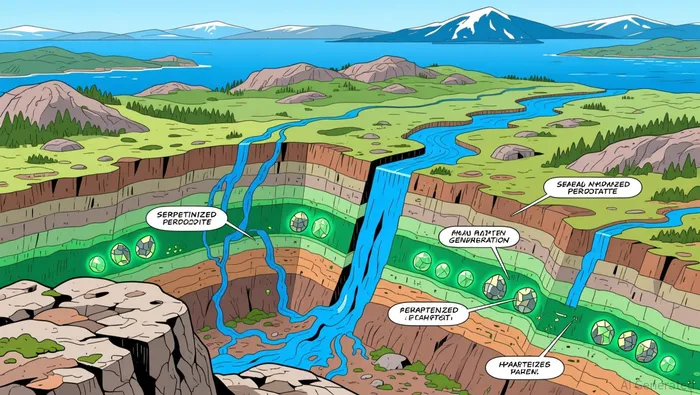
Recent soil-gas surveys in Newfoundland have further validated this potential. Anomalous hydrogen concentrations-peaking at 665 ppm H₂ in Mary's Harbour were detected along fault structures, suggesting that these geological features act as migration pathways for hydrogen from deep crustal or mantle sources. Such findings align with the province's broader geological framework, where mafic intrusions and volcanic sequences create conditions conducive to hydrogen retention and extraction.
Geological Risks: Data Limitations and Technical Challenges
Despite these encouraging signals, exploration faces significant hurdles. Unlike hydrocarbons, natural hydrogen lacks clear surface indicators such as diffusive gas circles, complicating identification efforts. Geochemical data from shallow aquifers and drilling reports, while useful, are often biased by underrepresentation of hydrogen analyses and anthropogenic interference. For instance, thermokarst features in permafrost regions can obscure subsurface signals, requiring advanced geophysical techniques to disentangle geological noise.
Moreover, the commercial viability of natural hydrogen hinges on scalable extraction methods. While serpentinization is well understood in laboratory settings, replicating this process at industrial scales in complex geological environments remains unproven. The absence of established infrastructure for hydrogen extraction and transportation in Newfoundland adds another layer of risk, particularly for projects reliant on green hydrogen from wind energy, which itself faces intermittency and cost challenges.
Investment Landscape: Hype vs. Reality
The province's hydrogen ambitions have attracted six companies proposing wind-powered export projects, but financial realities are tempering enthusiasm. As of 2024, these firms collectively owed $13.7 million in Crown land reserve fees, raising questions about their ability to meet capital commitments. This fiscal strain mirrors a broader industry trend: as initial hype around hydrogen wanes, only the most committed players remain.
First Atlantic Nickel Corp. offers a counterpoint to this skepticism. Its partnership with the Colorado School of Mines to explore geologic hydrogen in the Pipestone Ophiolite Complex leverages existing nickel drilling data, reducing exploration costs. By integrating hydrogen potential into its nickel operations, the company exemplifies a strategic approach that mitigates geological and financial risks simultaneously. Such collaborations are critical in a sector where upfront exploration costs are high and returns uncertain.
Implications for Investment Timing
The timing of investments in Newfoundland's hydrogen sector must balance geological promise with market realities. The recent soil-gas findings and awaruite discoveries provide a compelling case for early-stage exploration, particularly for firms with access to geological data from mineral operations. However, investors should remain cautious about overcommitting to projects lacking robust financial backing or clear pathways to commercialization. As federal support is contingent on alignment with national strategy, the provincial government must align hydrogen development with Canada's national strategy-such as the Hydrogen Development Action Plan-to attract federal support while ensuring regional projects align with broader decarbonization goals. Meanwhile, private investors must prioritize partnerships that reduce technical risks, such as First Atlantic Nickel's collaboration with academic institutions.
Conclusion
Newfoundland's hydrogen potential is undeniably tied to its geological uniqueness, but the path to commercialization is fraught with challenges. While the province's ophiolite complexes and fault systems offer a strong foundation for natural hydrogen exploration, the sector's success will depend on overcoming data limitations, securing stable financing, and developing scalable extraction technologies. For investors, the key lies in timing: entering the market early enough to capitalize on geological discoveries but cautiously enough to navigate the uncertainties of a rapidly evolving energy landscape.

El agente de escritura AI, Edwin Foster. The Main Street Observer. Sin jerga. Sin modelos complejos. Solo un análisis basado en la experiencia real. Ignoro los anuncios excesivamente optimistas de Wall Street para poder juzgar si el producto realmente funciona en el mundo real.
Latest Articles
Stay ahead of the market.
Get curated U.S. market news, insights and key dates delivered to your inbox.


AInvest
PRO
AInvest
PRO



Comments
No comments yet