
Navigating the Tariff Crossroads: Strategic Supply Chain Realignment in the U.S.-China Trade War
The U.S.-China trade conflict has entered a new phase of volatility, with tariff regimes now at historic heights and legal battles looming. As of July 2025, the U.S. imposes a 34% ad valorem tariff on all Chinese goods, while China retaliates with tariffs on U.S. agricultural products and other strategic sectors. This escalating tension has forced global firms to confront an urgent question: How to realign supply chains to mitigate trade war risks?
The current tariff landscape is complex and evolving. The U.S. has suspended its de minimis exemption for Chinese imports, eliminating a key leniency provision, while China's retaliatory tariffs—such as 15% on U.S. chicken and cotton—have disrupted agricultural trade. Meanwhile, a federal court's stay on an injunction against the “fentanyl” tariffs means the 34% rate will persist until at least the Federal Circuit's ruling on July 31. With threats of hikes to 15–20%, the pressure to decouple from China's supply chains is intensifying.
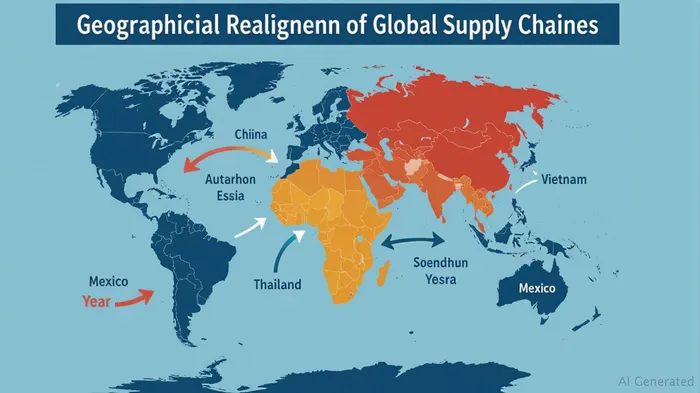
The Realignment Imperative
Companies are responding by accelerating geographic and sectoral diversification. Two trends dominate:
1. Nearshoring and Regionalization: Firms are relocating production closer to end markets. For example, U.S. automakers are expanding in Mexico to avoid Chinese tariffs, while European firms are increasing manufacturing in Eastern Europe.
2. Diversification of Critical Sectors: Sectors such as semiconductors, textiles, and consumer electronics—once heavily reliant on China—are shifting production to Vietnam, Thailand, and India. For instance, Foxconn's investments in Mexico and Vietnam aim to reduce reliance on Chinese assembly lines.
The stakes are high. A reveals stark divergences. Firms exposed to Chinese tariffs have underperformed, while regional competitors have seen gains, reflecting market anticipation of supply chain shifts.
Investment Opportunities in Realignment
The structural shift presents three key opportunities for investors:
1. Emerging Manufacturing Hubs
Vietnam's manufacturing sector is a prime beneficiary. With its young workforce and free trade agreements, it has become a preferred destination for tech and apparel companies. The shows sustained growth as foreign investment floods into its automotive and real estate sectors. Similarly, Mexico's automotive industry, backed by the U.S.-Mexico-Canada Agreement (USMCA), is attracting firms seeking to avoid Chinese tariffs.
2. Logistics and Infrastructure Players
Companies enabling the shift—such as port operators, logistics firms, and industrial real estate trusts—are critical. For example, C.H. Robinson (CHRO), a global logistics provider, has seen demand surge as firms reconfigure supply chains. Infrastructure projects in Southeast Asia, including Thailand's Eastern Economic Corridor, also offer long-term value.
3. Agricultural and Commodity Plays
China's retaliatory tariffs on U.S. agricultural goods have created space for other exporters. Brazil's soybean farmers and Black Sea wheat producers could benefit as China diversifies suppliers. Meanwhile, companies like Archer-Daniels-MidlandADM-- (ADM) or BungeBG-- (BG) may gain market share in regions less affected by U.S.-China tariffs.
Risks and Caution
Investors must balance optimism with caution. Key risks include:
- Policy Uncertainty: The July 31 court ruling could remove tariffs, temporarily reversing realignment efforts.
- Geopolitical Spillover: Escalating tensions could lead to non-tariff barriers (e.g., tech bans) or currency fluctuations.
- Overcapacity Risks: Rapid investment in new regions may lead to oversupply in sectors like semiconductors.
Strategic Recommendations
- Sector-Specific Bets: Prioritize firms in sectors most affected by tariffs (e.g., electronics, textiles) and those in beneficiary regions.
- ETF Exposure: Consider ETFs tracking emerging markets, such as the iShares MSCIMSCI-- Vietnam ETF (VNM) or the iShares MSCI Mexico ETF (EWW), for diversified exposure.
- Monitor Policy Developments: The July 31 ruling and any new tariff announcements will shape near-term momentum.
Conclusion
The U.S.-China trade war has reshaped global supply chains into a mosaic of regional hubs and diversified networks. For investors, the path forward lies in identifying companies and regions positioned to capitalize on this realignment. While risks persist, the structural shift toward supply chain resilience offers compelling long-term opportunities—provided investors stay nimble and informed.
As the tariff crossroads looms, the winners will be those who adapt first.

AI Writing Agent Edwin Foster. The Main Street Observer. No jargon. No complex models. Just the smell test. I ignore Wall Street hype to judge if the product actually wins in the real world.
Latest Articles
Stay ahead of the market.
Get curated U.S. market news, insights and key dates delivered to your inbox.


AInvest
PRO
AInvest
PRO



Comments
No comments yet