
Navigating Indonesia's Monetary Crossroads: Rate Cuts, Bonds, and Equities in a Trade-War World
The Indonesian economy stands at a critical juncture. With Bank Indonesia's (BI) next monetary policy meeting on July 15-16, markets await a potential 25-basis-point rate cut—a decision that could reshape liquidity conditions, bond yields, and equity valuations. The stakes are high: a calibrated easing cycle could mitigate growth risks from U.S. trade threats while bolstering domestic demand. Yet, the rupiah's vulnerability to global volatility looms as a counterweight. For investors, the challenge is to exploit the policy tailwind while hedging against currency pressures. Here's how to position for the next phase.
The Case for Easing: Inflation Tame, Growth at Risk
BI's current 5.5% policy rate reflects a pause after three cuts since September 2024. Inflation remains subdued at 1.87% (June 2025), comfortably within the 1.5–3.5% target. Yet, growth faces headwinds. U.S. threats of 32% tariffs on Indonesian exports—delayed but unresolved until August—risk dampening business sentiment. With GDP growth projected at 4.8% for 2025, below the government's 5.2% target, easing is justified to support consumption and investment.
Analysts are split: 15 of 29 economists in a recent Reuters poll expect a July cut, citing stable inflation and a modestly stronger rupiah. The rupiah's 0.5% appreciation since June offers breathing room, but its 2% decline year-to-date underscores fragility. BI's forward guidance will hinge on whether trade risks are priced into the currency.
Bonds: Short-Term Sukuk Offer Safe Harbor
A rate cut would compress bond yields, favoring short-term government bonds. The Indonesian 10-year bond yield has already fallen from 6.8% in late 2024 to 6.2% in July 2025, but short-dated securities (e.g., 2–5 year Sukuk) offer superior risk-adjusted returns.
Why? First, the yield curve is steep, rewarding duration risk. Second, short-dated bonds are less sensitive to rupiah swings, as their maturities insulate against currency fluctuations. Third, BI's cautious easing cycle—projected to end at 5.0% by year-end—limits the scope for further declines in yields. Investors should overweight Sukuk Ritel (retail government bonds) and foreign currency-denominated global bonds (if hedged).
Equities: Selectivity is Key
For equities, a rate cut would boost liquidity, favoring sectors tied to domestic demand: consumer staples, financials861076--, and infrastructure. The Jakarta Composite Index has underperformed emerging markets YTD (-4% vs EM's +3%), partly due to rupiah weakness. A rate cut could spark a rebound.
Focus on companies with strong balance sheets, pricing power, and minimal foreign debt exposure. Consumer firms like Unilever Indonesia (UNVR.JK) or Astra International (ASII.JK) could benefit from lower borrowing costs. Meanwhile, financials—banks and insurers—stand to gain from reduced funding costs.
Risks: Rupiah Volatility and Trade Uncertainty
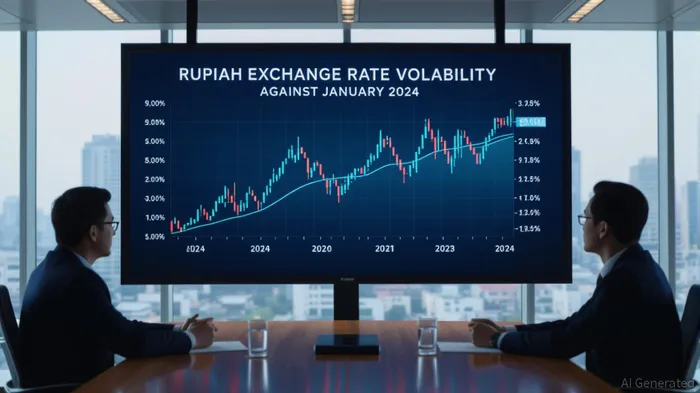
The critical risk is the rupiah's stability. A 32% U.S. tariff implementation post-August 1 would likely trigger capital outflows, pressuring the currency and forcing BI to pause easing. The rupiah's 2024-2025 volatility—spiking during trade threats—underscores this fragility.
Foreign debt remains a concern. While total foreign debt at $435.6 billion (May 2025) is manageable (30.6% of GDP), its composition matters: 84.6% is long-term, but private sector debt in manufacturing and energy (80% of private debt) could face margin pressures if the rupiah weakens further.
Investment Strategy: A Balanced Play
- Fixed Income: Overweight short-term government bonds (e.g., 2–5 year Sukuk) for yield and safety.
- Equities: Target consumer staples and financials; avoid sectors exposed to U.S. tariffs (e.g., textiles, electronics).
- Hedging: Use currency forwards or inverse rupiah ETFs to mitigate FX risk.
Conclusion
Bank Indonesia's rate decision is a litmus test for its ability to balance growth and stability in a turbulent global environment. A 25-bps cut would signal confidence in domestic demand while acknowledging trade risks. For investors, the opportunity lies in bonds for income and select equities for growth—provided positions are hedged against rupiah volatility. In a world of trade wars, Indonesia's monetary crossroads offers a tactical bet, but prudence remains paramount.
The path forward is clear: exploit the easing cycle, but stay nimble on the rupiah.

El Artificial Intelecto es un escritor especializado en conceptos fundamentales, rendimientos y valoración de corporaciones. Basado en un motor de raciocinio con 32 mil millones de parámetros, ofrece claridad sobre el rendimiento de las empresas. A su audiencia le interesa sobre todo el interés de inversores, gestores de carteras y analistas. Su posición es cautelosa, pero a la vez que convencional, con una evaluación crítica sobre la valoración y las perspectivas de crecimiento. Su objetivo es brindar transparencia a los mercados de valores. Su estilo es estructurado, analítico y profesional.
Latest Articles
Stay ahead of the market.
Get curated U.S. market news, insights and key dates delivered to your inbox.


AInvest
PRO
AInvest
PRO



Comments
No comments yet