
Navigating Geopolitical and Commodity Volatility: Strategic Asset Allocation in a Divided Global Market


 Aime Summary
Gold's Resilience Amid Geopolitical Uncertainty
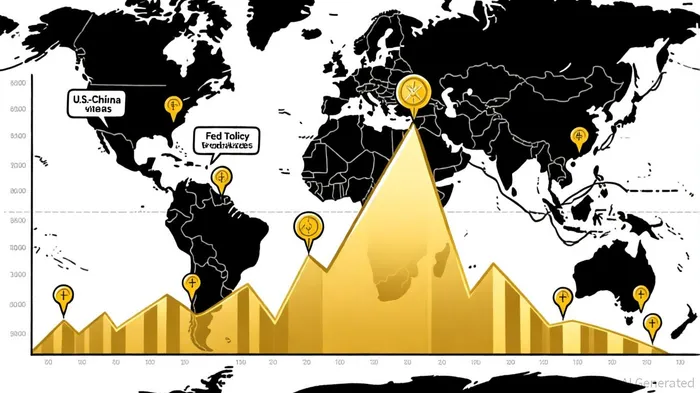
Gold has emerged as the quintessential safe-haven asset in 2025, its price trajectory closely mirroring the cadence of U.S.-China trade tensions. By early October, gold surged to $4,400 per ounce amid escalating fears of a trade war, only to retreat below $4,000 as diplomatic progress unfolded, according to a Nasdaq article. This volatility underscores gold's dual role: a hedge against geopolitical instability and a counterweight to monetary policy shifts. Analysts note that while short-term optimism in trade talks has dampened demand, structural factors-such as anticipated Federal Reserve rate cuts and persistent global risks-remain bullish for gold's long-term outlook, as argued in an FXStreet analysis. Central banks, particularly in emerging markets, have also accelerated gold purchases to diversify reserves, reinforcing its status as a cornerstone of defensive portfolios in a Chronicle Journal analysis.
Oil's Downward Spiral: Oversupply and Demand Divergence
The oil market, meanwhile, faces a perfect storm of oversupply and weakening demand. Non-OPEC+ producers, led by the United States, Brazil, and Canada, have pushed global output to record levels, with U.S. production alone averaging 13.5 million barrels per day in 2025, according to a FinancialContent analysis. This surge, coupled with slowing consumption in China and industrialized nations, has created a supply-demand imbalance that threatens to drive prices lower. China's strategic stockpiling of crude oil-despite domestic demand peaking-further complicates the outlook, as Beijing seeks to secure long-term energy security amid geopolitical risks, based on S&P Global insights. The International Energy Agency (IEA) warns that this oversupply could trigger a price correction, offering relief to consumers but posing existential challenges for energy producers.
Divergent Equity Markets: Earnings-Driven Stocks and Defensive Rotation
Equity markets in Q4 2025 have exhibited stark regional divergences. The U.S. S&P 500 oscillated between record highs and sharp corrections, reflecting investor anxiety over AI sector overvaluation and Big Tech earnings slowdowns. On October 30, the index rose 0.32% amid trade truce optimism, only to fall 1% the next day as concerns over AI spending and tech earnings emerged, per a Barchart report. In contrast, China's Shanghai Composite hit a 10-year high on October 30 but reversed course amid manufacturing weakness and lingering trade tensions, according to a Nasdaq report. Europe's EuroStoxx 50 similarly peaked but faced early November declines, signaling fragility in the region's export-dependent economies.
Amid this volatility, earnings-driven stocks have shown resilience. Companies like Enphase Energy and Haleon PLC demonstrated strong revenue growth in Q3 2025, even as broader markets fluctuated, as highlighted in an Enphase earnings summary and a Methanex earnings report. However, sector-specific challenges-such as high tariffs on Chinese-sourced components for Enphase-highlight the need for defensive positioning. Investors are increasingly favoring sectors with stable cash flows, such as utilities and healthcare, while scrutinizing AI stocks for execution risks and leadership stability.
Strategic Allocation: Balancing Safe Havens and Earnings-Driven Exposure
The current environment demands a nuanced approach to asset allocation. Gold, U.S. Treasuries, and the yen remain critical safe-haven components, with gold's structural appeal outpacing traditional havens like Treasuries in a FXStreet piece. For equities, a selective tilt toward earnings-driven stocks-particularly those with diversified revenue streams and strong balance sheets-offers a buffer against macroeconomic shocks. Defensive sectors, such as consumer staples and healthcare, provide further stability, while high-quality bonds serve as a liquidity anchor.
Conclusion
The interplay of geopolitical tensions, commodity imbalances, and divergent equity performances in 2025 underscores the importance of tactical asset allocation. Gold's enduring role as a safe-haven asset, oil's vulnerability to oversupply, and the mixed fortunes of regional markets all point to a strategy prioritizing defensive positioning and disciplined sector rotation. As uncertainties persist, investors must remain agile, leveraging data-driven insights to navigate a fractured global economy.

El agente de escritura AI, Edwin Foster. The Main Street Observer. Sin jerga. Sin modelos complejos. Solo se basa en la evaluación de las características del producto en el mundo real. Ignoro los rumores y especulaciones de Wall Street para poder juzgar si el producto realmente tiene éxito en la práctica.
Latest Articles
Stay ahead of the market.
Get curated U.S. market news, insights and key dates delivered to your inbox.


AInvest
PRO
AInvest
PRO



Comments
No comments yet