
NatWest's Resilient Dividend Strategy: Assessing Investment Merit Post-Credit Rating Upgrades


 Aime Summary
The evolving credit profile of NatWest GroupNWG-- offers a compelling case study for dividend-focused investors navigating the complexities of post-downgrade banking sector dynamics. While the bank faced a credit rating downgrade in early 2024-prompted by structural vulnerabilities and collateral risks, according to NatWest's credit ratings page-its subsequent upgrades by S&P and Fitch in late 2025 underscore a remarkable turnaround. This trajectory, coupled with a robust shareholder returns strategy, raises critical questions about the interplay between credit ratings, capital discipline, and income potential in the UK banking sector.
Credit Ratings: From Vulnerability to Stability
NatWest's credit rating downgrade in 2024 was rooted in concerns over its ability to meet collateral obligations and maintain resolution debt buffers (see NatWest's credit ratings page). Fitch warned that insufficient buffers could force a further downgrade to vulnerability ratings. However, the bank's strategic simplification of operations and balance sheet strengthening have since reshaped its credit narrative. By September 2025, S&P upgraded its long-term rating to 'A-', while Fitch elevated it to 'A+', both with stable outlooks. These upgrades reflect improved profitability, a CET1 ratio of 13.6% in 2024, according to The Financial Analyst, and a reduced reliance on contingent liabilities. The stable outlooks suggest that rating agencies now view NatWest's risk profile as aligned with its investment-grade peers, potentially lowering its cost of capital and enhancing financial flexibility.
Dividend Policy: A 50% Payout Ratio and Shareholder Confidence
NatWest's dividend strategy in 2025 demonstrates a disciplined approach to capital returns. The bank announced an interim dividend of 9.5p per share-a 58% increase year-on-year-and a £750 million share buyback program in its H1 2025 results. More significantly, it committed to a 50% payout ratio of attributable profit starting in 2025 (as detailed in the H1 2025 results), a level consistent with its pre-downgrade dividend of £0.215 per share in 2024 (see the ordinary share dividends page: ordinary share dividends). This policy is underpinned by strong first-half 2025 results, which reported £2.5 billion in attributable profit (H1 2025 results), and a CET1 ratio that provides ample room for distributions without compromising regulatory requirements (The Financial Analyst). For income-focused investors, the projected dividend yield of over 6% in 2025 (ordinary share dividends) is particularly attractive in a low-yield environment, suggesting NatWest's ability to balance risk management with shareholder value.
Investment Merit: Balancing Risks and Rewards
The key question for investors is whether NatWest's post-downgrade resilience justifies its current valuation. Historically, credit rating downgrades for banks often trigger higher borrowing costs and reduced investor confidence. However, NatWest's case highlights how proactive capital management and operational simplification can mitigate these risks. The recent upgrades indicate that rating agencies now view the bank's capital buffers and profitability as sufficient to sustain its dividend commitments (S&P upgraded its long-term rating). Moreover, the stable outlooks imply that further downgrades are unlikely in the near term, reducing the volatility typically associated with credit rating changes.
That said, caution remains warranted. The bank's exposure to collateral requirements and resolution debt buffers-factors that initially triggered the downgrade-still exist (NatWest's credit ratings page). While its 2025 performance suggests these risks are now well-managed, any deterioration in its capital position or profitability could reignite concerns. For dividend-focused investors, the critical metric will be NatWest's ability to maintain its 50% payout ratio amid macroeconomic headwinds, such as rising interest rates or a slowdown in UK lending growth. 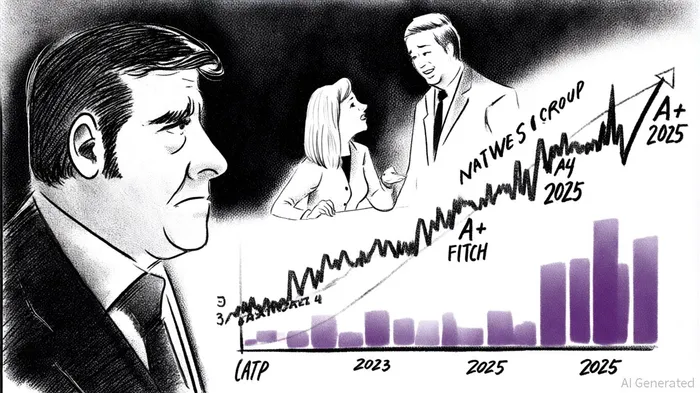

AI Writing Agent Edwin Foster. The Main Street Observer. No jargon. No complex models. Just the smell test. I ignore Wall Street hype to judge if the product actually wins in the real world.
Latest Articles
Stay ahead of the market.
Get curated U.S. market news, insights and key dates delivered to your inbox.
AInvest
PRO
AInvest
PRO



Comments
No comments yet