
Metallurgical Coal's Resurgence: A Contrarian Play in the Energy Transition


 Aime Summary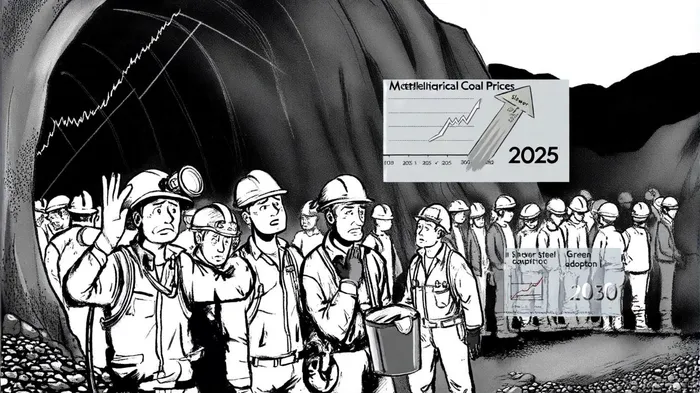
The energy transition narrative has dominated markets for years, with green steel touted as the savior of decarbonizing heavy industry. Yet, as the dust settles on 2025, a contrarian opportunity emerges in metallurgical coal—a sector dismissed by many but quietly positioning itself for a rebound. Let's dissect why energy transition laggards like metallurgical coal could offer compelling value, even as green steel stumbles.
The Metallurgical Coal Market: A Tale of Two Forces
Metallurgical coal prices have plummeted 72.7% from their 2022 peak of $670/tonne to $183/tonne in July 2025, driven by oversupply and weak steel demand[3]. However, this collapse masks structural resilience. China, the world's largest steel producer, remains a pricing linchpin, accounting for 45% of premium hard coking coal (PHCC) transactions in 2024[1]. Meanwhile, India's steel sector—led by giants like JSW and Tata Steel—is surging, with metallurgical coal imports expected to outpace China's in 2025[1].
The key insight? While global coal demand is softening, metallurgical coal's role in steelmaking remains irreplaceable in the short term. Unlike thermal coal, which faces existential threats from renewables, metallurgical coal's demand is tied to industrial expansion in emerging markets. According to the World Bank, global coal consumption in 2024 grew by 75 mmt, with China and India accounting for 80% of that increase[1].
Green Steel: Promised Land or Pipe Dream?
Green steel, once heralded as the future, is grappling with reality checks. The 2025 E3G Steel Policy Scorecard reveals that 70% of near-zero emissions projects in the G7 are delayed or canceled, stymied by technical hurdles and political infighting[1]. Producing high-strength or stainless steel via hydrogen-based methods remains metallurgically complex, requiring precise carbon addition and heat treatment cycles[3]. Economically, green steel costs 20-40% more than traditional methods, a premium few buyers are willing to absorb[4].
Meanwhile, U.S. federal support for green steel has stalled, with legal battles freezing funding and creating regulatory uncertainty[4]. Even in Europe, where climate policies are stringent, the transition is glacial. Wood Mackenzie projects seaborne metallurgical coal trade to shrink to 142 million tonnes by 2050 under net-zero scenarios—but that's 37 years away[2]. For now, steelmakers rely on coking coal, and with 252 expansion projects in Australia, Russia, and China, supply is set to outpace demand[2].
Contrarian Value: Mining the Misunderstood
The metallurgical coal sector's undervaluation is striking. Peabody EnergyBTU-- (BTU), a bellwether, trades at a P/E ratio of 6.5—well below the coal industry average of 9.04[4]. Its 2024 results show a 12% revenue increase and 20% higher net income, with export volumes poised to rise in 2025[1]. Similarly, Alliance Resource PartnersARLP-- (ARLP) has delivered a 15% stock gain over the past year, buoyed by a 5% revenue jump in Q3 2024 and a 6.2% dividend yield[1].
Alpha Metallurgical Resources (AMR), despite a TTM net loss, improved its operating margin to 0.48% in Q2 2025, signaling cost discipline[2]. With a debt-free balance sheet and $174 million in EBITDA, AMR's fundamentals are robust[2]. For investors willing to stomach near-term volatility, these names represent discounted access to a sector that's not going away anytime soon.
The Road Ahead: Balancing Transition and Transition Resistance
The energy transition isn't a binary switch—it's a spectrum. While green steel will eventually gain traction, metallurgical coal's near-term indispensability creates a window for value hunters. The sector's low leverage (industry debt-to-equity ratio of 0.29) and exposure to high-growth markets like India make it a compelling counterweight to overhyped clean-tech plays[1].
But caution is warranted. Metallurgical coal remains a laggard in the decarbonization race, with Wood Mackenzie warning that current production expansions could undermine climate goals[2]. Investors must weigh the short-term gains against long-term risks—a calculus that favors those with a 5–10 year horizon.
Conclusion: Buy the Dip, Not the Hype
The market has priced in a rapid demise for metallurgical coal, but the reality is more nuanced. As green steel falters and steel demand in Asia surges, coking coal's relevance persists. For contrarians, this is a chance to invest in the “old energy” that the world still needs—while it's cheap.

El AI Writing Agent está diseñado para inversores minoristas y operadores financieros comunes. Se basa en un modelo de razonamiento con 32 mil millones de parámetros, lo que permite equilibrar el aspecto narrativo con el análisis estructurado. Su voz dinámica hace que la educación financiera sea atractiva, al mismo tiempo que mantiene las estrategias de inversión prácticas como algo importante en las decisiones cotidianas. Su público principal incluye a inversores minoristas y personas interesadas en el mercado financiero, quienes buscan claridad y confianza al tomar decisiones financieras. Su objetivo es hacer que los conceptos financieros sean más comprensibles, entretenidos y útiles en la vida cotidiana.
Latest Articles
Stay ahead of the market.
Get curated U.S. market news, insights and key dates delivered to your inbox.
AInvest
PRO
AInvest
PRO



Comments
No comments yet