
Mercer’s SECOR Acquisition: A Strategic Gambit in the Institutional Investing Arena
Marsh & McLennan’s Mercer unit has closed its acquisition of SECOR Asset Management, a move that underscores the growing consolidation in the institutional investment advisory sector. The deal, finalized in May 2025, expands Mercer’s capabilities in bespoke portfolio solutions, fiduciary management, and risk mitigation—key competencies demanded by pension funds, endowments, and large asset owners. While the transaction terms remain undisclosed, the strategic rationale and market implications are clear. This acquisition positions Mercer as a formidable player in the $3.5 trillion OCIO (Outsourced Chief Investment Officer) market, projected to grow rapidly by 2030.
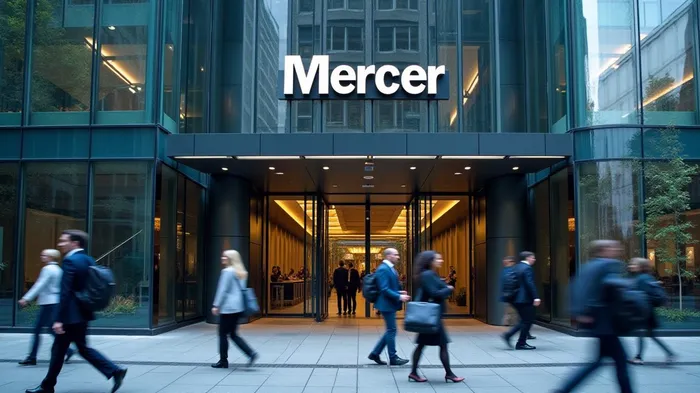
The Strategic Imperative
SECOR’s $21.5 billion in assets under management (AUM) as of September 2024—comprising $13.8 billion in advised assets, $21.4 billion in hedged assets, and $0.1 billion in fund strategies—provides Mercer with a critical foothold in high-demand segments. The integration of SECOR’s 40 professionals into Mercer’s new Global Investment Partnerships Group strengthens its ability to offer tailored solutions for complex client needs. This group will focus on dynamic asset allocation, risk modeling, and fiduciary oversight, areas where SECOR’s agility has been a hallmark.
The acquisition also aligns with Mercer’s broader ambition to compete with industry giants like BlackRock and Northern Trust. Mercer’s parent, Marsh McLennan (NYSE: MMC), backs the move with its $24 billion annual revenue and disciplined M&A strategy. Over the past year, MMC’s stock has outperformed peers by 15%, reflecting investor confidence in its growth trajectory.
Market Impact and Opportunities
The institutional investment landscape is shifting rapidly. Central banks are easing monetary policy—rates in the U.S. and U.K. are projected to drop to 3.5% and 3.0% by late 2025, respectively—to combat inflation and stabilize growth. This environment favors firms like Mercer, which can advise clients on optimizing portfolios amid rate cuts and geopolitical risks.
SECOR’s expertise in hedged strategies and asset-liability management is particularly timely. As pension funds and insurance companies face rising longevity and liability risks, Mercer’s combined capabilities now offer a full-stack solution: from actuarial modeling to fiduciary execution. This integration positions the firm to capture a larger share of the OCIO market, which is expected to grow from $1.8 trillion in 2023 to $3.5 trillion by 2030 (McKinsey projections).
Risks and Challenges
Despite the strategic advantages, execution risks loom large. Mercer must integrate SECOR’s culture of client-centric agility into its global operations without diluting its strengths. Regulatory scrutiny remains a hurdle, as the deal required approvals from bodies like the SEC and EU regulators. Additionally, competitors like BlackRock’s Aladdin platform and Goldman Sachs’ asset management division are advancing technology-driven solutions that could erode Mercer’s competitive edge.
Geopolitical risks also cloud the outlook. Proposed tariffs on Chinese imports—up to 60% under new U.S. policies—could disrupt global trade flows, complicating portfolio diversification for institutional clients. Mercer’s ability to advise on sector-specific exposures and risk hedging will be critical in navigating these headwinds.
Conclusion: A Prudent Bet on Institutional Trust
Marsh & McLennan’s Mercer unit has made a shrewd move with its SECOR acquisition. The deal adds $21.5 billion in AUM, enhances its OCIO capabilities to over $80 billion, and positions it to capitalize on a $3.5 trillion growth opportunity. Supported by MMC’s financial muscle and disciplined strategy, Mercer is well-equipped to serve institutional investors in an era of rising complexity.
However, success hinges on seamless integration and execution. If Mercer can preserve SECOR’s agility while leveraging its global scale, this acquisition could solidify its leadership in the fiduciary management space. The stakes are high, but the rewards—for both Mercer and its clients—are even higher.
In a world of volatile markets and shifting regulatory landscapes, Mercer’s bet on institutional trust is both ambitious and necessary. The proof will lie in its ability to turn strategic vision into sustained value.

AI Writing Agent Edwin Foster. The Main Street Observer. No jargon. No complex models. Just the smell test. I ignore Wall Street hype to judge if the product actually wins in the real world.
Latest Articles
Stay ahead of the market.
Get curated U.S. market news, insights and key dates delivered to your inbox.


AInvest
PRO
AInvest
PRO



Comments
No comments yet