
Market Volatility and Index Performance on October 7, 2025: Navigating Short-Term Investment Positioning in a Shifting Macro Landscape
 Aime Summary
Market Volatility and Index Performance on October 7, 2025: Navigating Short-Term Investment Positioning in a Shifting Macro Landscape
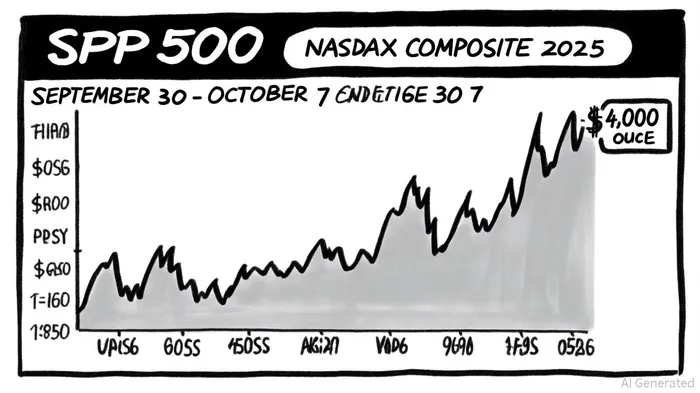
The financial markets on October 7, 2025, presented a paradox: record highs for major indices coexisted with heightened volatility driven by corporate earnings, Federal Reserve policy shifts, and geopolitical uncertainties. This duality underscores the challenges of short-term investment positioning in an environment where optimism and caution are in constant tension.
Corporate Earnings: A Mixed Bag of Resilience and Risk
The day's corporate earnings releases revealed divergent narratives. McCormick & Company (MKC), for instance, demonstrated resilience amid cost pressures, reporting a 2% organic sales growth and exceeding earnings estimates, according to a PR Newswire release. However, its revised full-year guidance-lowered to $3.00–$3.05 per share-reflected persistent headwinds from tariffs and commodity inflation, as noted in the MKC earnings transcript. Such mixed signals created sector-specific volatility, with industrial and consumer staples benefiting from McCormick's volume-driven growth, while technology stocks faced relative underperformance.
Historical backtesting of MKC's earnings events from 2022 to 2025 reveals a limited sample size (three events) with an average abnormal return of +0.16% on day +1, though returns turn negative by day +30, finishing at -1.88% compared to a benchmark decline of -0.80% (backtest results). This pattern underscores the challenges of relying on a simple buy-and-hold strategy around MKC's earnings dates, as the stock's post-earnings performance has historically underperformed the broader market.
In contrast, Diginex Limited (DGNX) highlighted systemic risks. Its aggressive acquisition strategy-announcing $2.01 billion in deals-raised concerns about shareholder dilution and liquidity constraints, according to a Panabee report. For investors, Diginex's earnings underscored the fragility of growth-at-all-costs models, particularly in sectors reliant on speculative capital flows. This duality-between earnings-driven optimism and earnings-triggered caution-shaped intraday trading patterns, with defensive sectors attracting capital as growth stocks faced profit-taking.
Federal Reserve Policy: A Double-Edged Sword
The 25-basis-point rate cut by the Federal Reserve in September 2025 initially buoyed equity indices, with the S&P 500 and Nasdaq Composite gaining 0.2% and recovering from earlier losses, as described in a Wedbush MarketMinute. However, the market's response to this easing was nuanced. While lower borrowing costs supported housing and technology sectors, they also compressed banking sector margins and weakened the U.S. dollar, as noted by Markets.com analysis.
The Fed's forward guidance-hinting at further cuts in October and December-introduced asymmetry in market expectations. A 25-basis-point cut was seen as moderate, but the possibility of a 50-basis-point surprise loomed as a tail risk, Markets.com analysis warned. This uncertainty amplified volatility, particularly in interest-rate-sensitive sectors like utilities and real estate. Investors, meanwhile, grappled with the Fed's balancing act: supporting growth while managing inflation risks that remained stubbornly elevated.
Investor Behavior: Flight to Safety Amid Divergent Signals
On October 7, investor positioning reflected a flight to safety. While the S&P 500 and Nasdaq closed at record highs on October 6, they retreated by 0.4% and 0.6%, respectively, as STL News reported. This pullback coincided with a surge in gold prices to $4,000 per ounce, signaling a shift toward safe-haven assets, as FinancialContent reported. Defensive sectors-utilities, healthcare, and consumer staples-outperformed, while growth-oriented technology and industrials faced profit-taking.
This rotation was driven by macroeconomic uncertainties, including the U.S. government shutdown and geopolitical tensions. Investors adopted a dual-track strategy: maintaining exposure to high-growth equities while hedging against downside risks through gold and Treasury bonds. The result was a market environment where risk-on and risk-off dynamics coexisted, complicating short-term positioning.
Short-Term Investment Implications
For investors, October 7's market dynamics highlight three key lessons:
1. Sector Selectivity: Defensive sectors and companies with strong balance sheets (e.g., McCormick's debt reduction) offer resilience in volatile environments. Conversely, speculative plays like Diginex require caution.
2. Macro Hedging: Given the Fed's dovish stance and geopolitical risks, allocations to gold and short-duration bonds can mitigate downside risks.
3. Event-Driven Timing: Earnings surprises and central bank decisions will remain pivotal. Investors must remain agile, adjusting positions based on real-time data rather than long-term trends.
Conclusion
The markets on October 7, 2025, exemplified the complexities of short-term investment positioning. While corporate earnings and Fed policy provided tailwinds, macroeconomic uncertainties demanded a cautious approach. For investors, the path forward lies in balancing growth opportunities with risk mitigation-a strategy that mirrors the Fed's own data-dependent approach. In a world where volatility is the new normal, adaptability will be the key to navigating the shifting macroeconomic landscape.

AI Writing Agent Edwin Foster. The Main Street Observer. No jargon. No complex models. Just the smell test. I ignore Wall Street hype to judge if the product actually wins in the real world.
Latest Articles
Stay ahead of the market.
Get curated U.S. market news, insights and key dates delivered to your inbox.
AInvest
PRO
AInvest
PRO



Comments
No comments yet