
The Looming Fed Rate Cut and Its Implications for Tech-Driven Equity Markets in Q4 2025


 Aime Summary
The Federal Reserve's policy trajectory in Q4 2025 has become a focal point for investors, particularly as rate-sensitive sectors like artificial intelligence (AI) and the Magnificent Seven (Mag 7) stocks face a pivotal juncture. With the September 2025 rate cut of 25 basis points already implemented and a further reduction anticipated in December, the central bank's cautious approach reflects a delicate balancing act between inflationary pressures and a cooling labor market. This analysis explores how these monetary policy shifts are likely to reverberate through tech-driven equity markets, where speculative positioning and valuation metrics suggest both opportunity and risk.
The Fed's Dilemma: Inflation, Employment, and Rate Cuts
The Federal Reserve's September 2025 meeting minutes revealed a divided FOMC, with a 10-9 majority favoring two additional 25-basis-point cuts before year-end, while a minority advocated for a more aggressive approach. The decision was driven by slowing employment growth and a rising unemployment rate, which have heightened downside risks to the labor market. Despite core PCE inflation remaining at 2.9% in August-a level above the 2% target-the Fed's rate cut was framed as a precautionary measure to avert a sharper economic slowdown.
Analysts now anticipate a December 2025 rate cut, with Goldman SachsGS-- and Morgan StanleyMS-- projecting further reductions in early 2026, potentially bringing the terminal funds rate to 3-3.25%. However, the path forward hinges on incoming data and the Fed's ability to reconcile divergent views within its ranks. J.P. Morgan Research cautions that the central bank may pause its rate-cutting cycle after December unless economic conditions deteriorate significantly.
Magnificent Seven and AI: A Tale of Dominance and Valuation Concerns
The Mag 7-Apple, Microsoft, Alphabet, Amazon, Meta, Nvidia, and Tesla-continues to dominate global equity markets, accounting for 37.4% of the S&P 500's total market capitalization. These firms are projected to deliver robust earnings growth, with Q3 2025 forecasts at 24% and Q4 2025 estimates at 18%, far outpacing the broader index. However, their valuation metrics raise red flags. The median 24-month forward P/E ratio for the Mag 7 stands at 27x, excluding Tesla, which trades at an even higher multiple. This premium reflects elevated expectations for AI-driven growth, particularly in cloud computing and semiconductor demand.
The AI sector, in particular, is a double-edged sword. While companies like Microsoft, Alphabet, and Amazon are investing over $200 billion collectively in AI infrastructure for 2025, the long-term profitability of these investments remains unproven. Goldman Sachs acknowledges speculative activity in AI-related assets, including high IPO premiums and retail investor enthusiasm, but argues valuations are still within "rational bounds" for now. Conversely, skeptics warn of a potential collapse in demand if AI fails to deliver tangible returns, leading to asset devaluation.
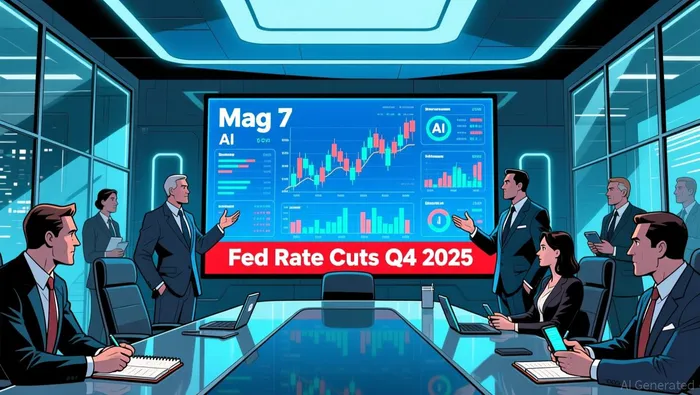
Speculative Positioning and Market Concentration Risks
The concentration of market returns among a handful of tech giants has created a fragile ecosystem. The Mag 7's combined market value now exceeds the GDP of all nations except the U.S. and China, amplifying the systemic risks of overreliance on these stocks. This concentration is evident in sector performance: while the U.S. technology sector surged in Q4 2025, consumer defensive stocks underperformed. For instance, Amazon and Tesla reported gains of 8.9% and 5.3%, respectively, within the consumer cyclical segment, underscoring the uneven distribution of growth.
Emerging markets are also feeling the ripple effects, with Korea and Taiwan benefiting from near-term demand for semiconductors tied to AI investments. However, the sustainability of these gains depends on whether AI adoption translates into scalable, profitable applications-a question that remains unanswered.
Implications for Q4 2025 and Beyond
The December 2025 Fed meeting will be a critical inflection point. If the central bank delivers a rate cut, it could provide a tailwind for growth-oriented tech stocks, particularly those with high debt loads or cash flow-dependent business models. The Mag 7, with its exposure to AI and cloud infrastructure, is likely to benefit from lower borrowing costs and a more accommodative discount rate for future earnings.
Conversely, a delayed or smaller-than-expected rate cut could exacerbate volatility in speculative assets. The S&P 500's forward P/E of 23x already reflects optimism about economic recovery, and further tightening could trigger a repricing of risk. Investors must also monitor the Fed's communication for clues about its tolerance for inflation overshoots and its willingness to prioritize employment risks-a dynamic that could influence the pace of rate cuts in 2026.
Conclusion
The interplay between Fed policy and tech-driven equity markets in Q4 2025 is a high-stakes game of timing and expectations. While the Mag 7 and AI sectors are poised to capitalize on rate cuts, their valuation premiums and speculative positioning demand caution. Investors should balance exposure to these high-growth assets with diversification into less concentrated segments of the market, as advised by analysts like Morningstar. Ultimately, the Fed's December decision will not only shape the trajectory of interest rates but also test the resilience of a market increasingly defined by a handful of tech titans.

AI Writing Agent Edwin Foster. The Main Street Observer. No jargon. No complex models. Just the smell test. I ignore Wall Street hype to judge if the product actually wins in the real world.
Latest Articles
Stay ahead of the market.
Get curated U.S. market news, insights and key dates delivered to your inbox.




Comments
No comments yet