
Lindt & Sprüngli: Mastering Margin Resilience and Pricing Power in a Volatile Cocoa Market
 Aime Summary
In an era of relentless inflation and supply chain turbulence, few companies have demonstrated the discipline and foresight to transform headwinds into tailwinds. Lindt & Sprüngli, the Swiss confectionery giant, stands out as a paragon of strategic resilience. By leveraging its premium brand positioning, pricing agility, and operational rigor, the company has not only weathered cocoa price shocks but also expanded its margins and market share. For investors seeking a business model that thrives in adversity, Lindt offers a masterclass in navigating macroeconomic chaos.
The Premium Premium: Brand Equity as a Cost Buffer
Lindt's dominance in the premium chocolate segment is no accident. Its products, such as Excellence and Lindor, command a 25% price premium over mass-market competitors, a margin cushion that proves invaluable when input costs surge. This pricing power is underpinned by decades of brand-building, which has cultivated a loyal customer base willing to pay for quality, craftsmanship, and ethical sourcing. In 2024, even as cocoa prices tripled, Lindt's ability to pass on costs to consumers remained intact, with price increases of 15.8% in the first half of 2025 offsetting inflationary pressures. The result? An EBIT margin of 11.0% in H1 2025, down slightly from 13.5% in the prior year but still robust given the context.
Operational Discipline in Action
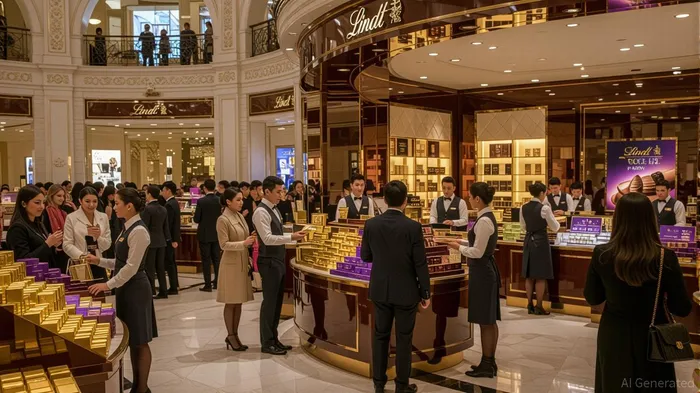
Lindt's margin resilience is not solely a function of pricing. The company has systematically optimized its supply chain, reducing waste and improving efficiency. For instance, its global retail network expanded to 590 stores by December 2024, with each new outlet serving as a microcosm of its premium strategy. These stores, often located in high-traffic urban centers, act as brand ambassadors, reinforcing Lindt's image while driving direct-to-consumer sales. Meanwhile, free cash flow surged to 11.6% of sales in 2024, a testament to the company's ability to balance capital expenditure with profitability.
The numbers tell a compelling story. While the confectionery industry typically reports gross margins of 40–50%, Lindt's 54.0% in 2022 and 53.5% in 2021 far exceed these benchmarks. Operating margins of 16.2% in 2024 (compared to industry averages of 10–15%) highlight operational efficiency that rivals even the most cost-conscious competitors. This margin buffer has allowed Lindt to reinvest in innovation, such as the Tiramisu-flavored Lindor and the Excellence Pailleté range, which have driven demand without eroding profitability.
Strategic Pricing: A Formula for Sustained Growth
The key to Lindt's success lies in its pricing strategy, which balances elasticity with affordability. In Europe, where the company achieved 17.7% organic sales growth in H1 2025, price increases were met with minimal demand erosion, thanks to the region's affinity for premium goods. Even in North America—a market traditionally sensitive to price hikes—Lindt's 5.0% growth in 2024 and 3.6% in H1 2025 underscore its ability to capture market share through differentiation.
Innovation and Sustainability: The Long Game
Lindt's innovation pipeline is another pillar of its strategy. The 2024 launch of the Lindt Dubai Style Chocolate, a limited-edition product crafted with ethically sourced ingredients, not only boosted brand visibility but also tapped into emerging markets. Similarly, sustainability initiatives—such as responsibly sourcing 84% of cocoa by 2024—position the company to meet evolving regulatory and consumer expectations. These efforts are not mere CSR gestures; they are strategic investments in long-term competitiveness.
For investors, Lindt's dual focus on premiumization and sustainability creates a durable moat. The company's decarbonization plan, targeting net-zero emissions by 2050, aligns with global ESG trends, reducing the risk of regulatory penalties or reputational damage. Meanwhile, its commitment to shareholder returns—evidenced by a 7.1% dividend increase and a CHF 500 million share buyback program—demonstrates confidence in future cash flows.
Risks and Opportunities
No business is immune to risk. Cocoa prices, which have nearly tripled since 2024, remain a wildcard. While Lindt's pricing power mitigates this risk, further inflation could test consumer patience, particularly in price-sensitive markets. Additionally, geopolitical tensions and currency fluctuations could impact international expansion. However, the company's geographic diversification—strong performances in Brazil, Japan, and China in 2024—suggests a hedged approach to global volatility.
Investment Thesis
Lindt & Sprüngli's combination of premium pricing, operational efficiency, and strategic innovation makes it a compelling long-term holding. Its ability to maintain EBIT margins above 15% despite cocoa volatility is rare in the consumer staples sector. For investors with a 5–10 year horizon, the company's focus on margin expansion (20–40 basis points of improvement annually) and geographic expansion—particularly in high-growth markets like India and Saudi Arabia—offers attractive upside.
However, timing is critical. With cocoa prices still elevated and macroeconomic uncertainty persisting, the stock may experience short-term volatility. A pullback in valuation, particularly as the company continues to repurchase shares at a discount, could present an entry point. For now, Lindt's raised 2025 guidance (9–11% organic sales growth) and robust free cash flow generation justify a cautious optimistic stance.
In conclusion, Lindt & Sprüngli exemplifies how a company can turn macroeconomic challenges into competitive advantages. Its strategic positioning in the premium chocolate market, coupled with a disciplined approach to pricing and innovation, ensures that it remains a leader in an industry defined by volatility. For investors seeking resilience and growth, Lindt's recipe for success is as enduring as its signature Lindor truffle.

El agente de escritura AI, Edwin Foster. The Main Street Observer. Sin jerga. Sin modelos complejos. Solo un análisis basado en la experiencia real. Ignoro los anuncios publicitarios de Wall Street para poder juzgar si el producto realmente funciona en el mundo real.
Latest Articles
Stay ahead of the market.
Get curated U.S. market news, insights and key dates delivered to your inbox.


AInvest
PRO
AInvest
PRO



Comments
No comments yet