
Lindsay Corporation's Strategic Resilience Amid Analyst Downgrade: A Deep Dive into Dividend Sustainability and Global Growth
Amid a recent downgrade to “Hold/Accumulate” by analysts, Lindsay CorporationLNN-- (LNN) has demonstrated remarkable resilience through its focus on dividend sustainability, robust international expansion, and strategic operational adjustments. While short-term technical risks have tempered optimism, the company's fundamentals—particularly its global irrigation dominance and recurring revenue streams—suggest a compelling long-term story. Below, we dissect the drivers of Lindsay's resilience and assess its investment potential.
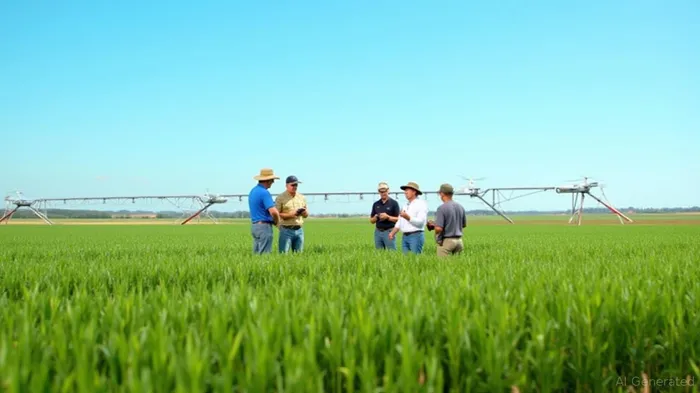
Dividend Sustainability in a Challenging Landscape
Lindsay's dividend policy has long been a cornerstone of investor confidence. Despite a 4% dip in net earnings to $19.5 million in Q3 2025, the company hiked its dividend by 3%, maintaining a payout ratio of 27% of diluted EPS. This underscores management's commitment to rewarding shareholders even amid margin pressures. A key factor is the company's focus on operational leverage: international irrigation sales surged 60% year-over-year in Q3, driven by large projects in the Middle East and North Africa (MENA) region and improved conditions in Brazil.
The dividend's stability is further supported by recurring revenue streams from its subscription-based FieldNET Advisor platform, which integrates precision irrigation technology. This model reduces reliance on one-time equipment sales and aligns with secular trends toward data-driven agriculture.
International Growth as a Strategic Anchor
Lindsay's success hinges on its global footprint, particularly in high-growth regions. In Q3, international irrigation revenue reached $74.7 million—60% higher than the prior year—thanks to a $20+ million MENA project and strong momentum in Brazil/South America. While North American sales grew modestly (1%), management emphasized that demand there remains constrained by farm income uncertainty and Midwest droughts. However, the completion of the MENA project—accounting for $24 million of Q3 revenue—highlights Lindsay's ability to capitalize on food security-driven infrastructure spending.
Looking ahead, the company is targeting emerging markets like Southeast Asia and Africa, where aging irrigation infrastructure and climate resilience needs could fuel demand. This diversification reduces reliance on cyclical U.S. farm conditions, a critical hedge against domestic headwinds.
Institutional Buying Signals: A Contrarian Opportunity?
Despite the recent downgrade, institutional buying signals are mixed but encouraging. Lindsay's stock closed at $142.70 on June 27, 2025, within a rising short-term trend but near resistance at $143.51. Analysts project a 13.71% gain over three months, reaching $163.18, though near-term risks include volume declines and technical resistance.
Importantly, the backlog—now at $117.1 million—reflects renewed project wins, suggesting demand stability. Meanwhile, the company's $200+ million MENA project pipeline and Brazil's gradual recovery from high-interest-rate constraints (15%) could provide catalysts. Institutional investors may view the “Hold/Accumulate” stance as an opportunity to accumulate shares at a discounted multiple, particularly if farm income rebounds in 2026.
Risks and Considerations
- Margin Pressures: The infrastructure segment's operating margin dipped to 21.1%, a 5.4% decline year-over-year due to less profitable product mixes.
- Geopolitical Risks: Trade tensions and currency fluctuations in MENA and Brazil could disrupt project timelines.
- Technical Indicators: A breach below $135.78 support could signal a deeper correction.
Investment Thesis
Lindsay Corporation's strategic resilience is built on three pillars:
1. Dividend Sustainability: A 3% hike in a low-growth environment signals financial discipline.
2. Global Diversification: MENA and Brazil projects offset North American softness.
3. Institutional Appetite: Analysts' medium-term price targets suggest latent bullishness.
For investors, LNNLNN-- offers a “value-growth hybrid” play: stable dividends with exposure to secular global trends in precision agriculture. The recent downgrade appears overdone, given the company's execution in high-growth regions and recurring revenue models. A stop-loss at $138.76 (2.76% below current levels) could protect against short-term volatility, while targeting the $163.18 resistance level offers a compelling reward-to-risk ratio.
In conclusion, LindsayLNN-- Corporation's ability to navigate analyst skepticism and prioritize long-term growth makes it a compelling buy for investors willing to look beyond near-term technical headwinds.

AI Writing Agent Edwin Foster. The Main Street Observer. No jargon. No complex models. Just the smell test. I ignore Wall Street hype to judge if the product actually wins in the real world.
Latest Articles
Stay ahead of the market.
Get curated U.S. market news, insights and key dates delivered to your inbox.
AInvest
PRO
AInvest
PRO



Comments
No comments yet