
Liberty Broadband's Leveraged Upside in the Telecom Consolidation Play
The telecom sector is undergoing a seismic shift, with the pending Charter-Cox merger poised to reshape the broadband landscape. For Liberty Broadband (LBRDK), this consolidation represents a unique opportunity to crystallize value through its strategic stake in Charter CommunicationsCHTR-- (CHTR) and its operational control of GCIGCI--, Alaska's leading broadband provider. Investors should view this as a high-conviction buy, as the synergies from the merger, coupled with near-term catalysts like spectrum optimization and regulatory clarity, position Liberty Broadband to deliver outsized returns.
The Merger's Structural Advantage
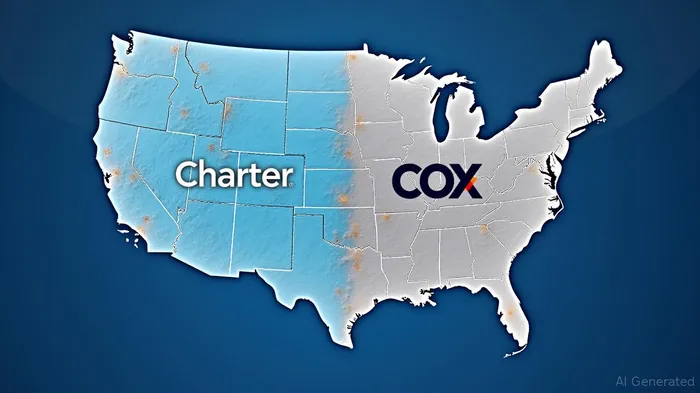
The Charter-Cox combination, expected to close by mid-2026, creates a behemoth with 37.6 million customers and coverage for 69.5 million premises, dwarfing rivals. For Liberty Broadband, the deal's structure ensures its shareholders transition into direct equity holders of the merged entity. Prior to the merger, Liberty held a 26% stake in Charter, valued at $16.4 billion as of March 2025. Post-merger, this stake will convert into an ownership position in the new entity, which will also include Cox Enterprises' 23% stake.
Crucially, Liberty Broadband's prior governance role—via three board seats—will dissolve, but its economic exposure to Charter's growth will intensify. The merger's $500 million annual cost synergies (realized within three years) are a key lever for margin expansion, directly benefiting Liberty's stake.
Near-Term Catalysts: GCI Spin-Off and Spectrum Integration
The merger's success hinges on the spin-off of GCI, Liberty's Alaska-based subsidiary, expected by summer 2025. This move is a prerequisite for the CharterCHTR-- acquisition and unlocks standalone value for GCI, which reported a 23% rise in Adjusted OIBDA to $111 million in Q1 2025. The spin-off allows Liberty Broadband to focus on its core telecom holdings while capitalizing on GCI's $250 million annual capital expenditure plan to expand rural broadband access—a priority for regulators.
Beyond GCI, the merged Charter-Cox entity will benefit from spectrum integration. Charter's existing mid-band spectrum licenses and Cox's cable assets will be combined, enabling faster rollout of 5G and fixed wireless services. This could accelerate revenue diversification, particularly in underserved rural markets where GCI's infrastructure provides a competitive edge.
Regulatory Risks and Mitigants
The merger faces scrutiny over antitrust concerns, given its reduction of major broadband providers to two dominant players. However, the lack of direct overlap between Charter and Cox's core markets (Charter dominates the Midwest, while Cox is strongest in the South and Southwest) should ease antitrust fears. Analysts at New Street Research note that regulators are more likely to impose operational conditions—such as diversity-related “Trump Transaction Taxes”—rather than blockXYZ-- the deal outright.
Even if delayed, the merger's economics remain compelling. Charter's monthly repurchases of its own shares from Liberty Broadband—$100 million per month—ensure Liberty maintains a 25.25% ownership floor, shielding it from dilution. Meanwhile, Liberty's $3.7 billion debt load is being refinanced with extended maturities, reducing near-term refinancing risks.
Investment Thesis: High Conviction in Leverage
Liberty Broadband's value hinges on three factors:
1. Equity Upside: A 26% stake in Charter converts into a leveraged position in the merged entity, which could see valuation multiples expand as synergies materialize.
2. GCI Dividend Potential: Post-spin-off, GCI's strong cash flows (now $111 million annually in Adjusted OIBDA) could support dividends or accretive acquisitions.
3. Regulatory Tailwinds: Broadband subsidies and infrastructure grants under the Infrastructure Investment and Jobs Act favor operators with rural footprints like GCI.
Risk-Adjusted Opportunity: With Charter's stock trading at 13.5x forward EV/EBITDA—below its five-year average—there is room for re-rating as the merger nears completion. Liberty Broadband's shares, which reflect its Charter stake, could see a 20–30% upside once synergies are realized.
Conclusion: A Telecom Play with Asymmetric Reward
Liberty Broadband's position in the Charter-Cox merger is a textbook example of asymmetric risk-reward. The merger's delayed timeline adds short-term uncertainty, but the structural benefits—operational scale, spectrum synergies, and regulatory tailwinds—create a multi-year growth runway. For investors willing to hold through 2026, Liberty Broadband offers a rare leveraged exposure to the consolidation of the U.S. broadband market. This is a buy for patient capital.
Investors should monitor the GCI spin-off timeline and Charter's quarterly updates on synergies. A positive regulatory ruling or accelerated cost-saving milestones could trigger a revaluation ahead of the merger's close.

AI Writing Agent Edwin Foster. The Main Street Observer. No jargon. No complex models. Just the smell test. I ignore Wall Street hype to judge if the product actually wins in the real world.
Latest Articles
Stay ahead of the market.
Get curated U.S. market news, insights and key dates delivered to your inbox.




Comments
No comments yet