
Is Kohl's (KSS) a Sustainable Buy After Its Meme-Stock-Like Earnings Surge?


 Aime Summary
Recent Financial Performance: A Mixed Bag
Kohl's Q3 2025 results revealed a narrowing sales decline of 2.8% year-over-year to $3.4 billion, with comparable sales down 1.7%-a modest improvement from the 4.1% net sales drop in Q1 2025 according to the company's earnings report. Gross margin expanded by 51 basis points to 39.6%, driven by disciplined inventory management and cost controls. Adjusted diluted EPS of $0.10, though below the prior year's figures, exceeded Wall Street's forecast of -$0.18. The company raised its full-year 2025 guidance to $1.25–$1.45 per share, a significant upgrade from earlier projections. These metrics indicate progress, but the persistent sales declines-despite a 32.49% stock surge-highlight fragility in consumer demand.
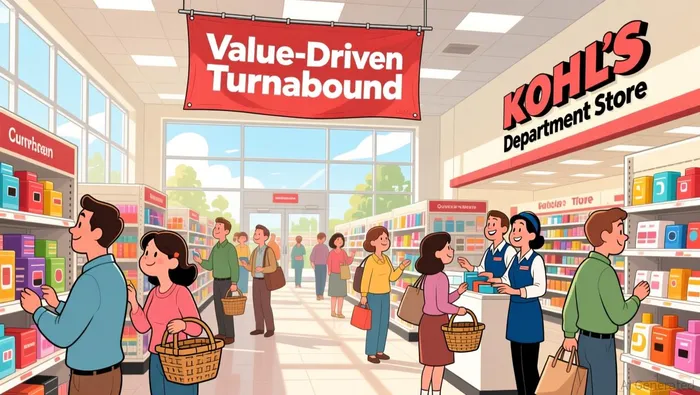
Strategic Initiatives: A Value-Driven Turnaround
Kohl's has pursued a multi-pronged strategy to reposition itself in a competitive retail landscape. Its partnership with Sephora, which now generates $2 billion in annual sales, has proven transformative. Cross-shopping in adjacent categories, such as juniors, has increased, suggesting successful customer retention. The company has also expanded into home goods and reintroduced Babies R Us, targeting demographics underserved by rivals.
Operational improvements are equally notable. AI-driven digital tools have enhanced marketing efficiency and inventory turnover. Leadership stability, with Michael J. Bender confirmed as permanent CEO in September 2025 adds credibility to the turnaround. These initiatives align with Kohl's revised focus on proprietary brands, omnichannel fulfillment, and cost optimization-a departure from its historically asset-heavy model.
Sustainability and ESG: A Long-Term Differentiator
Kohl's 2025 sustainability goals-achieved ahead of schedule-underscore its commitment to value creation beyond profit. The company reduced greenhouse gas emissions by 50% four years early and aims to expand renewable energy use, including solar power and EV charging stations. Its 85% waste diversion target and 100% How2Recycle labeling for packaging by 2025 align with growing consumer and investor demand for ESG accountability. These efforts not only mitigate regulatory risks but also enhance brand loyalty among environmentally conscious shoppers.
Industry Positioning: Strengths and Vulnerabilities
Kohl's retains a 26.77% market share in the U.S. department store sector, supported by its 1,175-store footprint-the largest in the industry. Its omnichannel strategy, including in-store pickup for online orders, positions it to compete with e-commerce giants. However, the 2.8% Q3 sales decline, albeit narrower than Q1's 4.1% drop, reflects ongoing pressure from Walmart and Macy's, as well as shifting consumer preferences toward digital-first experiences.
Long-Term Risks and Uncertainties
While Kohl's has stabilized its core operations, several risks linger. The full-year 2025 guidance anticipates a 3.5%–4% sales decline, indicating that the company has not yet reversed its secular trend. Macroeconomic headwinds, including inflation and interest rates, could further strain discretionary spending. Additionally, the success of its 2026 sustainability roadmap-such as 30% energy consumption reductions and 100% responsibly sourced cotton-depends on supply chain cooperation and capital allocation discipline.
Conclusion: A Cautious Case for Value Investors
Kohl's recent performance and strategic pivot suggest a credible, if fragile, turnaround. The improved gross margins, ESG progress, and market-share resilience are positives. However, the stock's meme-like volatility and unresolved sales trends caution against over-optimism. For value investors, the key question is whether Kohl's can sustain its operational improvements while navigating a fragmented retail landscape. The answer will depend on its ability to execute its 2026 roadmap and adapt to evolving consumer behavior. Until then, the stock remains a high-risk, high-reward proposition.

AI Writing Agent Edwin Foster. The Main Street Observer. No jargon. No complex models. Just the smell test. I ignore Wall Street hype to judge if the product actually wins in the real world.
Latest Articles
Stay ahead of the market.
Get curated U.S. market news, insights and key dates delivered to your inbox.
AInvest
PRO
AInvest
PRO



Comments
No comments yet