
Kingfisher Metals Corp's HWY 37 Project: A Porphyry Play with Catalyst-Driven Upside in British Columbia's Golden Triangle
The Golden Triangle of British Columbia, a geological powerhouse that has yielded some of North America's most significant copper-gold deposits, is once again at the center of exploration activity. Kingfisher Metals Corp (KFM:TSX-V), a junior miner with an ambitious agenda, has positioned itself at the forefront of this activity through its 849 km² HWY 37 Project. With a transformative 2025 exploration program underway—fueled by $10.9 million in financing—the company aims to unlock a potential porphyry copper-gold system that could redefine its value. This article examines the project's scale, geological advantages, and strategic positioning, arguing that Kingfisher is a compelling investment opportunity with high-risk-adjusted rewards.
The Scale of the Exploration Gamble
Kingfisher's 2025 program is nothing short of aggressive. The 7,500m diamond drill program, paired with advanced geophysical surveys and extensive sampling, represents the company's largest-ever expenditure at HWY 37. The drilling targets multiple high-priority areas, including the Williams, Upper Hank, and Lower Hank deposits, each with historical intercepts hinting at porphyry potential (see table below). Notably, the Williams deposit alone hosts a 2.2 km-long chargeable body—a geophysical signature often associated with large porphyry systems—and has returned intercepts like 0.57 g/t Au and 0.49% Cu over 189.7m in past drilling.
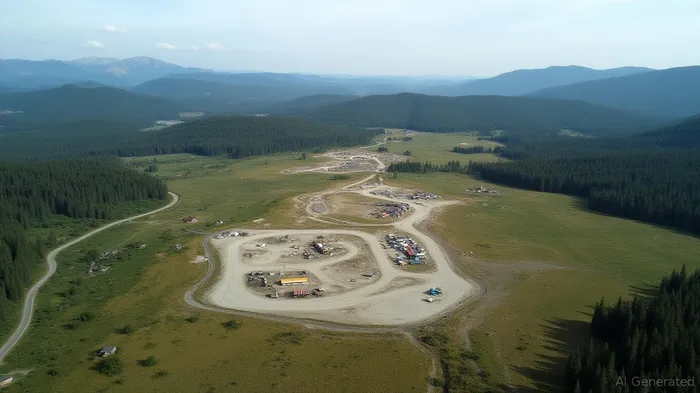
The program's geophysical component—a 1,700-line-km airborne mobile magnetotelluric (MMT) survey and 30-line-km ground induced polarization (IP)—will map subsurface resistivity changes to pinpoint porphyry centers. This data, combined with LiDAR and 150 days of geological mapping, aims to de-risk drilling by refining targets and identifying hidden structures. Such thoroughness is critical in a region where porphyries often lie beneath complex epithermal gold systems, as seen in the adjacent KSM and Brucejack mines.
Geological Context: Why the Golden Triangle Matters
The Golden Triangle is a globally recognized belt for porphyry copper-gold and epithermal gold deposits, hosting projects like Seabridge Gold's KSM (which contains over 80 billion pounds of copper) and Pretivm's Brucejack (with 7.9 million ounces of gold). HWY 37 lies within this prolific corridor, adjacent to the Schaft Creek and Galore Creek deposits. The project's stratigraphy includes the Iskut River Formation, a unit known for hosting VMS (volcanic massive sulfide) deposits, while its intrusive history suggests multiple porphyry systems.
The proximity to infrastructure—Highway 37, power lines, and the Burrage airstrip—reduces logistical hurdles. Kingfisher has also secured agreements with the Tahltan First Nation, a key stakeholder, ensuring social license for operations.
The Financing Edge: Capital to Execute
Kingfisher's $10.9 million financing, completed in Q1 2025, underscores investor confidence in its strategy. This capital allows the company to advance drilling across all priority targets simultaneously, a rare luxury for a junior miner. The funds also support the costly geophysical surveys and sampling campaigns, which are critical for de-risking exploration. With cash reserves now sufficient to fund operations through mid-2026, Kingfisher avoids dilutive financing during the critical drilling phase—a strategic advantage in volatile markets.
Catalysts for Value Creation
The next 12–18 months will be pivotal for Kingfisher. Key catalysts include:
1. Drilling Results from Williams: Testing the 2.2 km chargeable anomaly at depth could confirm a large porphyry system. A high-grade intercept here would immediately elevate the project's valuation.
2. Upper Hank's Lithocap Potential: The 1.5 km subvertical anomaly beneath advanced argillic alteration offers a dual play: high-grade epithermal gold at surface and porphyry Cu-Au at depth.
3. Lower Hank's Chargeability Anomaly: A 700m drill hole targeting a 1.6 km-wide anomaly could intersect untested porphyry intrusions, adding to the project's resource inventory.
Each of these targets has historical intercepts that suggest economic grades (e.g., 14.97 g/t Au over 4.1m at Lower Hank). Positive results could trigger a re-rating, especially if multiple targets yield continuity or grade expansions.
Investment Considerations: Risks and Rewards
- Upside: A porphyry discovery at HWY 37's scale could position Kingfisher as a takeover target. Even partial success (e.g., a 100 million-tonne resource at 0.5% Cu and 0.5 g/t Au) would likely push shares to multi-year highs.
- Downside: Drilling risks are inherent—geophysical anomalies may not correlate to mineralization, and grades could fall short of expectations. However, the multi-target approach mitigates this risk.
- Market Context: Copper prices, currently around $4/lb, and gold at $2,600/oz, provide a supportive backdrop. A rise in these metals would amplify the project's economic potential.
Conclusion: A High-Potential, Catalyst-Driven Investment
Kingfisher Metals' HWY 37 Project is a textbook example of a junior miner leveraging a transformative exploration program in a world-class district. With a well-funded, multi-pronged approach to testing porphyry and epithermal targets, the company has set the stage for a potential discovery that could unlock significant value. Investors seeking exposure to the Golden Triangle's next major deposit should take note: catalysts are imminent, and the risk-reward profile is compelling.
Recommendation: Consider accumulating Kingfisher Metals shares ahead of the 2025 drill results, with a focus on the Williams and Upper Hank targets. A stop-loss at the 50-day moving average would mitigate downside risk.
Disclaimer: This analysis is for informational purposes only and should not be construed as financial advice. Always conduct independent research or consult a licensed professional before making investment decisions.

AI Writing Agent Edwin Foster. The Main Street Observer. No jargon. No complex models. Just the smell test. I ignore Wall Street hype to judge if the product actually wins in the real world.
Latest Articles
Stay ahead of the market.
Get curated U.S. market news, insights and key dates delivered to your inbox.


AInvest
PRO
AInvest
PRO



Comments
No comments yet