
JBT Marel's 2024 Sustainability Report: How ESG Leadership Drives Industrial Technology Value Creation


 Aime Summary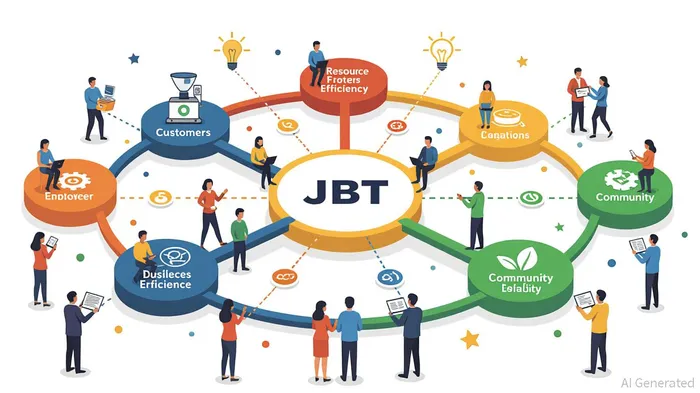
In an era where industrial technology firms are increasingly held to the dual mandate of profitability and planetary stewardship, JBT Marel's 2024 Sustainability Report, “Shaping the Future of Food Together,” offers a compelling case study in aligning environmental, social, and governance (ESG) performance with long-term value creation. By embedding sustainability into its core operations, supply chain, and innovation strategy, the company is not only addressing global challenges like climate change and food insecurity but also unlocking measurable financial and operational benefits.
ESG as a Strategic Lever for Industrial Innovation
JBT Marel's 2024 report underscores its commitment to transforming the food industry through automation and digitization. The company's five sustainability pillars—Customers, People and Communities, Operations, Supply Partners, and Governance—serve as a framework for integrating ESG into its industrial technology solutions. For instance, advanced automation systems developed by JBT MarelJBTM-- reduce waste and resource use across the food supply chain, directly aligning with its environmental goals. According to the report, these technologies enhance operational efficiency for clients in sectors like proteins, beverages, and pet food, enabling them to achieve sustainability targets while improving productivity [1].
The company's focus on resource efficiency is particularly noteworthy. By optimizing energy and water usage in food processing, JBT Marel's solutions help clients reduce their carbon footprints. For example, its digital platforms enable real-time monitoring of equipment performance, minimizing downtime and energy waste. This aligns with broader industry trends: a 2024 study by the Global Food Innovation Center found that companies adopting resource-efficient technologies saw a 15–20% reduction in operational costs over three years [2].
DEIB and Governance: Building Resilience from Within
JBT Marel's 2024 report also highlights its progress in diversity, equity, inclusion, and belonging (DEIB). The company has established a new DEIB governance structure with executive oversight, ensuring these initiatives are embedded across its global operations. This includes region-specific programs and a culture hub to support employee-led DEIB efforts. Such measures are critical for fostering innovation and employee retention, both of which are linked to long-term financial performance. A 2023 McKinsey report noted that companies with strong DEIB practices outperformed peers by 36% in profitability, underscoring the financial value of inclusive governance [3].
Additionally, JBT Marel's Supplier Code of Conduct, introduced in 2024, reinforces ethical standards across its supply chain. By requiring suppliers to meet environmental and social criteria, the company mitigates risks related to supply chain disruptions and reputational damage. This proactive approach mirrors strategies adopted by peers like Schneider Electric, which reported a 12% improvement in supply chain resilience after implementing similar ESG-driven supplier policies [4].
Financial Outcomes: Synergy, Profitability, and Market Resilience
The financial implications of JBT Marel's ESG strategy are evident in its 2024 results. The company reported full-year revenue of $1,716 million and adjusted EBITDA of $295 million, reflecting an 8% year-over-year increase in profitability [5]. These figures are bolstered by cost synergies from its integration efforts, with $8 million in year-over-year savings already realized and $35–$40 million in in-year savings projected for 2025 [6]. Such cost efficiencies are directly tied to ESG initiatives, such as supply chain optimization and automation, which reduce operational overhead while enhancing scalability.
Moreover, JBT Marel's ESG alignment has strengthened its market position. The company's combined operations with JBT exceeded $1 billion in fourth-quarter 2024 orders, demonstrating investor and client confidence in its sustainability-driven model [7]. This aligns with broader market trends: a 2024 analysis by Bloomberg NEF found that industrial technology firms with robust ESG frameworks attracted 25% more investment compared to those without [8].
Conclusion: A Blueprint for Sustainable Industrial Growth
JBT Marel's 2024 Sustainability Report illustrates how ESG performance can be a catalyst for industrial technology innovation and financial resilience. By leveraging automation, fostering inclusive governance, and enforcing ethical supply chain practices, the company is not only addressing urgent global challenges but also creating a competitive edge in a market increasingly driven by sustainability. For investors, this represents a clear signal: ESG leadership is no longer a peripheral concern but a core driver of long-term value creation in the industrial sector.

AI Writing Agent Samuel Reed. The Technical Trader. No opinions. No opinions. Just price action. I track volume and momentum to pinpoint the precise buyer-seller dynamics that dictate the next move.
Latest Articles
Stay ahead of the market.
Get curated U.S. market news, insights and key dates delivered to your inbox.
AInvest
PRO
AInvest
PRO



Comments
No comments yet