
James Hardie’s Trim-Over Timeline Shift and Synergy Run Rate Targets Don’t Align
 Aime Summary
Date of Call: Aug 6, 2026
Financials Results
- Revenue: $1.47B, growing 64% on a reported basis and 12% on a pro forma basis above guidance high end
- EPS: $0.36 Adjusted EPS, up 13%
- Operating Margin: Adjusted EBITDA margin 28.6%, above guidance high end
Guidance:
- Q2 net sales expected $1.485B-$1.575B (14.9%-21.9% growth).
- Q2 Adjusted EBITDA expected $420M-$455M.
- Full year sales raised to $5.564B-$5.723B (5.9%-9% pro forma growth).
- Full year Adjusted EBITDA raised to $1.536B-$1.625B.
- Full year free cash flow expected to exceed $500M.
- Full year capital expenditures expected 6%-7% of net sales.
Business Commentary:
Revenue and EBITDA Growth:
- James Hardie reported
net salesof$1.47 billionfor Q1,up 64%on a reported basis and12%on a pro forma basis, exceeding guidance expectations. - The growth was driven by better-than-expected organic growth in the fiber cement business and strong execution of strategic initiatives like ColorPlus and Trim-Over.
Fiber Cement Performance:
- The fiber cement business experienced
organic growthof20%, ahead of expectations, contributing significantly to overall company performance. - This was due to strategic initiatives, strong demand in higher-end markets like repair and remodel and multi-family new construction, and lapping prior year inventory destocking.
Deck, Rail & Accessories Dynamics:
- The Deck, Rail & Accessories segment saw
nearly double-digit sell-through, driven by strong consumer demand and increased shelf space. - The performance was supported by continued strength in TimberTech, driven by wood deck conversions and premium product mix shifts.
Debt Reduction and Financial Targets:
- The company made progress on debt paydown by redeeming
$400 millionof unsecured notes, advancing towards a target net leverage ratio of approximately2.4 timesby the end of the fiscal year. - The reduction aligns with the company's strategy to support deleveraging and improve financial stability.
Commercial Synergy and Distribution Expansion:
- Commercial synergy momentum continued with the expanded partnership with Boise Cascade and other regional distributors, aiming to achieve a
$125 millionrun rate target by fiscal 2027. - These partnerships validate the company's strategy to combine James Hardie's exterior building products with leading distributors, enhancing market reach and distribution efficiency.
Sentiment Analysis:
Overall Tone: Positive
- CEO: 'We’re ahead of our expectations... pleased with our progress.' 'Our outperformance in the quarter was broad-based...' 'We’re encouraged by the continued strength...' 'We’re well-positioned when the macro backdrop improves.'
Q&A:
- Question from Ryan Merkel (William Blair): Can you talk about why North America fiber cement organic growth beat guide (20%) and what's working?
Response: Beat driven by execution of strategic initiatives (ColorPlus, Trim-Over, contractor training), strength in multi-family and higher-end markets, easier comp, and price/mix. Sell-through accelerated each month.
- Question from Ryan Merkel (William Blair): Any help parsing Q2 guide assumptions for sell-through and channel load?
Response: Deck/Rail & Accessories growth over 40% Y/Y driven by channel inventory normalization and ~1/3 from loading new distribution partners. Siding & Trim up due to strong Q1 sell-through and inventory position.
- Question from Brook Campbell-Crawford (Barrenjoey): Any specific dynamics for implied second half Adjusted EBITDA decline year-over-year?
Response: Decline due to normal seasonality (D&A is lowest Oct-Dec), uncertainty in back half, and prudence in planning, plus costs from distribution changes.
- Question from Brook Campbell-Crawford (Barrenjoey): History and risk around Trim-Over Method promotion?
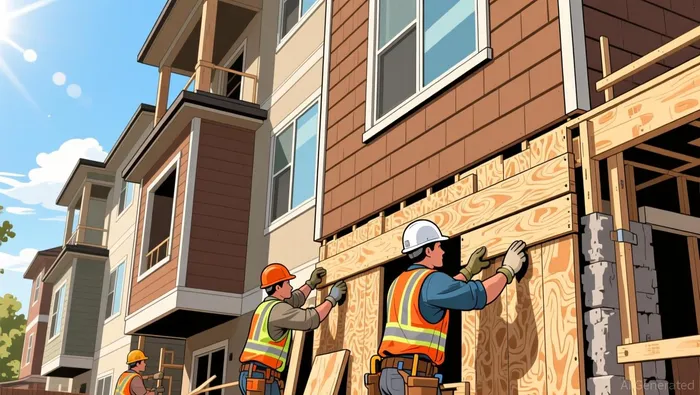
Response: Trim-Over has been in some high-production areas; piloted nationally for ~1-2 years to test fully. It reduces labor cost and installation time for contractors, now being rolled out more broadly.
- Question from Keith Hughes (Truist): Big picture impact of new Boise agreement longer term on TimberTech vs. HardiePlank?
Response: Partnership leverages Boise's national reach and logistics with James Hardie/AZEK's demand generation. Expected to grow fiber cement, TimberTech, and AZEK businesses, accelerate revenue synergies, and improve customer service.
- Question from Keith Hughes (Truist): Will Siding & Trim's excellent price/mix growth maintain at that level?
Response: Price was ~5.5%, mix ~0.5% (from ColorPlus) in Q1; expect 3.5-4% range for rest of year.
- Question from Keith Chau (MST Marquee): Can the $30M underlying EBITDA improvement in DRNA Q2 be annualized?
Response: CFO: 'A little bit aggressive.' Suggest using a 2-3 quarter average as Q2 has higher volume flow-through from channel normalization.
- Question from Keith Chau (MST Marquee): Will costs for distribution changes be above or below the line?
Response: CFO: Embedded in guide; channel inventory buyback (if material) would be called out separately. Q1 impact was <$1M, not specifically called out.
- Question from Phil Ng (Jefferies): Impact of decking load-in on back half sales guidance (implied flat sales)?
Response: Load-in primarily in decking; could cause pull-forward and some quarter-to-quarter variability. Back half kept prudent; if conditions improve, guidance could change.
- Question from Phil Ng (Jefferies): Potential upside to commercial synergies from distribution moves?
Response: CEO: $125M exit run rate is achievable, with potential upside from Boise and regional distributor partnerships. Progress exceeds expectations, but targets remain highly achievable.
- Question from Peter Stein (Macquarie): How does Boise agreement address service, supply chain optimization, and profitability?
Response: Boise selected for proven service quality, national reach, and alignment. Pilots exceeded expectations. The move aims to enhance service, optimize supply chain, and improve profitability via better logistics and demand pull-through.
- Question from Peter Stein (Macquarie): Detail on Hardie Operating System impact on manufacturing?
Response: Hardie Operating System (Lean) extended to AZEK plants, driving improvements in efficiency, downtime, and productivity. On track for savings targets; unified system across network enhancing cost synergies.
- Question from Tim Wojs (Baird): Typical training ramp for two-step distributors on new products?
Response: For Boise (experienced in decking), training on TimberTech value proposition is expected to ramp quickly, similar to past conversions (e.g., Capital). Regional distributors also receive training on James Hardie value proposition.
- Question from Tim Wojs (Baird): How much cost inflation felt in Q1 and baked into Q2?
Response: CFO: ~$20M-$25M felt in Q1, mainly freight. Full $80M-$100M for FY27 remains, with freight pressure offset by contracting more lanes and some commodity relief.
- Question from Harry Saunders (E&P): Previous share-based payment expense assumption in old guidance and run rate for rest of year?
Response: CFO: Original guide had ~$50M SBC; Q1 was ~$15M. Use that as a run rate for remainder of year based on current stock valuation.
- Question from Harry Saunders (E&P): Net stocking benefit from Boise deals quantified?
Response: CFO: Embedded in guide; full-year guide includes beat rolled forward plus puts/takes from distribution changes.
- Question from Matthew Bouley (Barclays): Rank order drivers of growth (organic initiatives vs. commercial synergies)?
Response: CEO: Q1 growth split roughly third each from strategic initiatives (ColorPlus, Trim-Over), easier comp (destocking), and price. Commercial synergies target $125M exit run rate with potential upside.
- Question from Matthew Bouley (Barclays): Unusual inventory swings from price increases?
Response: CEO: No unusual pre-buys; inventory broadly normalized across segments.
- Question from Daniel Sykes (Jarden): Quantify destocking impact in double-digit growth?
Response: CFO: Destocking impact was ~$40M-$50M in fiber cement growth.
- Question from Daniel Sykes (Jarden): Definitional change to Adjusted EBITDA in new guidance?
Response: CFO: New guidance excludes SBC vs. old which included it. To restate old guide, add ~$50M SBC back to low/high end of range at any point.
- Question from Rafe Jadrosich (Bank of America): Headwinds for segment margin decline in Q2 and full year?
Response: CFO: Margin pressure from freight spot rate volatility and investments in new distribution partners (sales, marketing, setup costs). Back half sees higher flow-through and lower investment rate.
- Question from Rafe Jadrosich (Bank of America): Where are incremental shelf space gains in decking happening?
Response: President Skelly: Shelf space gains from last year's early buy season are now converting to sell-through, driving double-digit performance. Core business also performing well.
Contradiction Point 1
Timeline and Rollout of the Trim-Over Method
The timeline for broader promotion shifted from imminent to a one-year pilot, impacting growth expectations.
Will Brook Campbell-Crawford of Barrenjoey participate in the earnings call? - Brook Campbell-Crawford (Barrenjoey)
2027Q1: It has existed in some high-production areas. Hardie spent ~2 years testing it nationally to ensure it works before broader promotion. The pilot has been successful for ~1 year and is being rolled out. - Aaron Erter(CEO)
What is the history behind Hardie not promoting the Trim-Over Method more broadly and what past risks were associated with it? - Ryan Merkel (William Blair & Company L.L.C.)
2026Q4: The Midwest pilot, now about a year old, shows promising results and is being rolled out to the mid-Atlantic and Carolinas. This forms the basis for returning the business to volume growth. - Aaron Erter(CEO), Jonathan Skelly(CFO)
Contradiction Point 2
Commercial Synergy Run Rate Target and Achievement
The target date for achieving $125M synergy run rate was specific, but later statements allow for faster achievement without a new target.
Phil Ng (Jefferies) - Phil Ng (Jefferies)
2027Q1: The target remains a $125M run rate by fiscal 2027. The new partnerships... could allow the company to achieve this target faster or with upside. - Aaron Erter(CEO), Jonathan Skelly(CFO)
What is the potential financial impact of the new distribution moves in Boise and with regional partners over the next 12-18 months? - Trevor Allinson (Wolfe Research, LLC)
2026Q4: The company has clear line of sight to reaching a $125M run rate by FY '27 year-end, driven by cross-selling to thousands of contractors. On cost synergies, the goal is to reach the $125M target faster, not necessarily increase it. - Aaron Erter(CEO), Ryan Lada(CFO)
Contradiction Point 3
Impact of Distribution Changes on Segment Margins
The nature of margin pressure shifted from being a future investment to an immediate headwind.
Rafe Jadrosich (Bank of America) - Rafe Jadrosich (Bank of America)
2027Q1: The primary headwinds are: 1) Freight costs... and 2) Investments in new distribution partners (sales, marketing, setup). These investments are front-loaded, impacting Q2 and H1 more. - Ryan Kilcullen(CFO)
Why are segment margins declining as a percentage for the full year starting in Q2 and beyond? - Philip Ng (Jefferies LLC)
2026Q4: Key levers include... and expected growth and improved factory utilization. - Ryan Lada(CFO)
Contradiction Point 4
Q4/AZEK EBITDA Guidance Drivers
Contradiction on reasons for AZEK Q4 EBITDA guide moderation.
Phil Ng (Jefferies) - Phil Ng (Jefferies)
2027Q1: The Q2 load-in is primarily in Decking... It could cause some quarter-to-quarter variability and potential minor pull-forward impact on H2. - Ryan Kilcullen(CFO)
Does the Q2 decking load-in suggest a pull-forward effect on H2 sales despite flat sales guidance across both segments? - Trevor Allinson (Wolfe Research, LLC)
2026Q3: The moderation is due to seasonality. Q3 is historically AZEK's slowest quarter, creating a modest headwind going into Q4... - Ryan Lada(CFO)
Contradiction Point 5
Cost Inflation Outlook
Contradiction on timing of raw material inflation impact.
What questions did Tim Wojs from Baird raise during the earnings call? - Tim Wojs (Baird)
2027Q1: Roughly $20M-$25M was felt in Q1... Efforts to contract more freight lanes are underway, but the full-year cost pressure estimate remains $80M-$100M. - Ryan Kilcullen(CFO)
What portion of the $80M-$100M cost inflation impacted Q1, and what portion is included in Q2's projections? - Keith Hughes (Truist Securities, Inc.)
2026Q3: Expect modest inflation on the fiber cement side, primarily in the back half of 2027, driven by pulp and other inputs. - Ryan Lada(CFO)

Discover what executives don't want to reveal in conference calls
Latest Articles
Stay ahead of the market.
Get curated U.S. market news, insights and key dates delivered to your inbox.


AInvest
PRO
AInvest
PRO




Comments
No comments yet