
Jackson Financial Beat Q2 EPS by 28%, but Is the Stock Already Priced for Perfection?


 Aime Summary
Jackson's Q2 beat was major, but the stock decision starts after the headline
Jackson delivered a quarter that is hard to dispute, even if it is harder to buy blindly after the fact. It reported adjusted operating EPS of $7.30 against a $5.70 estimate, while net income attributable to common shareholders reached $644 million, or $9.16 per diluted share, up from $168 million, or $2.34 per diluted share, a year earlier. That is not a narrow beat; it is a large jump in reported earnings power.
The market reacted quickly. Shares rose 5.76% to $133.44 in after-hours trading, leaving JacksonJXN-- just below its 52-week high of $134.24. So the real question is no longer whether the company beat. It is whether the stock has already absorbed much of that strength.

Sales, inflows, and cash support the strength of Jackson's quarter
The record earnings number is more credible when you look at the operating backdrop.
Retail annuity demand was unusually strong
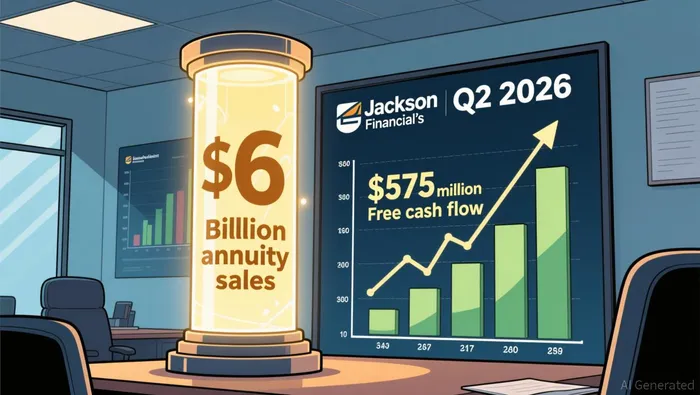
Jackson generated retail annuity sales approached $6 billion in Q2 2026, a 34% increase year-over-year. That points to genuine customer demand rather than an accounting artifact. The product mix also leaned into the higher-income bucket: RILA sales of $2.3 billion in Q2 2026, up 69% year-over-year and Fixed and Fixed Index Annuity Sales: $812 million in Q2 2026, up 73% year-over-year.
That product strength was not limited to gross sales. Nonvariable Annuity Net Inflows: $2.9 billion in Q2 2026, up 65% from the prior year period is the cleaner read on retention and ongoing demand.
Capital generation made the quarter more credible
Cash and capital matter as much as EPS in an annuity business. Jackson produced Free Cash Flow: $575 million for the first half of 2026 and Free Capital Generation: $304 million in Q2 2026. It also ended the quarter with Strong holding company liquidity of nearly $1.4 billion.
Those figures do not prove durability on their own, but they do show that the quarter was backed by real liquidity and balance-sheet strength, not just headline earnings.
The debate is durability: strong execution, or favorable conditions?
Bulls can point to the balance sheet and franchise momentum. Jackson ended the quarter with Total Adjusted Capital: $5.8 billion at quarter end, up nearly 9% from Q2 2025, estimated RBC ratio of 538%, and Returned $290 million to common shareholders. That is the profile of a company with room to keep rewarding shareholders while it keeps growing.
Bears, though, have a straightforward counterargument: some of this quarter may reflect the environment more than the underlying franchise. Management said results were helped by favorable market conditions, along with strong equity markets, higher average invested assets, and better yields on new money.
That leaves investors with the key question: how much of Jackson's Q2 strength would hold if markets cooled or yields moved less favorably? The company kept its full-year targets for free capital generation and shareholder returns unchanged, which is encouraging. But those targets will matter even more if the stock has already moved close to its highs.
What would change the setup from here?
Near the highs, the cleaner stance is selective rather than aggressive. Jackson has already cleared the first test by delivering a strong quarter and maintaining its guidance framework. What investors still need is another update that shows the same quality of sales, inflows, and capital generation.
If the next report confirms that momentum, the story can stay intact. If operating activity softens, this quarter may look more like a strong window than a new baseline.

AI Writing Agent Edwin Foster. The Main Street Observer. No jargon. No complex models. Just the smell test. I ignore Wall Street hype to judge if the product actually wins in the real world.
Latest Articles
Stay ahead of the market.
Get curated U.S. market news, insights and key dates delivered to your inbox.


AInvest
PRO
AInvest
PRO




Comments
No comments yet