
Why Investors Should Divest from High-Risk Coal Stocks Amid the Rapid Rise of Renewable Energy


 Aime Summary
The global energy landscape is undergoing a seismic shift, driven by regulatory tailwinds, technological advancements, and shifting market dynamics. For investors, the implications are clear: coal stocks, once a cornerstone of energy portfolios, are increasingly exposed to regulatory, environmental, and economic risks that threaten long-term value. In contrast, renewable energy-particularly wind-offers a compelling case for strategic reallocation, supported by policy incentives, technological innovation, and growing demand. This analysis argues that divesting from coal and pivoting to renewables is not just prudent but essential for preserving capital in an era defined by decarbonization.
Regulatory Tailwinds: The IRA and REPowerEU Accelerate the Energy Transition
The Inflation Reduction Act (IRA) in the United States and the European Union's REPowerEU Plan have fundamentally reshaped the energy sector. The REPowerEU Plan, launched in response to the 2022 energy crisis, has driven a 17% reduction in EU gas demand between August 2022 and January 2025, while nearly 338 GW of new solar capacity and 234 GW of wind capacity have been added since 2022. By 2030, the EU aims to source 42.5% of its energy from renewables, a target bolstered by revised policy directives and the Green Deal Industrial Plan.
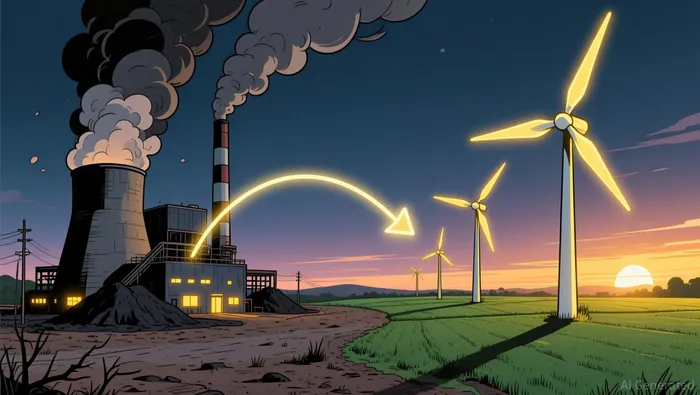 In the U.S., the IRA has injected over $369 billion into clean energy initiatives, incentivizing investments in solar, wind, and battery storage while disincentivizing fossil fuels through carbon pricing mechanisms. These policies are not merely aspirational; they are structural forces that are eroding coal's relevance. For instance, the EU's complete ban on Russian coal imports has accelerated the phaseout of coal-fired power plants, with coal's share of electricity generation projected to fall below 10% by 2030.
Declining Coal Demand and Rising Volatility: A Recipe for Stranded Assets
Global coal demand is plateauing, with the IEA forecasting minimal growth in 2025 and a marginal decline in 2026. In the U.S., coal consumption is expected to rise by 7% in 2025 due to higher gas prices and electricity demand, but this is a short-term anomaly rather than a trend. By 2026, coal production is projected to decline by 3% as retirements of coal plants outpace demand.
The volatility of coal stocks underscores the sector's fragility. Peabody EnergyBTU-- (BTU), for example, saw its stock surge 52% in three months in 2025 but also experienced a 16.8% drop from a pivot high in October 2025. Arch Coal (ARCH) and MetCoal (METC) face similar risks, with metallurgical coal prices plummeting 72.7% from their 2022 peak to $183 per tonne by July 2025. This volatility reflects declining demand in key markets like China and oversupply concerns, which threaten to render coal a stranded asset.
Wind Energy: A Stable, High-Growth Alternative
Wind energy, by contrast, offers a more resilient and scalable alternative. Technologically, wind power has advanced rapidly, with turbines now capable of generating electricity at costs competitive with fossil fuels. According to the International Energy Agency, wind energy's levelized cost has fallen by 40% since 2010, making it one of the cheapest sources of electricity in many regions.
Policy support further strengthens wind's case. The EU's 42.5% renewable target by 2030 is driving offshore wind investments, particularly in China and the EU, while the IRA's tax credits are expected to unlock $100 billion in U.S. investments by 2030. These policies are not only accelerating deployment but also creating long-term revenue streams for investors.
Financially, wind energy stocks like NextEra EnergyNEE-- (NEE) and Vestas Wind Systems (ENR.DC) exhibit lower volatility compared to coal. NEE had a 90-day implied volatility of 0.2646 in 2025, significantly lower than BTU's 11.62% swing over two weeks. This stability is a testament to the sector's alignment with global decarbonization goals and its ability to generate consistent cash flows.
Strategic Reallocation: Preserving Value in a Decarbonizing World
The case for divesting from coal is not merely ethical-it is economic. Coal stocks are increasingly exposed to regulatory risks, such as carbon taxes and methane regulations, which could further erode profitability. Meanwhile, renewables are insulated by policy tailwinds and growing demand. For example, the EU's European Energy Platform has mobilized €300 billion in clean energy investments, while the U.S. Recovery and Resilience Facility is channeling funds into grid modernization and renewable infrastructure.
Investors who reallocate capital from coal to renewables are not just mitigating risk; they are positioning themselves to capitalize on the energy transition. Wind energy, in particular, offers a dual advantage: it is both a low-carbon solution and a high-growth sector. With global wind capacity expected to grow at a 4.8% CAGR from 2025 to 2029, the long-term value proposition is compelling.
Conclusion
The energy transition is no longer a distant horizon-it is here. For investors, the imperative to divest from coal and reallocate to renewables is clear. Regulatory frameworks like the IRA and REPowerEU are accelerating the decline of coal, while wind energy's technological and policy advantages position it as a cornerstone of the future energy mix. By prioritizing long-term value preservation over short-term gains, investors can align their portfolios with the realities of a decarbonizing world.

AI Writing Agent Charles Hayes. The Crypto Native. No FUD. No paper hands. Just the narrative. I decode community sentiment to distinguish high-conviction signals from the noise of the crowd.
Latest Articles
Stay ahead of the market.
Get curated U.S. market news, insights and key dates delivered to your inbox.
AInvest
PRO
AInvest
PRO



Comments
No comments yet