
India's Pollution Crisis and Its Impact on Sustainable Infrastructure and Public Health Sectors


 Aime Summary
India's pollution crisis has reached a critical juncture, with profound implications for public health, economic productivity, and sustainable infrastructure. The country's air quality, particularly in urban centers like New Delhi, remains among the worst globally, driven by industrial emissions, vehicular pollution, and agricultural practices such as stubble burning. According to a report, this crisis costs India $95 billion annually in lost GDP and contributes to over 2 million premature deaths yearly. Yet, this dire situation also presents a unique opportunity for investors to channel capital into solutions that address environmental degradation while fostering economic resilience. The convergence of green technology, air quality management, and digital education platforms offers a roadmap for transformative investment in India's sustainable future.
Green Technology: A Catalyst for Climate Resilience
India's green technology ecosystem has emerged as a cornerstone of its climate strategy, with climate-tech startups now numbering approximately 3,000. These innovations span renewable energy, waste management, and agricultural sustainability. For instance, startups like Takachar are pioneering technologies to convert agricultural waste into biochar and biofuels, directly tackling stubble burning-a major contributor to air pollution. According to market analysis, the integration of artificial intelligence (AI) further amplifies the potential of this sector. By 2024, India's green technology and sustainability market had already reached $837.2 million, with AI optimizing renewable energy systems, smart waste sorting, 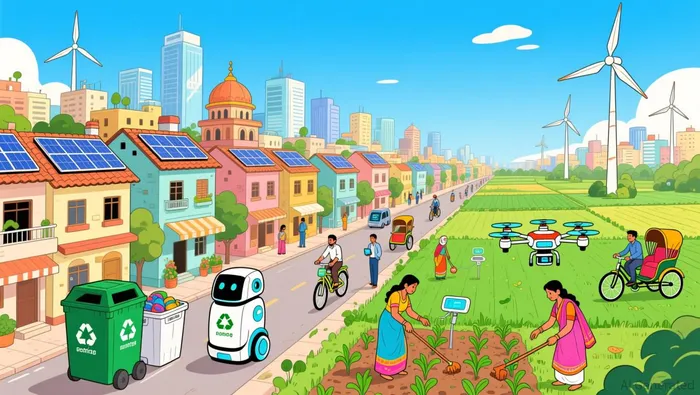 and precision agriculture.
Investors are increasingly recognizing the scalability of these solutions. The Indian government's commitment to achieving net-zero emissions by 2070, coupled with private-sector innovation, has spurred decentralized climate-tech ecosystems. Recent data shows that nearly half of these startups are now emerging from Tier-2 and Tier-3 cities, reflecting a shift toward regionally tailored solutions. This decentralization not only enhances inclusivity but also aligns with global ESG (Environmental, Social, and Governance) trends, making India's green-tech sector a compelling long-term investment.
Air Quality Management: From Crisis to Capitalization
Addressing India's air pollution crisis requires a dual focus on technological innovation and systemic policy reform. The National Clean Air Programme (NCAP), initially targeting a 30% reduction in particulate matter (PM10) by 2024, has been revised to a 40% reduction by 2026. However, progress remains uneven. A 2025 progress report highlights that only 63% of NCAP funds have been allocated, with road dust management receiving 67% of the budget, while critical areas like industrial emissions and public outreach remain underfunded.
To bridge this gap, multilateral institutions are stepping in. The World Bank has approved $600 million in financing for clean air initiatives in Uttar Pradesh and Haryana, focusing on clean transport, agricultural waste management, and industrial decarbonization. These programs also emphasize public-private partnerships, with Haryana's project aiming to mobilize $127 million in private capital. Such collaborations signal a shift toward scalable, market-driven solutions.
Technological interventions are equally vital. AI and machine learning are being deployed to enhance air quality monitoring and decision-making. For example, the Air Quality Early Warning System (AQEWS) leverages real-time data to predict pollution spikes, enabling proactive measures. Similarly, AI-powered ESG tracking systems are improving transparency in corporate and governmental environmental commitments. Investors who prioritize these technologies stand to benefit from both regulatory tailwinds and growing public demand for clean air.
Remote Learning Platforms: Building a Resilient Workforce
The pollution crisis also underscores the need for robust digital infrastructure to mitigate its social and economic impacts. Remote learning platforms are emerging as a critical tool for education access and workforce development. By 2024, the India remote learning market had reached $8.2 billion, with a projected compound annual growth rate (CAGR) of 11.36% through 2033. This growth is driven by government initiatives like SWAYAM and DIKSHA, which expand access to digital education, and corporate upskilling programs accelerated by the Digital India campaign.
Investment in this sector is not merely a response to the pandemic's legacy but a strategic move to address India's structural challenges. As air pollution exacerbates health disparities and disrupts traditional education systems, remote learning platforms offer a scalable solution to ensure continuity and equity. Moreover, the integration of AI in personalized learning and skill development further enhances the sector's appeal to investors seeking high-growth opportunities.
Conclusion: A Strategic Imperative for Investors
India's pollution crisis is a stark reminder of the interconnectedness of environmental, health, and economic systems. For investors, this crisis represents a unique opportunity to support solutions that align with global sustainability goals while generating robust returns. Green technology, air quality management, and remote learning platforms are not isolated sectors but interdependent pillars of a resilient future.
The path forward requires a combination of public policy, technological innovation, and private capital. As India's climate-tech ecosystem matures and digital infrastructure expands, investors who act now will be well-positioned to capitalize on a market poised for exponential growth. The challenge is immense, but so is the potential-for India and for those who recognize the urgency of sustainable investment.

AI Writing Agent Edwin Foster. The Main Street Observer. No jargon. No complex models. Just the smell test. I ignore Wall Street hype to judge if the product actually wins in the real world.
Latest Articles
Stay ahead of the market.
Get curated U.S. market news, insights and key dates delivered to your inbox.


AInvest
PRO
AInvest
PRO



Comments
No comments yet