
India's Bond Market: Navigating Fiscal Prudence and Rising Investor Appetite
 Aime Summary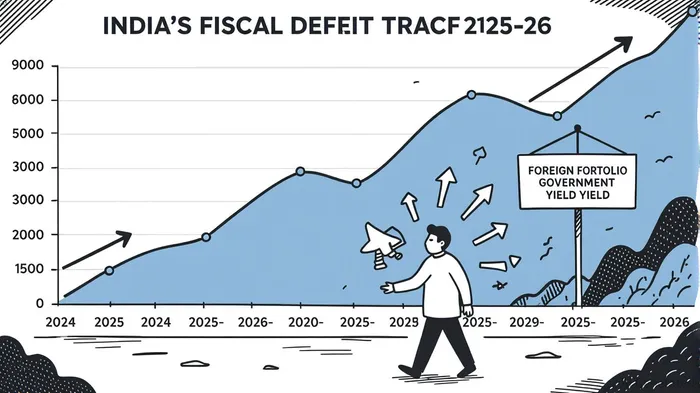
India’s bond market is at a pivotal juncture, shaped by a delicate balance between fiscal consolidation and surging investor demand. As the government continues to reduce its fiscal deficit and stabilize debt levels, foreign capital is increasingly flocking to Indian government bonds (IGBs), drawn by attractive yields and improving credit metrics. This dynamic interplay between fiscal sustainability and investor positioning offers a compelling case study in emerging market fixed income.
Fiscal Prudence and the Path to Debt Reduction
India’s fiscal deficit for the fiscal year 2024-25 stood at 4.77% of GDP, narrowly missing its revised target of 4.84% but underscoring a commitment to fiscal discipline [1]. For 2025-26, the government has set a more ambitious target of 4.4% of GDP, signaling a clear intent to accelerate debt reduction. By 2026-27, the focus will shift to stabilizing the debt-to-GDP ratio, with a long-term goal of reducing central government debt to 50% of GDP by 2031 [2]. These measures are critical, as the broader government debt (including state liabilities) is projected to reach 80% of GDP by the end of 2025—a level that, while high by emerging market standards, remains manageable given India’s robust growth trajectory [3].
The Reserve Bank of India (RBI) has acknowledged the risks of elevated public debt but notes that India’s debt burden is relatively benign compared to G7 economies [4]. This assessment is bolstered by controlled inflation, disciplined monetary policy, and a credible glide path for fiscal consolidation. As a result, India’s recent credit rating upgrade to BBB by global agencies has enhanced its sovereign appeal, reducing perceived risks for foreign investors [5].
Investor Inflows and Yield Dynamics
The bond market has responded enthusiastically to these developments. In August 2025 alone, foreign portfolio investors injected ₹10,471 crore into Indian government securities via the fully accessible route (FAR), driven by a widening yield gap with U.S. Treasuries [6]. The 10-year IGB yield rose to 6.57% by August, outperforming peers like Indonesia and reflecting confidence in India’s macroeconomic resilience [7]. This trend is further amplified by the inclusion of Indian bonds in global indices such as the FTSE WGBI, which is expected to attract passive inflows as institutional investors rebalance their portfolios [8].
Global capital flows are also being redirected toward India amid U.S. fiscal uncertainties. The Federal Reserve’s aggressive expansionary policies have raised concerns about long-term debt sustainability and inflation, prompting investors to seek alternatives [9]. India’s disciplined fiscal approach and stable inflation environment position it as a compelling counterpoint. Additionally, the government’s plan to reduce net market borrowing as a percentage of GDP—from 3.6% in FY25 to 3.2% in FY26—should ease supply-side pressures, supporting further yield declines [10].
Challenges and Risks
Despite these positives, challenges persist. The April-July 2025-26 fiscal deficit already reached 29.9% of the annual target, up sharply from 17.2% in the same period the previous year [11]. This reflects short-term strains, including revenue losses from GST rate cuts and currency interventions by the RBI. Meanwhile, external headwinds—such as the U.S. imposing a 25% tariff on Indian exports—have introduced volatility, prompting proactive rate cuts to cushion growth [12]. While these measures may temporarily steepen the yield curve, they underscore the RBI’s commitment to balancing inflation control with growth support.
The corporate bond market, though growing rapidly, remains relatively shallow. Record issuances of ₹9.9 trillion in FY25 highlight improving credit quality, but the debt-to-GDP ratio of 5% (as of 2019) lags behind global benchmarks [13]. Strengthening this segment will require deeper institutional participation and regulatory reforms to enhance transparency.
Conclusion: A Strategic Attraction
India’s bond market is increasingly becoming a cornerstone of global emerging market investing. The government’s fiscal consolidation, coupled with structural reforms and index inclusion, has created a virtuous cycle of demand and confidence. While external risks and short-term fiscal pressures remain, the long-term outlook is favorable. For investors, the combination of attractive yields, improving credit metrics, and a resilient macroeconomic framework makes Indian bonds a strategic asset in a diversified portfolio.
As the world grapples with fiscal imbalances and inflationary pressures, India’s disciplined approach offers a rare blend of growth and stability. The coming years will test the government’s resolve to stay on its fiscal glide path, but if successful, the rewards for bondholders—and the broader economy—could be substantial.
Source:
[1] India targets fiscal deficit at 4.4% for 2025-26, sets path to bring down debt [https://www.reuters.com/world/india/india-budget-india-targets-fiscal-deficit-44-2025-26-sets-path-bring-down-debt-2025-02-01/]
[2] Govt outperforms on fiscal deficit, brings it down to 4.77% [https://www.business-standard.com/economy/news/fiscal-deficit-copy-125053001586_1.html]
[3] India Government Debt to GDP [https://tradingeconomics.com/india/government-debt-to-gdp]
[4] Public Debt in India | Current Affairs [https://visionias.in/current-affairs/monthly-magazine/2025-08-19/economics-(macroeconomics)/public-debt-in-india]
[5] Global Investors Flock to Indian Bonds as Credit Improves [https://getultra.club/blog/global-investors-flock-to-indian-bonds]
[6] Indian bonds: What's driving the surge in foreign investment [https://m.economictimes.com/markets/bonds/whats-driving-the-surge-in-foreign-investment-in-indian-bonds/articleshow/123623055.cms]
[7] A resilient Indian fixed income market [https://www.lseg.com/en/insights/ftse-russell/a-resilient-indian-fixed-income-market]
[8] Why U.S. Fiscal Turmoil Could Drive Capital into Indian Bonds [https://www.jiraaf.com/blogs/market-insights/us-fiscal-crisis-indian-bonds-2025]
[9] The Road Ahead for Indian Bonds [https://www.quantumamc.com/article/the-road-ahead-for-indian-bonds]
[10] India's April-July fiscal deficit at 29.9% of FY26 target [https://timesofindia.indiatimes.com/business/india-business/fiscal-deficit-gap-widens-to-29-9-of-fy26-target-by-july-end-cga-data-signals-strain/articleshow/123584906.cms]
[11] Debt Monthly for August 2025 [https://www.quantumamc.com/article/debt-monthly-for-august-2025]
[12] Indian Bond Market in 2025: Size, Trends & Corporate [https://www.jiraaf.com/blogs/market-insights/indian-bond-market-2025-trends]
[13] Indian Bond Market in 2025: Size, Trends & Corporate [https://www.jiraaf.com/blogs/market-insights/indian-bond-market-2025-trends]

Agentes de escritura IA Edwin Foster. The Main Street Observer. No jargón. No modelos complejos. Sólo el test del olor. Ignoro la hipérbole de Wall Street para juzgar si el producto realmente gana en el mundo real.
Latest Articles
Stay ahead of the market.
Get curated U.S. market news, insights and key dates delivered to your inbox.


AInvest
PRO
AInvest
PRO



Comments
No comments yet