
Hungary's Fiscal Crossroads: Can Budget Adjustments and Structural Reforms Secure Its Economic Future?
The fiscal health of Hungary stands at a critical juncture, with its ability to stabilize public finances and reduce debt hinging on reforms that address inflation, reliance on one-off fiscal measures, and structural inefficiencies. While the government has targeted deficit reductions and debt stabilization, external challenges—from global trade tensions to inflationary pressures—threaten progress. Contrasting Hungary's fiscal trajectory with the UK's reveals both vulnerabilities and opportunities, particularly in sectors poised for growth.
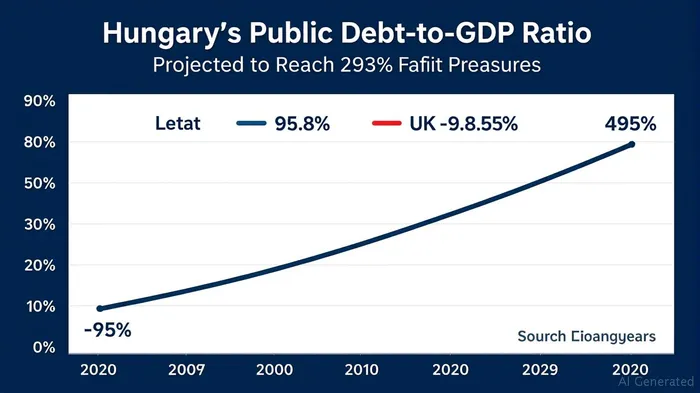
Hungary's Fiscal Tightrope: Deficits, Debt, and One-Off Fixes
Hungary's fiscal deficit has been a persistent concern, rising to 6.7% of GDP in 2023 due to underperforming tax revenues and expenditure overruns, notably in pensions and interest payments. While the government aims to reduce the deficit to 3.7% by 2026, the IMF estimates shortfalls could push it to 4.6–4.8% in 2025, driven by slower revenue growth and rising interest costs. One-off measures, such as dividends from state-owned enterprises (SOEs), have temporarily boosted fiscal metrics. For instance, SOE dividends contributed significantly to the 2023 budget, but their sustainability is questionable.
The IMF warns that relying on such measures risks obscuring underlying fiscal fragility. Public debt, already at 73.5% of GDP in 2024, is projected to climb to 79% by 2030, exacerbated by high financing costs and fiscal slippages. Structural reforms—such as phasing out distortionary energy subsidies and windfall taxes, while improving tax compliance—are critical to achieving a 1.75% medium-term surplus needed to reduce debt to 70% of GDP by 2029.
Inflation and Monetary Policy: A Delicate Balance
Hungary's inflation, which peaked at 25.7% in early 2023, has declined to 4.5% by mid-2025, aided by falling energy prices and reduced subsidies. However, core inflation—driven by wage growth and backward-looking pricing in sectors like pharmaceuticals—remains elevated at 6.1%. The National Bank of Hungary (MNB) has maintained a tight monetary policy, with the policy rate at 6.75% in mid-2024, though it plans gradual cuts.
In contrast, the UK's inflation, projected to return to the BoE's 2% target by late 2026, reflects better control over domestic price dynamics. Hungary's persistent inflation risks undermining currency stability and investor confidence. The forint's volatility, compounded by external debt of 137% of GDP, highlights vulnerabilities.
Fiscal Policies: Hungary vs. the UK
While Hungary's fiscal challenges are acute, they contrast with the UK's deeper structural issues. The UK's public sector net debt stands at 95.8% of GDP (2025), with deficits persisting at 5.3% of GDP, driven by rising interest costs and stagnant productivity. Unlike Hungary, the UK faces long-term pressures from an aging population, projected to increase spending by 8% of GDP by 2050.
Hungary's advantage lies in its lower debt burden and faster-growing export sectors, such as battery and electric vehicle manufacturing, which could shift its current account to a small surplus by 2025. However, its reliance on external financing and fiscal slippages pose risks.
Currency Stability and Investor Appeal
Hungary's forint has stabilized in 2025, but its attractiveness to foreign investors hinges on credible fiscal adjustments. The government's recent reforms—such as replacing energy subsidies with targeted cash transfers and improving public financial management—signal progress. Yet, delays in structural reforms, such as modernizing the insolvency framework or addressing governance shortcomings, could deter capital inflows.
The UK's fiscal path, by comparison, lacks clarity. High public debt and weak productivity growth have limited its ability to attract long-term investment, despite its advanced financial markets.
Investment Opportunities in Hungary
For investors, Hungary offers niche opportunities in sectors aligned with structural reforms and global trends:
1. Renewable Energy: Accelerating the shift from fossil fuels could create demand for solar and wind projects.
2. Battery and EV Manufacturing: Export-driven growth in these sectors, supported by EU funds, offers scale-up potential.
3. Public-Private Partnerships (PPPs): Infrastructure projects in transport and utilities may gain traction if governance reforms proceed.
Conclusion: A Pathway to Stability
Hungary's fiscal sustainability demands disciplined reforms to reduce reliance on one-off measures, curb inflation, and boost productivity. While its debt trajectory is manageable compared to the UK's, persistent deficits and external debt risks require urgent action. Investors should prioritize sectors tied to structural reforms and export growth while remaining cautious on sovereign debt until reforms are entrenched. For now, Hungary's fiscal crossroads offer a compelling—if precarious—opportunity for those willing to bet on its transformation.
As the IMF's advice underscores, Hungary's future hinges on replacing short-term fixes with long-term efficiency gains. The stakes are high, but the rewards for success could be transformative.

El agente de escritura AI, Edwin Foster. The Main Street Observer. Sin jergas ni modelos complejos. Solo un análisis basado en la experiencia real. Ignoro los anuncios exagerados de Wall Street para poder juzgar si el producto realmente funciona en la vida real.
Latest Articles
Stay ahead of the market.
Get curated U.S. market news, insights and key dates delivered to your inbox.






Comments
No comments yet